
Why Basic Mathematics Dooms This Protectionist Gambit Before It Begins
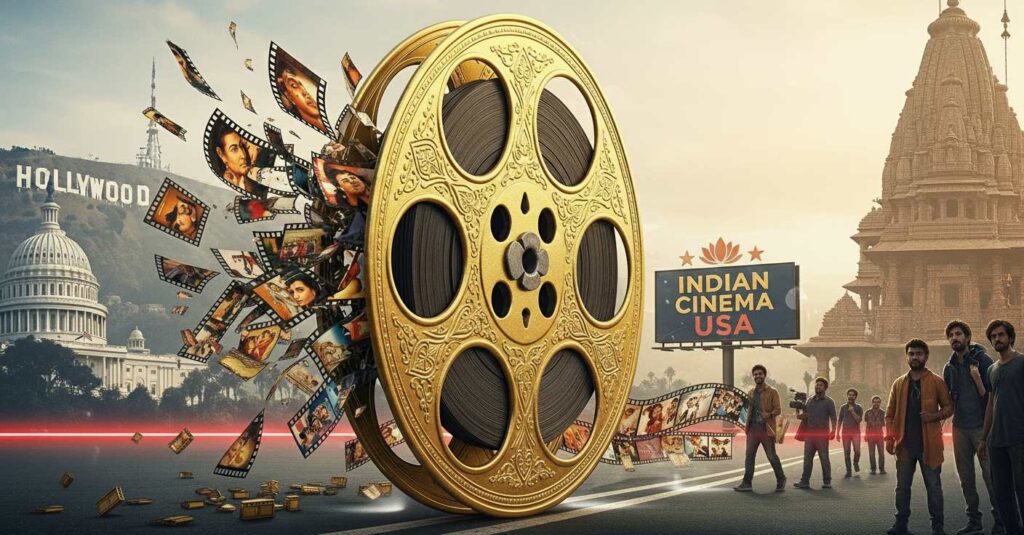
President Donald Trump’s announcement of a 100% tariff on foreign films represents an unprecedented act of cultural protectionism. The arithmetic, however, is brutally simple: this policy will barely scratch Indian cinema while delivering substantial political costs directly back to Trump himself.
Here’s the calculation. The United States accounts for merely 5–7% of Indian cinema’s total box office revenue, according to industry data from Statista and trade analysts. For an industry generating over $2 billion annually from its domestic market alone, before counting substantial earnings from the Gulf, United Kingdom, Europe, Asia-Pacific, and Africa, losing 5% is manageable, perhaps even irrelevant. Indian filmmakers will redirect resources toward the 93–95% of revenue that remains unaffected.
Trump’s political liability, however, is immediate and measurable. The 4.5 million-strong Indian diaspora in America, a demographic with high voter participation and disposable income,now faces doubled ticket prices for cultural connection to their homeland. Meanwhile, mainstream American audiences who embraced films like RRR lose access to diverse entertainment options. When voters experience restricted choice and inflated costs, they remember who authored the policy. The blowback isn’t speculative; its mathematical certainty embedded in consumer behaviour and electoral consequences.
The Streaming Revolution as Strategic Defence
The globalisation of OTT platforms has fundamentally restructured the distribution economics of Indian cinema. Netflix, Amazon Prime Video, Disney+ Hotstar, and regional platforms like ZEE5 now serve as direct-to-consumer pipelines, bypassing traditional theatrical gatekeepers entirely. According to EY industry reports, digital platforms distributed over 500 Indian films and series internationally in recent years, reaching audiences across 190+ countries simultaneously.
This digital infrastructure nullifies the strategic importance of physical theatrical releases in protectionist markets. When a Telugu-language film can premiere globally on streaming platforms and generate hundreds of millions in licensing fees plus subscriber retention value, the tariff becomes a relic of outdated distribution thinking. Indian producers increasingly structure financing around guaranteed OTT deals rather than speculative theatrical runs in secondary markets.
Blowback: The Domestic Political Cost of Cultural Isolation
Trump’s tariff carries significant domestic political liabilities. The Indian diaspora in the United States, approximately 4.5 million strong with high voter participation rates, views access to homeland cinema as cultural connection. Doubling ticket prices through tariffs directly taxes this community’s cultural consumption, creating resentment among a demographic with above-average political engagement.
Beyond the diaspora, American audiences have increasingly embraced international cinema. Films like RRR and Pathaan demonstrated crossover appeal, with mainstream American viewers seeking alternatives to formulaic Hollywood output. The tariff restricts consumer choice, effectively subsidising domestic studios by eliminating competition rather than encouraging innovation. As ticket prices surge and diversity evaporates from multiplexes, voter dissatisfaction will concentrate on the architect of this artificial scarcity.
The Narrative Arc Toward Victory
Indian cinema’s foundational mythology revolves around dharma conquering adharma,righteousness prevailing over injustice through perseverance and ingenuity. This thematic consistency reflects industry reality: Indian filmmakers have overcome colonial censorship, post-independence economic controls, and technological disruption to build the world’s most prolific film industry.
The current challenge fits this historical pattern. With 1,800–2,000 films produced annually across multiple languages, robust domestic demand, diversified international revenue streams, and direct digital distribution capability, Indian cinema possesses structural advantages that transcend any single market’s protectionist impulses. The industry will adapt,prioritising markets with genuine reciprocity, deepening streaming partnerships, and continuing to serve global audiences hungry for alternatives to Hollywood homogeneity.
Trump’s tariff ultimately represents protectionism’s last gasp against globalisation’s inevitable tide. Indian cinema’s victory is not aspirational—it is mathematical certainty.
About The Author