Once the Crown Jewel of Indian Art and Culture, Now a Citadel of Crime and Terror. The land of Tagore, Ray and Vivekananda has surrendered to the underworld. From the Left’s cadre-raj to the TMC’s communal compact, and now the execution-style killing of Suvendu Adhikari’s aide within 48 hours of his historic victory: Bengal’s addiction to political blood refuses to relent even before the verdict of the people.
West Bengal should have been India’s crown. It was, for a century, the subcontinent’s intellectual nerve centre; the land that gave the world Tagore’s humanism, Vivekananda’s fire, Ram Mohan Roy’s reformation, and a Bengal Renaissance that made colonised India stand taller than its chains. Today, that same land is a case study in civilisational self-destruction; methodical, ideologically driven, and catastrophically underdiscussed in the national conversation.
What happened to Bengal is not a mystery. It is a crime with identifiable perpetrators, traceable methods, and a victims’ list that grows longer with every election cycle, every communal flash point, every displaced Hindu family fleeing Murshidabad in the dead of night. Understanding it requires the courage to name things precisely — without the Hindu nationalist’s temptation toward apocalyptic oversimplification, and without the secular liberal’s cowardly habit of looking away.
The Communist Original Sin
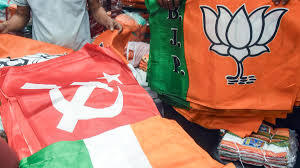
Begin where the rot begins: 1977. When the Left Front swept to power under Jyoti Basu, it inherited a traumatised but still culturally vital Bengal. What it built over the next 34 years was not socialism. It was a cadre-state , a precisely engineered apparatus in which the CPI(M) fused itself to the panchayat system, the police machinery, and the rural employment network so completely that political loyalty and physical survival became indistinguishable.
This was governance as organised intimidation. The local party strongman decided who got land, who got work, whose child got a school transfer. Dissent had a price a broken house, a broken body, occasionally a broken life. Booth capturing was not electoral malpractice; it was system maintenance. Cadre killings were not aberrations; they were the load-bearing columns of Left Front permanence.
The economic consequences were devastating capital fled, industry collapsed, the educated migrated. But the cultural consequence was more insidious: Bengal normalised political violence as the natural grammar of public life. A generation grew up understanding that power was enforced through fear, that the state’s neutrality was a fiction, and that the strong took from the weak with institutional blessing.
This is the Left Front’s poisoned bequest to Bengal not merely the violence it committed, but the violence it made thinkable, habitual, and structurally available to whoever came next.
TMC: The Inheritance, Not the Departure
Mamata Banerjee swept the Left Front from power in 2011 on a wave of genuine popular exhaustion. What Bengal did not reckon with could not, perhaps, in its relief was that she had not dismantled the cadre-state. She had captured it.
The panchayat networks remained. The police politicisation deepened. The culture of reprisal intensified. The 2018 panchayat polls left twelve dead. The 2021 post-election violence killed over fifty BJP workers in organised reprisals bearing every hallmark of the Left Front playbook , except that TMC flags now flew above the perpetrators. The 2022 Bogtui massacre eight to ten people burned alive in a single coordinated night of revenge was not a Bengal anomaly. It was Bengal continuity.
But TMC introduced one crucial, devastating innovation: it replaced class patronage with communal patronage. Where the Left Front controlled Bengal through cadres, Mamata would control it through demography.
The Vote-Bank Compact and Its Lethal Consequences
West Bengal’s Muslim population ,approximately 27–28 percent statewide, concentrated to 66 percent in Murshidabad and over 51 percent in Malda became the cornerstone of TMC’s electoral mathematics. The geography of impunity, it turns out, faithfully follows the geography of electoral arithmetic.
The mechanism was not subtle once you see it. TMC’s political dominance in these districts rested on Muslim bloc voting. Muslim bloc voting was maintained through a compact of protection and permissiveness protection from BJP encroachment, and deliberate blindness toward communal mobilisation that any serious rule-of-law state would have prosecuted swiftly.
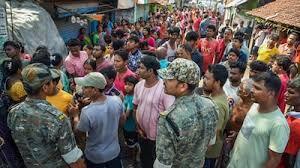
The documented consequences are damning. Deganga 2010: over 250 Hindu structures razed. Canning 2013: 200 homes torched. Kaliachak 2015: temples attacked. Basirhat 2017: Hindu neighbourhoods burned. Murshidabad 2025: 400–500 Hindu residents displaced by Waqf-linked violence — families who packed what they could carry and fled, in independent India, from their own homes, in their own state.
Sixty-five communal incidents in eighteen months between 2021 and 2022 documented not by a BJP think tank but by Newsclick, a publication whose left-leaning credentials make its findings carry particular evidentiary weight. Let the number land: sixty-five incidents in eighteen months, and the national conversation barely flickered.
Islamism, the Border, and the Variable Nobody Discusses
Precision demands an important distinction here one the original article insists upon and that intellectual honesty requires repeating. The overwhelming majority of West Bengal’s Muslim citizens are ordinary Indians navigating poverty, marginalisation, and political manipulation. This is emphatically not an Islamic state project. Mamata Banerjee carries no theological agenda. What she carries is an electoral one and she has been willing to pay for it in Hindu displacement and blood, precisely because the political cost of accountability consistently exceeds the political cost of looking away.
But the Bangladesh border variable demands serious attention that it has consistently, almost willfully, failed to receive. The frontier is not merely a geographic fact. Post-2024, following the overthrow of Sheikh Hasina and the ascent of forces carrying documented Islamist sympathies in Dhaka, the geopolitical environment of Murshidabad and Malda has materially and dangerously changed. Cross-border family networks, illegal migration that alters demographic arithmetic in real time, and organisational linkages to hardline formations now actively operating in Bangladesh , these are not hypotheses or saffron-tinted speculation. They are documented structural realities that create mobilisation dynamics with no parallel in India’s landlocked communal conflict zones.
Bengal’s border is live. Its consequences are live. And the national discourse treats both with a negligence bordering on dereliction.
The Intellectual Blind Spot That Costs Real Lives
Bengal’s left-liberal intellectual establishment still formidable, still prestigious, still setting the terms of cultural legitimacy in Kolkata has a long-standing asymmetric sensitivity: acutely alert to caste-Hindu majoritarianism, systematically underattentive to minority communalism. This is not conspiracy. It is an ideological blind spot baked over decades of ideological formation. But blind spots have consequences and in Bengal, the consequence is a consistent pattern in which Hindu-targeted violence receives measurably less analytical accountability than comparable violence against minorities would instantly command.
The victims of that inattention are not abstractions. They are real people, displaced from real homes, whose suffering is diminished every time an intellectual decides that naming it accurately would be politically inconvenient.
The Ballot Changed. The Bullet Did Not.
Then came May 4, 2026. Bengal delivered a verdict of seismic proportions , BJP crossing 200 seats, TMC reduced to 81, Mamata Banerjee herself defeated in Bhabanipur by Suvendu Adhikari by a margin of 15,105 votes after a record 92.93 percent voter turnout the highest in Bengal’s electoral history. A historic mandate. A democratic thunderclap heard across the subcontinent.
Bengal answered with a gun.
Less than 48 hours after the results, Chandranath Rath Suvendu Adhikari’s personal executive assistant, the man serving the very face of Bengal’s incoming dispensation was shot dead at point-blank range by bike-borne assailants on a public road in Madhyamgram, North 24 Parganas. Three rounds fired. The gun pressed against the car window. A man killed in cold blood in the immediate aftermath of his principal’s greatest political triumph.
The motive, police stated dutifully, “is yet to be ascertained.”
Bengal, tragically, has seen this script so many times it no longer requires explanation. The target’s identity was not incidental it was the message. Clinical. Calculated. Aimed directly at the incoming dispensation: the election may have changed hands, but the grammar of fear remains non-negotiable.
What Bengal Demands Now
The evidence, read honestly, yields a portrait of three-generation structural accumulation: Partition’s unhealed communal trauma, the Left Front’s institutionalised violence culture, TMC’s vote-bank permissiveness, and now a radicalised cross-border variable collapsing together into a state where impunity is the operating system and accountability is the perpetual exception.
Neither the Hindu nationalist right’s apocalyptic framing uniform persecution, existential civilisational threat nor the secular left’s protective minimisation , “it’s just politics,” “BJP is manufacturing victimhood” serves the people of Bengal. Both are evasions. Both abandon the displaced families of Murshidabad and the slain in Madhyamgram to their respective rhetorical conveniences.
What Bengal demands is something far more difficult: the intellectual honesty to say that political violence normalised by communists, communal impunity enabled by populists, Islamist mobilisation protected by electoral calculation, and a destabilised border have together produced a crisis that is structural, documented, and worsening.
The Bengal Renaissance produced minds that could hold complexity without flinching. That tradition not its caricatures of either the saffron or the red variety is what this wounded, magnificent state most urgently needs to recover. A 92.93 percent turnout told the world Bengal desperately wants to be heard. Chandranath Rath’s killing, in the silence of a Madhyamgram night, tells us the old order is not yet done speaking.
The ballot roared. The bullet answered. Bengal’s true reckoning begins now.
About The Author