How a Swiss Dam Wall Exposed India’s Biggest Energy Blind Spot
The Mountain Was Never the Problem, Delhi’s Imagination Is
Every energy planner carries a mental map of where solar belongs, flat, hot, dust-blown, and low. For fifty years, India’s version of that map drew a hard line at the foothills. Above it: hydropower, diesel generators, and the quiet assumption that altitude and snow were problems to be endured, not resources to be harvested. Nobody wrote this down as policy. It simply hardened into one, the way untested assumptions always do, repeated often enough to feel like fact.
Then a dam wall in Switzerland tested it. And the assumption, not the mountain, was what broke.
The Alps Ran the Experiment First
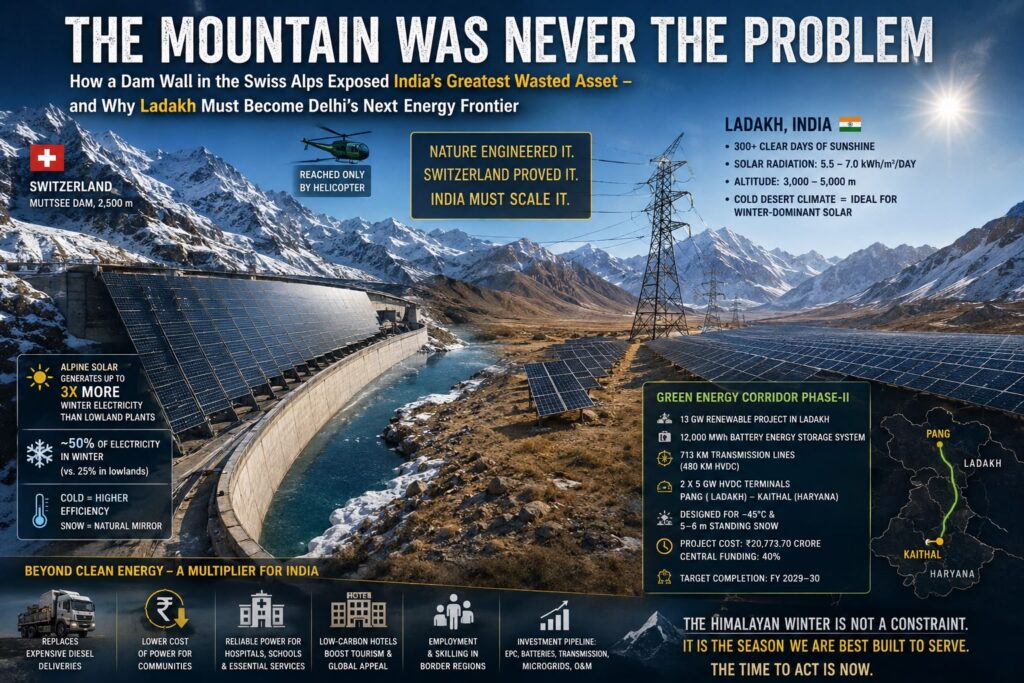
On the steep south face of Switzerland’s Muttsee dam, engineers bolted down roughly 5,000 solar panels and asked a question lowland utilities rarely bother with: what does a solar plant do in a world buried in snow? The intuitive answer output collapses turned out to be backwards. The Muttsee installation delivered close to half its annual generation in winter, precisely when Alpine Europe’s demand peaks and grid stress is worst. Cold air, thin atmosphere, cloudless skies, and snow’s own reflectivity combined to make winter the plant’s strongest season, not its weakest. Switzerland didn’t file this away as a curiosity; it folded it into national energy security policy.
Ladakh Already Has What Switzerland Had to Engineer
The comparison to Ladakh is not aspirational it is, if anything, understated. Ladakh’s cold-desert climate offers elevation comparable to or exceeding the Alps, more than 300 clear days of sunshine a year, and solar radiation running between roughly 5.5 and 7.0 kWh per square metre per day across Leh, Kargil, and the Hanle–Nyoma and Pang–Debring–Kharnak belts. Where Switzerland proved its case on a single dam wall, India already has the scaffolding of a national programme in motion:
- Green Energy Corridor Phase-II, sanctioned to evacuate 13 GW of renewable power out of Ladakh
- 12 GWh of battery storage to smooth supply through the dark months
- 713 km of new transmission lines and two 5 GW HVDC terminals
- A 13 GW hybrid renewable park spanning Pang, Debring, and Kharnak
- A 25 MWac solar-plus-storage project already rising at Taru, Leh
- Early rooftop solar policy aimed at Ladakh’s hotel and commercial sector
The infrastructure is not a proposal on paper. It is under construction. What is missing is the strategic conviction to treat it as a frontier rather than a footnote.
The Mistake to Avoid: Treating the Himalaya as One Region
The temptation in Delhi’s policy corridors will be to bundle Ladakh and Kashmir into a single “Himalayan renewable zone.” That would be a costly error. Ladakh’s dry, high-altitude clarity is the genuine analogue to the Swiss model built for winter-dominant, utility-scale solar farms. Kashmir’s valleys, by contrast, carry fog, persistent cloud cover, and terrain shading that call for a different toolkit entirely: elevated slopes, reservoir-linked installations, and public rooftops rather than sweeping utility parks. Flatten this distinction and the result is misallocated capital, disappointing yield data, and a ready-made argument for critics to declare the whole strategy a failure. Respect the distinction, and India has the blueprint for a genuinely differentiated regional energy policy.
Beyond Climate: The Commercial Logic Is Already There
Strip out the sustainability framing and the economics still hold up on their own. Remote Ladakhi communities currently absorb the cost of trucking diesel over some of the most punishing roads on earth expensive, logistically fragile, and strategically precarious in a border region. Solar-plus-storage doesn’t just cut emissions; it lowers household energy bills, keeps hospitals and schools running through winter stress, and gives hotels and guesthouses a reliability story to sell in a tourism economy that depends on uninterrupted power.
For capital markets, the corridor itself is the product: EPC contracts, battery supply chains, transmission construction, microgrid development, and long-term O&M contracts a multi-year investment pipeline in a market that remains largely untouched. This is infrastructure economics with a climate dividend, not a subsidy-dependent green project.
What Sequencing Discipline Looks Like
Switzerland didn’t need a white paper; a dam wall made the case for it. India doesn’t need another feasibility study to confirm what altitude, sunlight, and 300 clear days already demonstrate. What it needs is disciplined sequencing:
- Build first on existing infrastructure – dam walls, transmission corridors, public rooftops to sidestep land conflict and prove winter performance at low regret.
- Demand hard operational data from these pilots: capacity factor, snow-related downtime, cold-weather battery behaviour, and real tariff impact on consumers.
- Scale to full utility replication only once that data holds up , folded into a single framework that treats energy security, tourism resilience, and border-region employment as one strategic objective, not three disconnected ministries.
The Mountain Was Never the Problem
Return to where this began: a mental map that placed solar in the plains and left the mountains to hydropower and diesel. That map was never drawn by the Himalaya. It was drawn by planners who mistook their own untested assumptions for the terrain’s limits. Switzerland corrected the error with 5,000 panels on a single dam wall. India has an entire mountain range, a sanctioned transmission corridor, and a solar resource base the Alps cannot rival and it is still arguing from the old map.
The old planning model asked what was easiest to build. The better model asks what is most valuable to deliver, and when. By that measure, the Himalayan winter stops looking like a constraint to be tolerated and starts looking like the exact season Ladakh is best positioned to serve. The mountain was never the obstacle. The only question left is whether Delhi revises its assumptions before winter energy stress forces the revision for it.
(AI-generated image)
About The Author