
Long Before The Supreme Court, Kashmiri Pandits Had Already Solved Hindu Law’s Biggest Debate
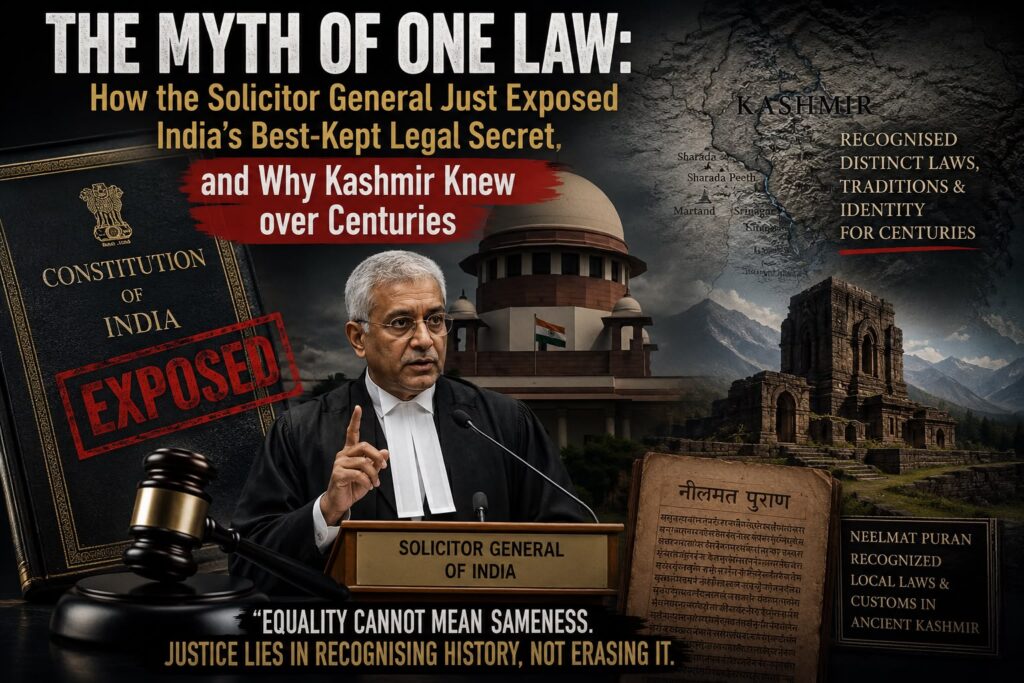
How a Supreme Court Submission Rewrote 200 Years of Legal Assumption
For more than two hundred years, Indian jurisprudence has carried a fiction so persistent that it hardened into common sense: that “Hindu Law” is the Manusmriti singular, codified, and applicable across the subcontinent. Solicitor General Tushar Mehta’s submission before the Supreme Court has now dismantled that fiction with the institutional weight of the state’s highest law officer. In doing so, he has confirmed, decades after the fact, what legal historians already knew and what one community , the Kashmiri Pandits had worked out independently, through custom rather than doctrine, nearly a thousand years earlier.
The Submission
Mehta’s argument before the Court was not rhetorical embellishment; it was a doctrinal correction delivered at the apex of the Indian judicial system. His claim was precise: Hindu law across most of India rests not on the Manusmriti but on the Mitakshara, a commentary on the Yajnavalkya Smriti, with only Bengal and Assam historically governed by the Dayabhaga school linked to Manusmriti. This is not new information to legal historians, but it has rarely been stated with such institutional authority.
The Manusmriti’s outsized reputation as “the” Hindu legal code owes less to its actual use in the vyavahara (litigation) courts of pre-colonial India and more to colonial administration chiefly Sir William Jones, who in 1794 translated and elevated the text into an “Institute of Hindu Law,” constructing a tidy counterpart to the Islamic legal codes then governing Muslim litigants under British rule.The Mitakshara, authored by Vijnaneshvara in the eleventh or twelfth century as a commentary on Yajnavalkya rather than Manu, was the text actually cited, argued, and applied across the overwhelming majority of the subcontinent.
Two Schools, Two Philosophies of Justice
What Mehta’s submission clarifies is that Hindu law was never monolithic. It was bifurcated at its jurisprudential root , a split that was philosophical rather than cosmetic, touching the fundamental question of what ownership means and when filial right begins.
| Dimension | Mitakshara (rest of India) | Dayabhaga (Bengal, Assam) |
|---|---|---|
| Textual root | Yajnavalkya Smriti | Digest drawing on multiple Smritis, including Manusmriti |
| Doctrine of inheritance | Birthright (janmasvatva); sons are coparceners from birth | Spiritual efficacy; right vests only on the father’s death, historically tied to the capacity to perform pind daan |
| Legal character | Orthodox, consanguinity-based | Reformist, contract-like, individuated |
| Father’s power over property | Constrained; sons can demand partition | Absolute during his lifetime; property freely alienable |
Mehta’s characterisation of the Mitakshara as the more liberal of the two doctrines is not editorial flourish it is jurisprudentially exact. Under Mitakshara, a son acquires an indefeasible interest in family property the instant he is born. Under classical Dayabhaga, he waits at his father’s discretion, and in its strictest historical form, at the mercy of his own ritual competence to perform obsequies. One school anchors right in birth. The other anchors it in duty, ritual, and death. This is not a footnote in legal history. It is two competing theories of what a family and a self owes to blood versus obligation.
Kashmir’s Independent Verdict
This is where the record demands closer attention rather than a passing mention. The Kashmiri Pandit community, geographically isolated behind the Himalaya and cut off from the Gangetic centres of Dharmashastric scholarship, developed its own customary order of inheritance, attributed to Rishi Logakshi. That system arrived at a rule of inheritance by birth — a result that aligns, in substantive effect, with the Mitakshara model rather than the Dayabhaga.[10][11]
This is not a trivial coincidence of terminology. It is a data point of considerable civilisational significance. Classical Dharmashastra itself sanctioned exactly this kind of outcome: the theory of the sources of dharma recognised achara the conduct and custom of the virtuous as valid alongside textual injunction. Kashmir did not need to import the Mitakshara or formally adopt its label to reach a functionally identical, birthright-based family law. It reasoned its way there independently, through a living customary tradition rooted in its own Saiva-Tantric intellectual ecosystem and it did so with a rigor that anticipated, by centuries, the eventual national consensus that birthright succession, rather than ritual gatekeeping, was the more coherent principle for the Hindu joint family.
That anticipation deserves to be stated plainly rather than buried as an aside. When the Hindu Succession Act, 1956, and its landmark 2005 amendment nationalised the Mitakshara’s birthright coparcenary principle extending it, eventually, even to daughters – Indian statutory law was, in effect, catching up to a customary instinct the Kashmiri Pandit community had already institutionalised through Rishi Logakshi, without external compulsion, centuries before. A community whose contemporary discourse centres almost entirely on displacement and exile deserves to be recognised, in the same breath, for jurisprudential foresight: its customary law quietly forecast the direction Indian succession law would eventually and deliberately take.
Conclusion: A Federation, Not an Empire
The substantive finding buried inside Mehta’s Supreme Court submission is this: there has never been one Hindu law. There has been a federation of customary and textual traditions – Mitakshara, Dayabhaga, and regional systems such as Kashmir’s Rishi Logakshi bound not by obedience to a single scripture but by a shared vocabulary of dharma, pinda, and coparcenary, each region free to interpret, adapt, and, as Kashmir demonstrates, to anticipate.
To read this plurality as a weakness would be to misread it entirely. It is, rather, Hindu law’s oldest and most durable strength: a legal civilisation confident enough in its foundational principles to permit a thousand regional expressions of a shared underlying justice and, in Kashmir’s case, precise enough to arrive at the right answer first.
(AI-generated image)
About The Author