The The Saint and The Curse
On that haunting November day in 1966, Delhi didn’t just witness a protest; it witnessed a cosmic rupture. Beneath the blue expanse of GopaAshtami, when Hindus revere the cow as divine mother, thousands surged toward the heart of modern power, the Indian Parliament, demanding what they called the nation’s moral redemption: a ban on cow slaughter.
At the head of this living tide stood a monk whose presence still unsettles the silence of history, Swami Karpatri Ji Maharaj.
Born Shriram Sharma in 1907, he had abandoned comfort, fortune, and family to walk the fierce path of renunciation. He was not the gentle mendicant of popular imagination but a firebrand of Dharma; scholar of Vedanta, philosopher, activist, and founder of the Akhil Bharatiya Ram Rajya Parishad. His words carried the chill of truth and the heat of conviction.
Before Indira Gandhi became Prime Minister, she visited Swami Karpatri Ji to seek his blessing. He told her, ‘Ban cow slaughter; make it your first act as ruler.’ Indira Gandhi agreed, and in that moment, a promise was made between them.
But promises made at an altar often perish in Parliament.
When Faith Confronted Power
As reminders from the saint grew urgent, the corridors of government grew cold. What began in faith turned into betrayal. And so, on November 7, 1966, the nation’s saints, monks, and believers, Jains, Sikhs, Arya Samajists, Shankaracharyas, Ramanuja monks, even Buddhist bhikkhus, marched shoulder to shoulder from the Red Fort to the gates of Parliament.
Their faces glowed with devotion; their chants mingled heaven and protest. Delhi’s lanes overflowed with saffron robes and hymns. It was a sight India had not seen before and perhaps never will again.
Then came the moment when devotion met the trigger.
Bullets tore through the air, drenched in prayer. The march turned into martyrdom. Saints fell; sadhus bled; cows collapsed amid screams and chants of Go-mata ki jai. The very soul of India was riddled with bullets.
Official records reported a few deaths. Witnesses whispered of hundreds. History, as always, leaned toward power.
The Curse That Followed
As dusk fell, Karpatri Ji Maharaj stood over the bodies of slain monks and cows, weeping not for flesh but for faith itself. What left his lips that night became the nation’s most chilling prophecy. He cursed, not in anger, but in divine sorrow, that those who fired upon the saints would meet the same fate; that the bullets that silenced the protectors of Dharma would one day return upon those in power.
Two decades later, Indira Gandhi’s blood soaked the earth, felled by bullets on her own grounds. Her son Rajiv would be followed by a blast, not far removed from prophecy. And from the Himalayas would rise another saffron-clad warrior, one who would rewrite India’s political fabric, an uncanny echo of Karpatri Ji’s mystical forecast.
Was it a coincidence, karma, or a curse? Even time refuses to give a clear answer.
The March That Became a Mirror
The GopaAshtami massacre was not just about the cow, it was about conscience. It split modern India’s soul between governance and faith, between industrial modernity and inherited sanctity, between the body politic and the moral self.
That day near Parliament still whispers to us—not as myth, but as memory. It reminds us that when a civilization forgets what its saints died for, it courts the cycle of its own undoing.
The Saint Who Stood Against Time
Karpatri Ji Maharaj was more than a protest leader; he was the last sentinel of a tradition refusing to bow to modern convenience. A scholar of dazzling intellect and a monk of fiery temperament, he translated the serenity of scriptures into the battle cry of a culture under siege. Whether one reveres or rejects him, his story demands remembrance, for it is not merely about religion, but about a nation’s uneasy soul-searching.
When saints walked toward Parliament, they sought not law but justice. When bullets answered them, a nation earned its curse.
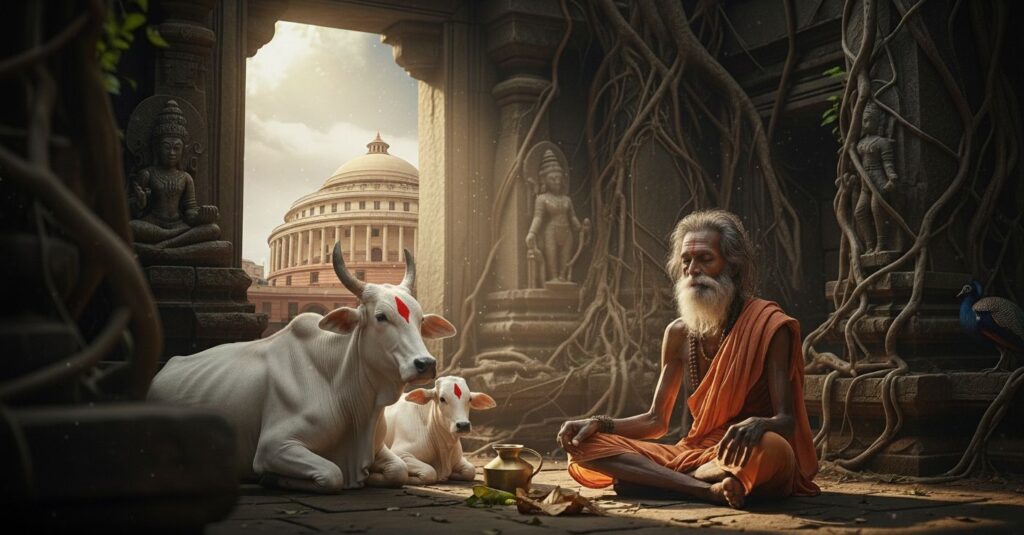
image for representation purpose only
About The Author