
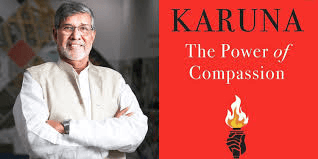
A Review of Karuna: The Power of Compassion by Kailash Satyarthi
There is an old indigenous parable about a hummingbird. When a great forest fire rages and every animal flees in panic, the tiny hummingbird flies repeatedly to the river, picks up a single drop of water in its beak, and drops it on the flames. The larger animals mock it. “What difference will your tiny drop make?” they ask. The hummingbird replies: “I am doing what I can.”
Karuna: The Power of Compassion is Kailash Satyarthi’s hummingbird drop deceptively small in its prose, monumental in its intention.
I first encountered Satyarthi-ji when I was a young, wide-eyed media person, barely finding my footing, slightly overwhelmed by his sheer moral gravity. He spoke then the way he writes now , simply. Almost disarmingly so. And I remember being fooled by that simplicity, the way you underestimate still water. Only later did I realize: when this man says something plainly, in the quietest possible voice, that is exactly the thing you must lean in and hear most carefully.
Karuna is built on precisely that quality.
Satyarthi makes a declaration early: compassion is not kindness, mercy, pity, benevolence, sympathy, or empathy. People lump all of these together, but compassion is altogether different , it is a force born of feeling another’s suffering as your own, and it compels mindful action. That distinction, dressed in plain kurta-cotton language, is the most radical idea in the book. He is not softening you. He is arming you.
The storytelling is where the book truly earns its keep. Satyarthi recalls how, as a schoolboy, he saw classmates dropping out because they couldn’t afford books. He took his reward money, went door to door collecting used books, and built a small “Book Bank.” No grand philosophy, no UN convention , just a child who felt someone else’s problem as his own and acted. That is karuna, distilled to its purest form.
Then there is the visceral account of Wasel Khan’s daughter, being trafficked after the family was driven from Aligarh. Satyarthi tried to rescue her. He was beaten. He came back empty-handed but went to the High Court, and within days rescued 36 children and women. “I felt like I freed myself too,” he said. That sentence alone is worth the price of the book.
He also recounts leading a procession of Dalit friends to the Shrinathji Temple in Nathdwara on 2 October 1988 , a temple whose gates literally read “Untouchables are not allowed.” Not rage. Not rhetoric. Compassion as protest, as presence, as power.
The book’s most audacious contribution may be its concept of the Compassion Quotient (CQ), a framework to actually measure compassion scientifically, built across dimensions of awareness, connectedness, and the drive to act. Unlike IQ or EQ, CQ is unlimited and can be increased in everyone, because compassion is innate and infinite. Satyarthi even suggests that future marriages could be evaluated not on birth charts or beauty, but on how partners respond to each other’s vulnerabilities. That’s not idealism. That’s a civilizational upgrade.
The book doesn’t sound the alarm, but carries an urgent undertone that demands attention. That is vintage Satyarthi. The man never shouts. He simply keeps dropping water on the fire, one quiet sentence at a time, trusting that you will eventually hear the hiss of the flames dying down.
Read it slowly. The simple parts especially. Those are the ones that will stay with you longest.
About The Author