Will Charanjit Singh Channi Emerge As The Game Changer?
Punjab has never been a state that votes in straight lines. Its rivers braid and split before they reach the plains. Punjab politics has always mirrored this; fracturing along lines of faith, caste, land, and grievance long before a verdict settles. For half a century after Partition, this fracturing resolved into a tidy duopoly: Akali Dal against Congress, Panth against tricolour, turn and turn about. 2022 shattered that pattern. A party with no history in the state, no agrarian base, no Panthic credential, swept to power with 92 of 117 seats. Punjab, it transpired, was not choosing between two familiar houses; it was choosing to burn the street down.
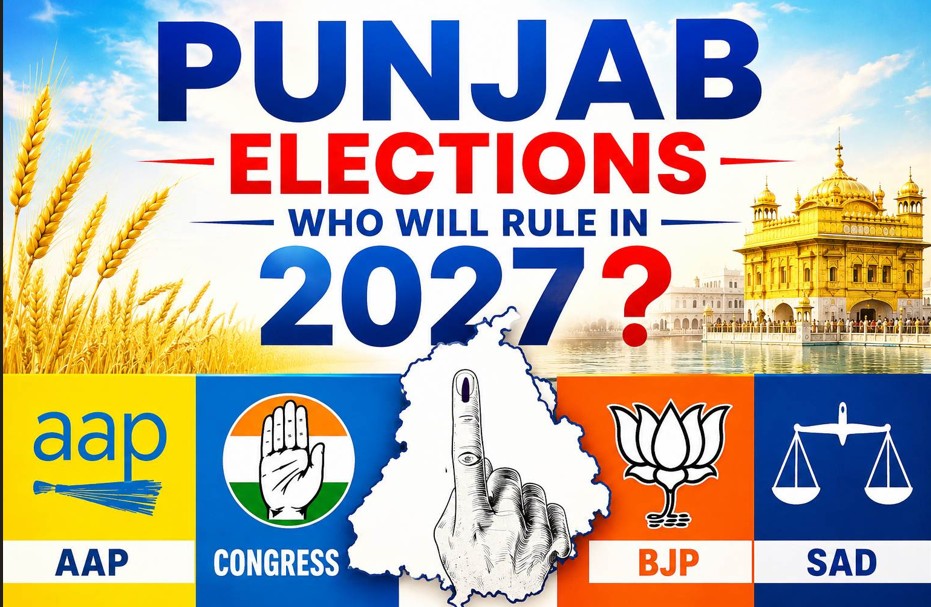
Three years on, the fire has not spread as widely as anticipated; and it is Bhagwant Mann’s government, not the parties it displaced, that must now account for what has been built on the ashes. Punjab’s 2027 Assembly election will not be the rematch anyone scripted in 2022. Instead, it is shaping into a four-cornered contest – AAP, Congress, BJP, and a possible resurrected BJP–SAD combine; where governance record, organisational discipline, religious politics, and the arithmetic of alliance will all matter more than any single party’s state-wide appeal.
Three years on, the fire has not spread as widely as anticipated, and it is Bhagwant Mann’s government, not the parties it displaced, that must now account for what has been built on the ashes
The Incumbent’s Paradox
Bhagwant Mann carries into 2027 what every first-term Punjab chief minister since 1997 has carried into re-election: the trappings of incumbency, and the inherent liabilities. His advantages are tangible. He remains the most recognisable face in state politics, the welfare architecture built around free electricity and mohalla clinics has not collapsed, and the 2026 municipal elections – where AAP secured 958 of 1,977 wards and majorities in five of eight corporations – suggest an organisational machine that survived the bruising of the 2024 Lok Sabha election rather than one limping towards irrelevance.
However, the 2022 coalition was a protest vote cloaked in a governing party’s attire, and protest votes do not automatically renew themselves. The 2024 general election, in which Congress secured seven of Punjab’s thirteen Lok Sabha seats to AAP’s three, provided the first evidence that the 92-seat mandate was a moment, not a permanent realignment. AAP is no longer the insurgent promising to dismantle a rotten system. It is the system now, and Punjab will judge it as it judges every government: on drugs it has not eliminated, on young people still boarding flights out of Amritsar and Jalandhar because the state offers them no future worth staying for, on farmers still awaiting the promised diversification, on an exchequer strained thin by subsidy commitments, and on a relationship with Sikh religious institutions that Mann has never fully made his own. Incumbency in Punjab has historically been a wasting asset. Nothing so far suggests AAP has found the exception.
Congress’s Self-Inflicted Wound
If anti-incumbency is Punjab’s most reliable political weather, Congress should be the natural beneficiary – and it remains, on paper, the party with the deepest bench: local networks cultivated over decades, candidates who have won previously, and a residual base that never fully migrated to AAP. What it lacks is the one element that converts sentiment into seats: a leadership capable of presenting a united front. The unresolved contest between Charanjit Singh Channi and Raja Warring, with Partap Singh Bajwa running his own parallel operation, is not a subplot to Congress’s Punjab story; it is the story. A party can survive losing an election. It cannot as easily survive workers who would rather sabotage a rival faction’s candidate than secure a seat for the party banner. The newly announced network of 25,000 booth-level workers will mean nothing if those booths report to three different masters.
The unresolved contest between Charanjit Singh Channi and Raja Warring, with Partap Singh Bajwa running his own parallel operation, is not a subplot to Congress’s Punjab story; it is the story.
Channi himself remains Congress’s most consequential asset and its most combustible one. As a Dalit leader with genuine Sikh identity, he offers Congress something no rival can manufacture: a credible bridge into Doaba’s Dalit-majority constituencies and simultaneously into Malwa’s Sikh electorate. That bridge holds only if Congress’s high command treats him as the party’s face rather than as one claimant among three. Every month that question remains unresolved is a month handed, free of charge, to AAP.
BJP’s Ceiling, and the Alliance That Could Break It
The BJP arrives in Punjab with a paradox of its own: real and rising support, yet no proven method to translate it into government. Its 2024 vote share confirmed the party is no longer a marginal urban curiosity – it now competes seriously in trader constituencies, among urban Hindus, along the border belt where national security resonates as a lived concern rather than an abstraction, and in a scattering of Dalit and rural seats bolstered by defectors from Congress, AAP, and the Akalis. And yet the same election delivered zero Lok Sabha seats. Votes without geographical concentration are not power; they are a very expensive opinion poll.
This is why the reported contact between Prime Minister Narendra Modi and Sukhbir Singh Badal matters more than any single opinion poll. A revived BJP–SAD alliance would, on paper, marry BJP’s financial resources, media reach, and urban base to whatever remains of SAD’s rural and Panthic networks – networks battered by the farm-law protests, the 2015 sacrilege controversies, and a decade of organisational drift, but not yet extinguished. The arithmetic is tempting. The politics, however, is not simple addition. Akali voters spent a decade being told BJP could not be trusted with Punjab’s agrarian and religious sensitivities; some will not forgive the reconciliation. BJP’s own cadre, built partly on distancing the party from a rural ally seen as compromised, may resist sharing seats with the very partner it replaced. And the Panthic vote that both parties are chasing now has other suitors – Waris Punjab De and a scattering of independents who, as 2024 already demonstrated in Khadoor Sahib and Faridkot, can win outright when the establishment options all feel compromised. An alliance is a hypothesis. It becomes a strategy only when it survives contact with the ground.
The politics, however, is not a simple addition. Akali voters spent a decade being told BJP could not be trusted with Punjab’s agrarian and religious sensitivities; some will not forgive the reconciliation. BJP’s own cadre, built partly on distancing the party from a rural ally seen as compromised, may resist sharing seats with the very partner it replaced
Security Is Real. Do Not Confuse It With the Electorate.
No honest accounting of Punjab in 2027 can ignore its security file; foreign-linked extremist financing, encrypted recruitment networks, and drone-borne weapons drops across the international border are documented operational concerns, attested to by successive investigations, not manufactured anxieties. Editorial honesty demands they be named plainly.
Editorial honesty also demands a second sentence, one too often left unwritten: none of this is evidence of mass separatist sentiment among Punjab’s voters. Assertive Sikh identity politics, demands for greater federalism, and sharp criticism of the Union government are the ordinary vocabulary of Punjabi democracy, they are not a security threat, and conflating the two has, in past decades, done more damage to the state’s peace than the threats themselves. Whichever party treats Punjab’s electorate as a population to be reassured about its own loyalty, rather than a citizenry to be governed competently, will pay for the insult at the ballot box. This distinction is not a rhetorical nicety. It is, arguably, the single most consequential judgement any national party makes about Punjab between now and polling day.
About The Author