
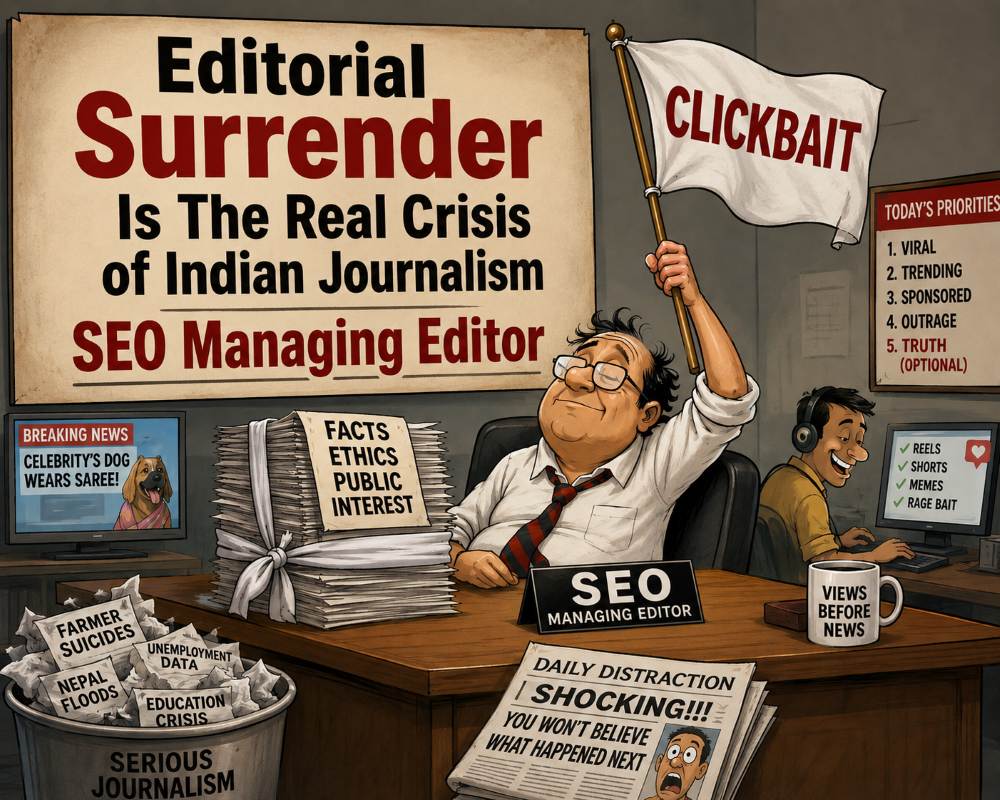
A news organisation doesn’t disappear simply because it has closed down, its television studio is empty, or a robotic voice has replaced a reporter. Rather, its decline occurs before that, when a newsroom can no longer decide what is important. Can we say that India’s media is already in the ICU (intensive care unit), surviving via a ventilator but essentially dead and not yet reported to the world at large? For how long can it remain concealed?
India’s greatest current threat to its press is the extent to which journalism has surrendered part of its editorial control to systems created to maximise visibility, retention, and money-generating eyeballs. Headline writing is determined by SEO (search engine optimisation); trend data determines assignment; social engagement determines angle; recommendation engines determine prominence. CTR (click-through rate), scroll depth, session duration, watch time, and social engagement determine content to be repeated. In addition, a managing editor has acquired three new colleagues who are both tireless and virtually invisible: the platform, the dashboard and the machine learning model.
The issue is no longer if journalism is evolving; it is whether the editor has already become a ceremonial position. A patient in intensive care appears alive because machines perform bodily functions required for life. Likewise, can a news organisation appear alive today? Its site is updated, notifications appear, auto-played videos play, articles are published, the audience graph goes up, even though editorial judgment- the ability of humans to determine what the public should know as opposed to what they will most likely consume- may have failed under layers of optimisation software. The machines are functioning properly. The conscience may not be.
When Journalism Had a Civic ‘Bait’
It would be unrealistic to romanticise the Indian press. It has always faced challenges such as patronage, bias, financial dependency and vanity of professionals. However, it has also produced reporting that understood itself as an instrument of democratic accountability, not just a means of distributing audience impulses.
The Indian Express documented Emergency abuses despite the existence of a censorship apparatus. The Hindu’s Bofors investigation fundamentally changed India’s lexicon in terms of politics and institutions. Harshad Mehta coverage showed the extraordinary scope of market euphoria, weak regulation and deception. Telgi coverage disclosed the enormous extent of organised institutional complicity. Jessica Lal coverage maintained that public interest would continue to scrutinise justice until it was achieved. Priyadarshini Mattoo coverage maintained that impunity would continue to reside in the national consciousness. These examples were neither comprehensive nor unique; likewise, the success of these investigations was not due solely to journalism. Judges, investigators, activists, whistleblowers and citizens all worked together to bring about each example. The purpose is far more stringent. Serious reporting transformed private injustices and hidden institutional failures into issues that could no longer be quietly dismissed. It provided facts, timelines, memories and continued scrutiny. It made power accountable.
That is public service journalism, not journalism that appeals to the public but journalism that empowers them. Its standard is not whether a particular article temporarily captures the nation’s attention. Its standard is whether the article expands public knowledge, rectifies an abuse of power, discloses an institutional failure or provides information necessary for public decision-making.
Indian reporting continues to reflect this ideal. Awards given to investigative reporters, Ramnath Goenka, Prem Bhatia and Red Ink awards, demonstrate an enduring professional legacy. Additionally, local and regional journalists often face increased risk and limited resources, yet continuously report on systemic failures that national studios fail to document. Therefore, the argument here is not that journalism has disappeared, but that there are diminishing conditions under which it flourishes.
Historically, editors asked themselves: “What is important?” Today’s digital newsroom asks: “What will travel?”
This distinction is more than semantics. Importance requires civic consequences; Travel predicts potential circulation. Importance requires editorial discretion; Travel rewards behavioural forecasting. Platform journalism values newsworthiness according to searchability, shareability and emotional velocity.
Reuters Institute’s 2025 Digital News Report provides stark evidence of these pressures. Among 48 markets studied worldwide, use of social networking sites, video platforms and aggregation services has dramatically increased since 2009; meanwhile, audiences have dramatically decreased in television viewing, print reading and publisher website visits. Social video news consumption jumped from 52 percent in 2020 to 65 percent in 2025; forty percent of survey participants admitted to occasionally or regularly avoiding news altogether, an increase from twenty-nine percent in 2017. While this does not indicate diminished concern among the public toward civic life, it suggests an overwhelming abundance of conflict-ridden and tiring news environments has contributed significantly to decreasing attention levels essential for democratic reporting.
In the Reuters Institute’s 2025 online survey of English-speaking news users in India, the majority of respondents (55%) reported using YouTube for news; 46% reported using WhatsApp for news; and 40% said they preferred to watch news over reading it. Eighteen percent of those surveyed said they engaged with AI chatbots at least once a week for news purposes; 44% reported feeling comfortable with AI-generated news. Again, it is important to note that these figures are not national population estimates; however, the report appropriately notes that the Indian sample is “over-representatively online, urban, educated and English speaking”; thus, while it is a snapshot of one particular demographic group, it does show the direction of the economically desirable, platform-based audience.
A publisher dependent on search referrals, social distribution and programmatic advertising cannot reasonably claim that the systems it uses as conduits are neutral. Rather, they tend to influence editorial priorities. Thus, a story evolves into an opportunity to monetise keywords; an event is reduced to an explainer only if it matches the intent of search; a report is updated based on how quickly a publication must produce new content; a headline is carefully crafted to optimise click-through rate (CTR); a video is thoroughly optimised to maximise viewer retention. Collectively, these represent algorithmically controlled access: decisions about which news items receive prominence are determined by technical and economic factors unrelated to the public good. Ultimately, this represents the pathological condition known as audience capture. Audience capture occurs when a news organisation determines that it exists to serve its audience as citizens, versus serving the most reactive elements of its audience as a consumer. The news organisation identifies which outrage generates the greatest ROI; which identity conflict keeps viewers tuned in; which photo attracts the most clicks; which accusation generates the greatest number of comments. As such, the organisation continues to create similar types of content. While an organisation measures its audience, it trains them.
Television and the marketplace of spectacle
Spectacle was not created by Indian television; rather, Indian television industrialised it. While ratings provide a measure of how many people view a channel, ratings do not provide a measure of whether an individual understands an issue; nor do ratings provide a measure of whether a story was reported accurately; nor do ratings indicate whether an investigation resulted in corrective actions being taken; nor do ratings provide a measure of whether public discourse has been enhanced due to reporting. Ratings measure visual exposure; ratings are, therefore, an inaccurate proxy for civic value.
This differentiation is especially relevant in light of television’s ability to evolve evidence into spectacle very rapidly. An anchor’s confrontation replaces a reporter’s inquiry; the panellists’ cacophony replaces documentation; repetition replaces proof. Crime, sports, celebrities, communal tensions and patriotic theatrics all lend themselves easily to the grammatical constructs of real-time dashboards. Conversely, structural issues (i.e., education quality, law enforcement hiring/recruitment processes, municipal finances, public health procurement processes, labour inspections, land registry records or the slow erosion of local institutions) take time, expertise and follow-up. They are more inconvenient to present visually; however, they are no less consequential.
Ultimately, the problem is not establishing strict boundaries between serious journalism and other forms of journalism. Journalism can be lucid, visual and broadly consumable. The failure resides in refusing to allow public consequence to determine how journalism will be presented. A broadcaster able to elevate a relatively minor spectacle into a nationally prominent topic is equally able to make sense of a collapsing civic structure. The decision ultimately lies with editorial discretion.
India’s current regulatory conversation acknowledges that measurement requires increased transparency and accountability. The Ministry of Information and Broadcasting’s proposed television rating policy 2026 directs registered rating agencies to increase their sampling base to a minimum of 80,000 metered households within eighteen months and to release their methodologies and anonymous data along with undergoing both internal and external audits. These are laudatory protections. However, regardless of whether a rating agency increases its representative sample size, there remains a much larger question: why should a commercial measure of viewership be considered a complete measure of journalistic success? Therefore, journalism needs an additional ledger: an independent audit of journalistic public-interest/impact.
The audit would examine original reporting; correction processes; source diversity; coverage of underrepresented geographic areas and demographics; follow-up on investigations; public explanation; documented response from institutions; and documented evidence of harm averted or rectified. The audit must not degenerate into a state-controlled merit badge. The sole purpose of the audit is to guarantee that while reach remains a commercial metric for journalism, it is not the journalistic equivalent of a moral compass.
The digital identity crisis in Print journalism
As previously noted, print journalism faces challenges unique unto itself; yet, each challenge is equally dire. Once, print journalism derived part of its credibility from scarcity: limited space forced newspapers to select stories that were worthy enough to publish; to create hierarchies among those stories; and to have editors willing to reject certain stories. The digital page does not possess such constraints. Infinite scrolling architecture creates a different imperative: rapid production; constant updates; and content inflation.
Editorial consequences include editorial debt: the cumulative costs associated with producing rapidly, superficially and constantly without sufficient reporting; context; corrections; or follow-up that the subject deserves. A newspaper can gain traffic while degrading its archive. It can gain search results while losing reader confidence. Programmatic advertising further exacerbates this pressure. With programmatic advertising tied directly to impressions, a story’s value is measured more so by its potential for generating page views and ad inventory rather than the quality of its reporting. While search intent mapping and headline optimisation can direct readers toward high-quality reporting, they become corrosive when they predefine the value of journalistic effort. SEO is a tool; an SEO-first publishing strategy is an abandonment of editorial responsibility.
Trust deficits resultant from programmatic advertising
Given the prior discussion regarding programmatic advertising, it is no surprise that trust deficits arise from such strategies. The Reuters Institute’s India study found that only 36% of online English-speaking Indians surveyed expressed faith in news overall. Fifty-seven percent of those surveyed expressed concerns regarding the validity of online news. While these numbers should not be interpreted as indicative of a national consensus, given the sample limitations, the trend is evident: even though an economy can boast abundant amounts of information available, trust deficits exist as regards reliable journalism.
Not the fault of AI
AI did not initiate this crisis; AI has simply exposed an existing weakness: the widespread tendency within news organisations to view editorial judgment as an unnecessary expense. AI offers great utility. AI can transcribe interviews; translate official documents; analyse massive databases to find patterns; help reporters review documents; facilitate reporters in finding evidence within large volumes of documentation; and make critical work available across multiple languages and mediums. When properly utilised, AI can greatly benefit explanatory journalism; investigative journalism; and public service journalism. AI can liberate reporters from administrative tasks.
However, absent robust editorial oversight, AI reduces into an industrial process for creating derivative summaries, synthetic images, automated rewrites, search-optimised headlines, and low-cost pages designed to attract attention. Furthermore, generative AI reinforces automation bias, i.e., acceptance of outputs based purely upon fluency, speed and technical production capabilities. Additionally, generative AI can confuse corrections; mask originations; and disperse accountability. Therefore, the critical question is not: “will AI replace journalists?” rather, the critical question is: “will AI replace editors who have already relinquished their authority?”
If a system defines what is an appropriate keyword; defines what angle is correct; defines what headline is optimal; defines when content should be produced/released; defines what images are best-suited for content; defines what channels are best-suited for dissemination; defines what recommendations should be made for consumption; defines what retention strategies should be employed, then an editor who provides final approval for output is acting as nothing more than a human seal-of-approval mechanism for a machine-driven workflow.
Thusly, an AI-assisted news organization requires guidelines that are proportional to its power: human accountability for every assertion published via the organization’s systems; transparent disclosures where synthetic materials might potentially mislead consumers/readers; verifiable sourcing mechanisms; corrective procedures established for errors discovered after publication; protections afforded to confidential sources; regular testing for biases inherent in output data; and formal rights provided to editors to override performance metrics when necessary as defined by the public interest.
These are not barriers to innovation; rather, they are foundational principles for authentic innovation. Indian journalism will be revitalised neither by nostalgia nor moral indignation alone; rather, it will require institutional reforms.
Publishers must distinguish between audiences & editors
Publishers must divorce intelligence collected about their audience from control exercised by editors. Analytics must inform distribution/presentation of content, not define the hierarchy of public interest in the newsroom. All news organisations require written editorial charters defining non-negotiable commitments, including verification/independence/disclosure/corrections/source protection, and covering topics outside of preference by their most commercially successful audience segments.
Editors must regain right to publish regardless of data
Editors must recover their right to publish regardless of whether data indicates otherwise. There are certainly investigative pieces that will never go viral. There are certainly rural realities that will never become viral content. Certain explanations require patience. These are exactly the type of reporting that require strong editorial sponsorship. Public interest starts where predictive behaviour driven by audience metrics ceases.
Transparency regarding accountability data
News organisations should publish meaningful transparency data:
* Corrections issued
* major investigations conducted
* Follow-up rates
* Diversity of sources engaged
* Geographic areas covered by reporting
* Time devoted to explanatory reporting
* Documented outcomes
Transparency will enable impact journalism to become visible without converting it into just another marketing phraseology.
Platform literacy without equating platform literacy with editorial wisdom
Journalism schools must educate about platforms without confusing them with editorial decision-making capability. Students need to understand the mechanics of recommendation engines/synthetic media/programmatic advertising/data driven publishing platforms, but also that none of these technologies provides answers to journalism’s most fundamental question: what does the public need to know to hold power accountable and govern themselves effectively?
Citizens must be viewed more than just traffic
The public has a right to receive factual information, quickly, and comprehensively explained, in addition to receiving timely corrections and meaningful representations. Democracy requires news organisations able to resist the profitable urge to minimise content quality. India still has exceptional reporters/vigilant local journalism/serious editors/audience willing to fund high-quality work that respects their intelligence. Its news industry also possesses technology capable of providing access to rigorous reporting at levels unimagined by any previous generation.
Tools are not enemy number one; Rather, tools remain tools. The editor’s primary function is to assess relevance/evaluate evidence/determine proportion/determine consequence/pursue stories which require effort, even when those stories are difficult, and protect the public interest when algorithms fail to do so
About The Author