
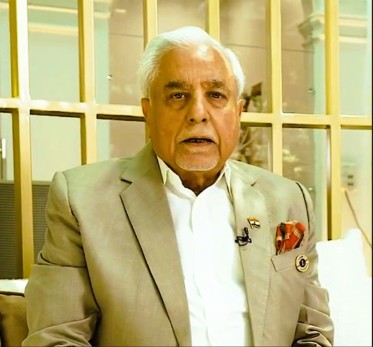
The iconic silver streak once inspired me to create the rising Essel Group logo. That silver streak has paved way for all white hair now. Will this be the end of a legendary entrepreneurial journey?
Subhash Chandra helped build private television in India. The gap between the wealth once certified in his name and the sum now offered to creditors poses a question that lenders, regulators and courts can no longer postpone.
Certificates tied to Subhash Chandra’s personal guarantees reportedly placed his net worth at about ₹59,113 crore in March 2017 and ₹40,562 crore in July 2018. In personal insolvency proceedings in 2024 it was reportedly stated at about ₹31.79 crore. The distance between those figures is too large to pass as an accounting detail.
The Enforcement Directorate has opened a money-laundering investigation on the strength of a CBI FIR concerning two LIC Housing Finance facilities, together worth ₹980 crore, sanctioned in 2018 to borrowers linked to the Essel Group. The lender puts its loss after default at about ₹1,322.39 crore. At the centre of the case are the net-worth certificates that accompanied the guarantees, and, according to reporting on the FIR, the CBI alleges that Chandra has denied ever possessing the wealth they described.
All of this is allegation, and no agency has found anyone guilty of anything. The CBI must establish whether the representations were false, who prepared them, what the lender checked and where the money went; the ED must establish whether the predicate case discloses money laundering. My argument is narrower: a matter of this size should be settled by documents, and neither sentiment nor headlines will do as a substitute.
Wealth that vanished and wealth that never existed are different propositions. One is a misfortune; the other is a question for the courts.
I. Six figures, six meanings
Public discussion tends to fold every large number into one. The figures below measure different things.
| Figure | What it measures | Status |
| ₹59,113 crore (Mar 2017) · ₹40,562 crore (Jul 2018) | Net worth reportedly stated in certificates tied to Chandra’s personal guarantees | Alleged basis of the CBI case; authenticity and preparation under investigation |
| ₹980 crore | Two LIC Housing Finance facilities sanctioned in 2018 (₹500 crore + ₹480 crore) | Amount sanctioned, not amount lost |
| ₹1,322.39 crore | Loss the lender alleges after default | Lender’s allegation; yet to be tested |
| ₹31.79 crore (2024) | Net worth reportedly declared in personal insolvency proceedings | Requires reconciliation with earlier representations |
| ₹22,006.57 crore | Admitted claims arising from personal guarantees | Admitted in the insolvency process |
| ₹6.25 crore | Proposed repayment — about 0.0284%, under three paise per ₹100 | Approved by 80.814% of creditor vote; stayed by a five-member NCLT bench |
Adding them together produces a total that corresponds to nothing, and anyone who offers it as the size of a “scam” misleads the reader. An editorial can be forceful and exact at once, and if an indictment does come, exactness is what will let it stand.
II. It all began from the sea
Any fair account has to begin with what Chandra built. In Fortune India in October 2021 I wrote that “it all began from the sea,” recalling an enterprise that proposed to send entertainment signals into India from ships, when the country had no real market for private television. He was among the people who made that market.
Zee did more than launch channels. Advertisers, distributors, performers, technicians and investors all had to be persuaded that an Indian broadcaster could work at scale, and its listing gave a new industry a place in the imagination of Indian investors. Its move into cable and later direct-to-home television rested on a sound instinct, that whoever controls the route into the household shapes what reaches it.
That achievement is real, and it is why the present moment is so uncomfortable. When the credibility of a founder this consequential collapses, the harm reaches the banks that lent against his name, the professionals who certified his accounts and the boards that governed his companies. History should not be erased, and it should not serve as an excuse.
III. How the pledge worked
The vulnerability lay in the financing. The Indian School of Business’s case study traces Chandra’s difficulties to debt stress in the infrastructure business he founded in 2007. By January 2019 most of his holdings in listed group companies had been pledged against borrowing, and lenders were threatening to sell shares in the media businesses. The study also records concern about related-party transactions.
A promoter’s shareholding can be long-term ownership of a productive company, or it can be collateral for obligations that have nothing to do with it. Once heavily pledged, its fate follows the market’s mood and the lenders’ margin calls. Zee Entertainment and the Essel Group were never one balance sheet, but the financing gave the group’s distress a path into the value and ownership of the listed media company. The success of the institution had become borrowing capacity for the empire.
In January 2019 that path was used. A sell-off in Essel Group shares wiped out more than ₹13,000 crore of market capitalisation, and Zee Entertainment’s shares fell by more than 26 per cent. Falling prices thinned the collateral, thin collateral alarmed lenders, and lender action pushed prices lower again.
By December 2019 Business Standard described a group that had lost control of important cash-generating businesses, among them Zee Entertainment and Essel Propack, while the debt-heavy operations remained; it put Essel Infraprojects’ consolidated debt at about ₹17,000 crore as of March 2018. Selling productive assets can be unavoidable in a debt crisis, but each sale removes income that might have serviced what is left.
IV. The 2018 loans
LIC Housing Finance sanctioned two facilities against this background: ₹500 crore involving Vasant Sagar and associated entities, and ₹480 crore involving Digital Subscriber Management and associated entities.
A personal guarantee exists to put a credible second source of recovery behind the corporate borrower. Its worth depends on what the guarantor actually owns, what is already encumbered and what other liabilities claim the same assets, and a large figure on a certificate settles none of those points. Investigators must reconstruct the position as it stood at sanction. Were the assets held personally or through companies? Were pledged shares shown without allowance for the pledge? Were other guarantees disclosed? What independent valuation was done? And, since the question concerns the lender as much as the borrower, what did the institution verify before committing nearly a thousand crore rupees?
If the certificates were materially false, it must be established who knew, who took part and whether the lending was induced by them. If the assets were real and later lost value, that history has to be documented line by line. A criminal case cannot assume that every failed loan was a fraud, but neither should “business failure” be allowed to close the file on alleged misrepresentation.
V. Reinvention that did not happen
In October 2021 the proposed Zee–Sony combination seemed to offer renewal in place of retreat. I asked then whether Chandra could rise like a phoenix, a question less about restoring a fortune than about whether a company formed in the era of satellite television could carry its habits into a digital market. The merger did not go ahead. Its failure was not the source of the debt crisis, which had been exposed years earlier, and neither event explains the other away.
VI. Three paise
The guarantees eventually reached the insolvency process. A proposed payment of about ₹6.25 crore against ₹22,006.57 crore in admitted claims is a recovery of roughly 0.0284 per cent, less than three paise for every hundred rupees claimed.
That figure does not by itself show the plan to be improper. If a debtor truly has almost nothing recoverable, rejecting a small offer cannot create a bigger estate, and a negotiated settlement can sometimes yield more than liquidation. That was the reasoning of those who backed the plan, and they commanded 80.814 per cent of the creditor vote.
A vote is only as reliable as the information on which it is cast. Opposing lenders questioned whether the search for assets had been adequate and alleged links between Chandra and some creditors supporting the plan; those allegations remain untested. A five-member bench of the National Company Law Tribunal nonetheless stayed the approval, restrained Chandra from disposing of his properties and ordered a rehearing.
“Commercial wisdom” deserves respect, but it cannot excuse anyone from examining the information on which that wisdom was exercised.
Shares fall, assets are sold, security is enforced and guarantees crystallise, and none of this is unlawful in itself. But each event should leave a documentary trail, and when a declared fortune shrinks from tens of thousands of crores to a few tens of crores, that trail is the substance of the case: what changed, when, through which transactions, and for whose benefit?
VII. What the institutions owe
It would be easy to make this a morality tale about a fallen tycoon, and that would be a way of avoiding the harder questions. The lender must explain its due diligence, the certifiers their methods, and the guarantor his representations and the history of his assets. The insolvency process must show that its recoveries reflect an estate properly examined and not merely a declaration left unchallenged.
Three reforms follow. High-value personal guarantees should require verifiable asset schedules, disclosure of encumbrances and a register of competing obligations, because a promoter’s standing is no substitute for security. A gap of this order between earlier wealth representations and later insolvency disclosures should prompt a reasoned decision on forensic scrutiny. And creditor relationships and voting interests should be disclosed openly enough to show that an approved outcome was informed and independent.
None of this is meant to punish honest failure. An economy worth the name must allow for risk, loss and a lawful fresh start, but a fresh start should follow a credible account of what came before it.
What remains to be decided
Zee Entertainment has stated that the investigation concerns Chandra personally and certain promoter entities and does not affect its operations; its employees, investors and operating businesses should not be implicated through a shared name. Chandra’s contribution to Indian broadcasting is substantial, the allegations against him are unproven, and the contradictions in the financial record are unanswered. Each statement is true, and none cancels the others.
India should neither convict a founder through headlines nor absolve him through nostalgia. The man who helped change Indian television is entitled to due process, and the institutions asked to absorb the losses are entitled to the truth. An empire can run out of money. The inquiry into what it owed should not run out of resolve.
Image curtsey www / video grab
About The Author