
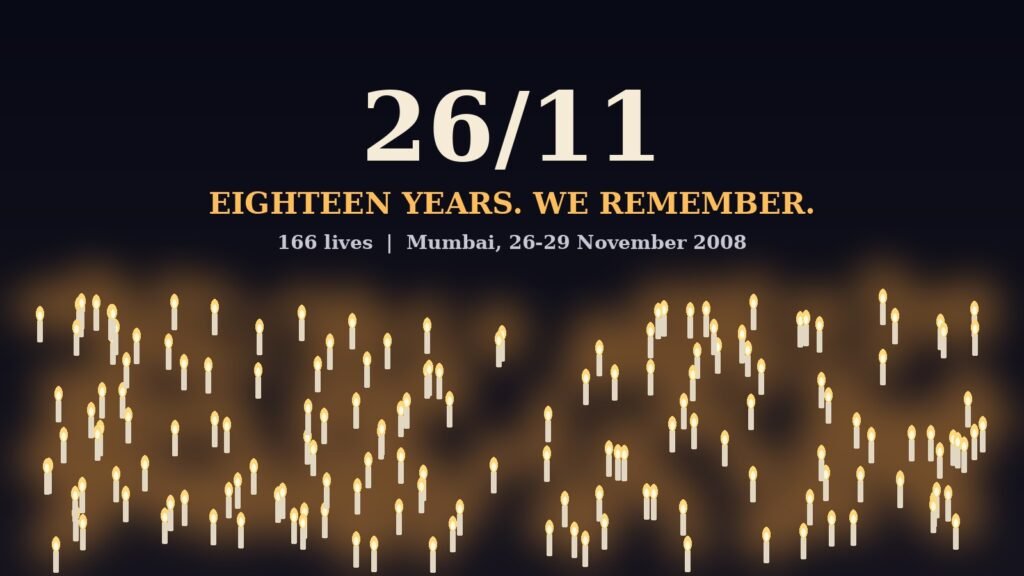
I did not believe it. That is the plain truth of how the night of 26 November 2008 reached me, and for a long time afterwards I still did not believe it.
I watched the news unfold the way the whole country did, in fragments. A railway station. A hotel we all knew. A cafe. A hospital. Each flash on the screen asked my mind to accept something it had no room for. I never believed India could be attacked in this fashion: in the open, in its financial capital, for days, with the whole world watching. I was stunned, and the stun did not lift quickly. It took me time to accept that Mumbai, this restless and forgiving city, had been brutally attacked. A part of me, I confess, has never finished accepting it.
Eighteen years have passed. The question I keep returning to is not what happened. It is whether we have the courage to keep remembering it.
Also read: L-G Manoj Sinha Mourns SSF Constable Shabaz Ahmad, Prays for Injured Zorawar Singh
Ten men, one hijacked trawler
They came by sea. Ten Lashkar-e-Taiba gunmen from Pakistan hijacked an Indian fishing boat, killed its crew and slipped into Mumbai, then spread out across the south of the city. Over roughly sixty hours they struck the Chhatrapati Shivaji Terminus, the Taj Mahal Palace, the Oberoi-Trident, Nariman House, Leopold Cafe and Cama Hospital. By the end, 166 people were dead and more than 300 wounded. Among the dead were 26 foreigners and 20 members of the security forces.
Begin with the railway station, because that is where ordinary India died. Two gunmen, Ajmal Kasab and Ismail Khan, fired at Chhatrapati Shivaji Terminus for about ninety minutes. Fifty-eight people were killed and more than a hundred wounded. A platform is the most democratic place in the country. Nobody there had done anything except travel.
The men who walked toward the gunfire
Terror reveals who stands between a city and the dark. Hemant Karkare, the chief of the Anti-Terrorism Squad, Additional Commissioner Ashok Kamte and the encounter specialist Vijay Salaskar drove toward the trouble near Cama Hospital. They were killed in a narrow lane between St Xavier’s College and Rang Bhavan.
Assistant Sub-Inspector Tukaram Omble was unarmed when he closed in on Ajmal Kasab. His sacrifice is the reason the police were able to take the only attacker alive, and with him the proof of where the attack came from. At Nariman House, Major Sandeep Unnikrishnan and Havildar Gajender Singh of the National Security Guard went in for the hostages. Unnikrishnan’s reported last words to his men were that they should not come up, he would handle them. On 29 November the NSG finished Operation Black Tornado at the Taj. In January 2009 these men were honoured with the Ashok Chakra, posthumously.
What justice has actually delivered
Kasab was tried, sentenced and hanged on 21 November 2012, five days before the fourth anniversary of the attack. That chapter closed. Others did not.
Tahawwur Rana, accused of helping the conspiracy, was extradited from the United States in April 2025 and is being tried at Patiala House in Delhi. On 9 October 2026 a special NIA court listed his case for arguments on the charges. Read that sentence again: eighteen years after the massacre, we are still at the stage of arguing what the charges should be. India’s request for Hafiz Saeed, the Lashkar founder named among the planners, has long lain with the Pakistani authorities. Those who planned, financed and directed the killings have largely walked free.
Have we forgotten?
Every 26 November the rituals arrive on time. Wreaths at Mumbai Police headquarters. Floral tributes at the station, the hospital, the hotel. This year the NSG is holding a memorial at the Gateway of India under the banner NEVEREVER. Leaders post their tributes. I do not doubt the sincerity of any of it. But a ritual is not the same as a memory, and a hashtag is not a duty.
Consider the arithmetic of time. A child born in the week of the siege is eighteen today and old enough to vote. Ask yourself how many of that generation can name the officers who died in that lane, or the commuters killed on a platform on an evening like any other. A nation that cannot name its dead has already begun to forget them.
To be fair, much has changed. Mumbai’s police have been strengthened with modern equipment and technology, and the attack forced overdue reforms to coastal security. After the Pahalgam massacre of tourists in April 2025, India answered in May under Operation Sindoor, a sign that the patience of 2008 has run out. These are real gains.
But remembering is not only the government’s task. It belongs to the family in Mumbai that still sets a place for someone who never came home, to the widows who collected gallantry medals on behalf of husbands, to every one of us who scrolled past a candle emoji this morning. The attackers wanted to be remembered for the horror. Our answer is to remember the names, the courage and the 166 lives, and to refuse to let the trial of the men behind it fade into the background of a busy news cycle.
I was stunned in 2008. I would rather be stirred in 2026. Say the names aloud. Ask when the cases will end. Do not let this be only a date on a calendar.
Sources: Business Standard, Outlook India, Deccan Herald, The Week, Free Press Journal, Tribune India, Press Trust of India reporting on the Rana proceedings (9 October 2026), Government of India gallantry award records (January 2009).
About The Author

The day’s verified news, in your inbox
One short email every morning with our original reporting. Free, and you can unsubscribe at any time.
Prefer WhatsApp? Get our top stories on our channel.
Follow us on WhatsApp