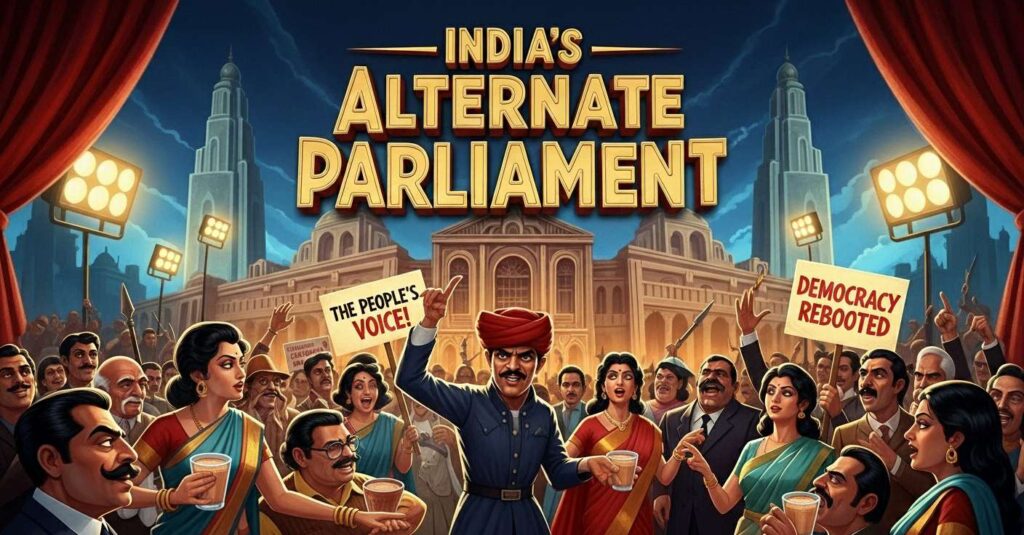
Inside India’s Alternate Parliament and The Access Costs just About Rs.10
While the world marvelled at India’s digital revolution, a Chaiwala already knew the algorithm. Not in Silicon Valley code, but in the steam rising from millions of roadside stalls. In 2014, when Narendra Modi, a tea-seller, won India’s highest office, it wasn’t an upset. It was a revelation: the real power code of this nation had always been written in ₹10 transactions, whispered over cutting chai, sealed in the clatter of glass tumblers.
“Chai pe charcha” wasn’t campaign genius. It was acknowledgment of what already existed, an unofficial parliament running parallel to the official one, more accessible, more honest, more powerful. But how did a foreign leaf become India’s most potent political infrastructure?
The Seed of Empire, The Root of Rebellion
Tea arrived as colonialism’s courier. When Robert Bruce stumbled upon wild tea plants in Assam in 1823, he couldn’t have imagined he was discovering India’s future soul. By 1837, British plantations sprawled across Assam’s belly, fed by the blood and sweat of tribal labourers torn from their lands, recast as cogs in an imperial machine. Tea was luxury, sipped in English drawing rooms and Indian palaces, a beverage of power and distance.
But imperialism always plants the seeds of its own undoing. By the early 1900s, as the Swadeshi Movement urged Indians to reclaim their economy, British tea planters faced a paradox: to survive, they had to sell to the very people they colonized. In 1903, the Indian Tea Association sent all-female teams to railway stations and bazaars, demonstrating how to brew the perfect cup. What began as commercial desperation became cultural infiltration. Tea descended from aristocratic salons to factory floors, from elite ritual to everyday necessity.
The humble cutting, half a cup, affordable at every corner, became the great equalizer. Rich and poor stood shoulder to shoulder at roadside stalls, class distinctions dissolving in shared steam. Tea wasn’t just a drink anymore; it was a space, a pause, a conversation.
Independence Brews a New Identity
When India won freedom in 1947, tea won its Indian citizenship. The colonial plantations changed hands, and in 1953, the Tea Board of India was born. The 1970s brought the CTC revolution: Crush, Tear, Curl, a faster production method yielding robust tea that married perfectly with milk and spices. Masala chai was democratized, its recipe standardized across millions of kitchens and street corners.
This was India’s genius,taking something foreign and making it so deeply ours that its origins became footnotes. By 2000, when Tata Tea acquired British brand Tetley, the circle closed: the colonized had conquered the colonizer’s cupboard.
But the true magic wasn’t in boardrooms. It was in the tapris and dhabas, in railway platforms and office canteens, where chai became the backdrop to every major decision, every minor grievance, every friendship forged and strategy plotted. Politicians held secret meetings over chai. Students planned protests. Lovers exchanged first words. Families reconciled. Without fanfare or official decree, chai became India’s unofficial parliament,where everyone had a voice, and every conversation mattered.
The Chaiwala Who Decoded the System
Modi didn’t invent chai culture; he simply read the room, or rather, the roadside. His 2014 campaign brilliance lay in recognizing what elites had overlooked: while they built war rooms and hired consultants, India’s real conversations happened at ₹10 per transaction, millions of times daily. His chaiwala origins weren’t a liability to overcome but a credential to leverage, proof he’d been inside the system politicians only visited for photo-ops.
“Chai pe charcha” tapped into something ancient and new simultaneously,the Indian tradition of gathering, of solving through conversation, now wrapped in the aromatic embrace of our most unifying beverage. Suddenly, the phrase was everywhere: in political rallies and corporate meetings, family gatherings and neighbourhood associations.
The ₹10 Algorithm That Runs India
Today’s chai stalls are India’s truest institutions,more accessible than courts, more equal than temples, more honest than parliaments. From Srinagar to Kanyakumari, the ritual is identical: the clatter of glasses, the whistle of boiling milk, the generous pour, the first sip’s consolation. In those moments, India drinks itself into existence daily.
Forget apps and portals. The real infrastructure of Indian democracy fits in a glass tumbler. Every chai transaction is a data point, every conversation a focus group, every stall a polling booth that never closes. Modi didn’t discover digital India; he rediscovered analog India, the version that had been governing itself, solving its own problems, building its own networks, all while the official machinery slept.
Tea had no roots here. But in 240 years, it grew them deeper than any technology ever could, through colonial soil and independence struggles, through exploitation and liberation, through calculated marketing and organic embrace. It became the medium through which a fractious nation found common ground: not through bandwidth or broadband, but through the simple, profound act of sharing a cup and conversation.
The power code was never digital. It was always there, hiding in plain sight, in every ₹10 chai, waiting for someone who’d served enough cups to finally crack it.
About The Author