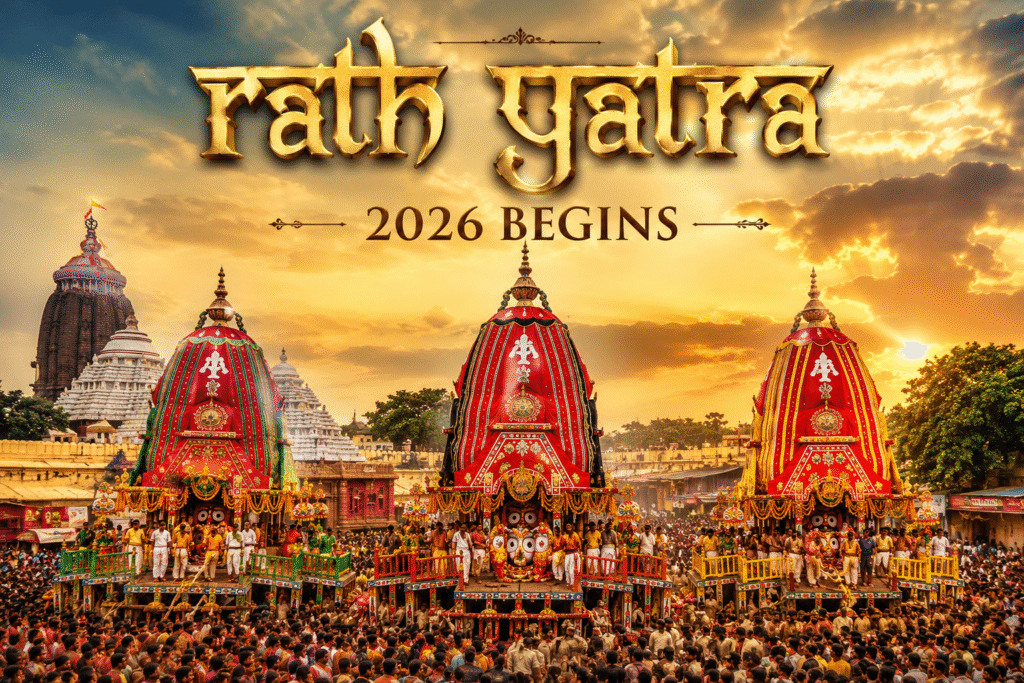
As lakhs of voices rise in a single roar on Puri’s Grand Avenue, broadcasters clear their schedules and a five-thousand-year-old procession once again proves that faith, economy and community can still move in perfect, thunderous rhythm.
“Jai Jagannath!”
It begins as a murmur near the Singhadwara – the Lion’s Gate, and by the time the towering, 45.6-foot Nandighosha inches forward, it has swallowed the conch shells, the temple drums, every other sound in Puri. This is the Rath Yatra’s true anthem: no composer, no rehearsal, just a chant so old it seems to live in the body itself. Riding alongside it is the Dahuka boli cheeky, unscripted verses sung atop the chariot, which tradition insists are the very thing that gets the Ratha moving. Faith in Puri has always needed a soundtrack, and this week, an entire town becomes its orchestra.
A Legend Older Than Memory
The festival’s roots run through the Skanda Purana, the Brahma Purana and the Kapila Samhita, with European travellers already describing it by the 13th century. Legend traces it to King Indradyumna, who followed a divine vision to Puri’s shore, where a sacred log had washed up waiting to become the Lord’s own form.
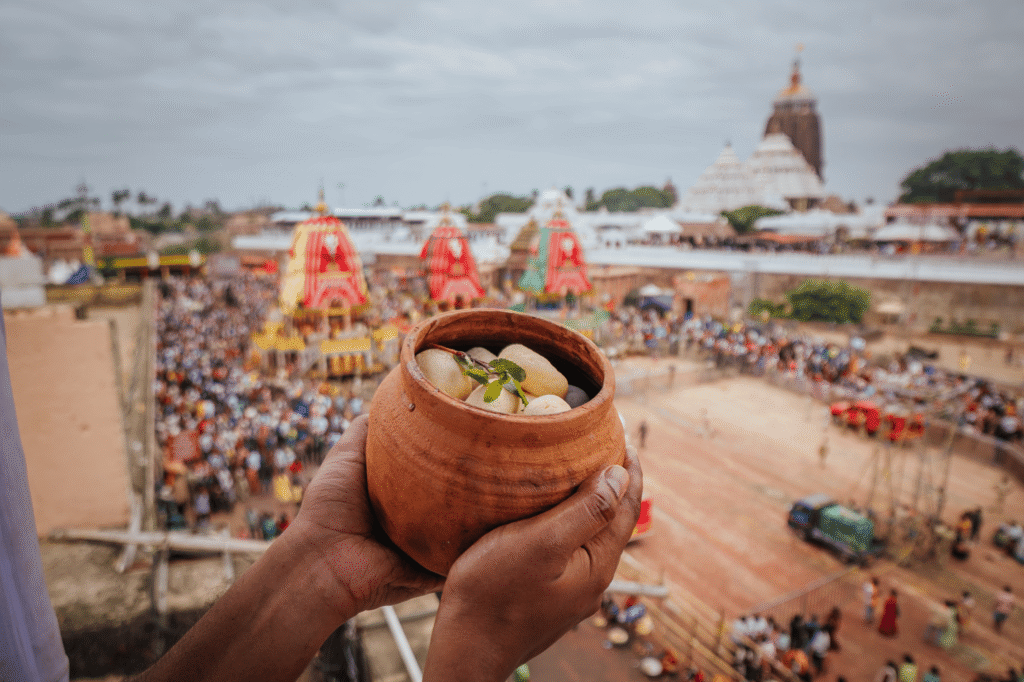
Every year since, three chariots are rebuilt from scratch, without a single nail, using phassi and dhausa wood floated down the Mahanadi exactly as it was centuries ago. Few know that when the deities return home, they pause at the Mausi Maa temple for a bite of Poda Pitha offered, tradition says, simply because the Lord asked for it.
This Year, Puri Is Bigger, Safer and More Watched Than Ever
Behind the spectacle sits a vast, largely invisible workforce: roughly 200 artisans – carpenters, blacksmiths, painters, woodcutters spent 58 days this year assembling the three chariots from 865 wooden logs. What makes 2026 stand apart is the scale of care wrapped around the celebration. For the first time, authorities have built dedicated insurance cover against accidents, stampedes and worse ,directly into the festival’s planning for the 15–20 lakh devotees expected on Bada Danda, alongside 185 round-the-clock drinking-water points and 1,000 temporary toilets. And the Lord’s reach keeps growing beyond the street itself: recent years have seen digital darshan carry the Yatra to devotees who may never stand on the Grand Avenue at all, turning one procession into a moment shared by millions who are nowhere near Puri.
Why the Whole Nation Tunes In
Few Indian festivals refuse to stay local quite like this one. Doordarshan has long arranged direct, high-resolution telecasts DD Odia in the regional tongue, DD Bharti carrying commentary in Hindi, English and Sanskrit , while private channels and NIC’s live web feed carry the Yatra into homes far beyond Odisha. In the days before, Puri itself turns into something between carnival and vigil: lodges overflow, dhaba stoves never cool, and pilgrims, sadhus and sand artists all drift toward the same three freshly painted colossi. Visitors arrive expecting a parade; they leave with a memory that won’t let go the Gajapati King sweeping the chariot platform with a golden broom, a ruler humbling himself before the divine; thousands of hands on a single rope, pulling toward one god.
What hasn’t changed in a thousand years is the ritual. What has is the reach ,screens now carrying the Lord’s presence to homes he will never visit in person. Yet the oldest promise still holds: the divine does not wait to be visited, it comes looking for you. And so, right now, cameras are being tested on rooftops, a Dahuka is warming up his voice, and somewhere in the crowd the first “Jai Jagannath!” is about to break – unrehearsed, unstoppable, gloriously human sending the wheel forward once more.
About The Author