
Phubbed at Home: The New Word for an Old Kind of Loneliness, as every generation in the Indian household gets outbid by a screen, and the casualties show up in missed medicines, reheated meals, and a quiet erosion of the conversations that used to hold families together.
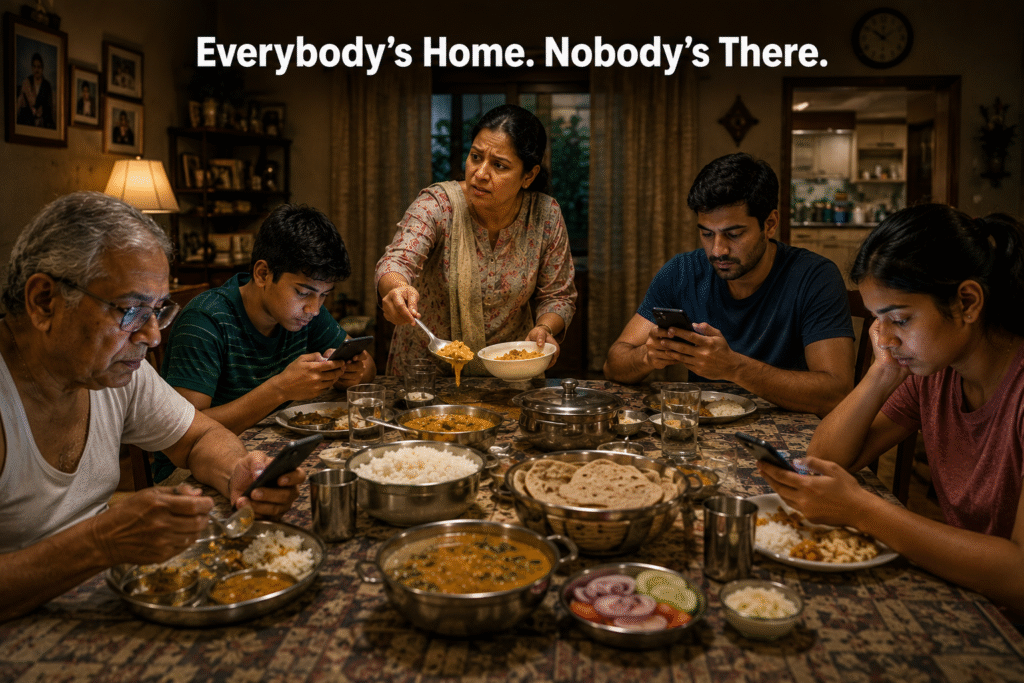
The rotis have gone cold twice this week in the Malhotra household. Not because anyone forgot to cook them, but because by the time everyone actually sits down to eat what’s already on the table, the food has stopped being warm and stopped being the point. Papa is three levels deep into a game of Ludo on his phone. Maa is watching a cooking reel about the very dish she made an hour ago. The teenager is texting under the table. There’s a word for what’s happening at that table now: phubbed – phone-snubbed by the very people meant to be present. It’s a strange, clinical-sounding term for a very old ache being unseen by someone in the same room and it is becoming the quiet, everyday rhythm of Indian family life, reshaping the family from the inside, one distracted meal at a time.
The assumption that screen dependency is a “young person’s problem” no longer holds. Research published in the International Journal of Indian Psychology on smartphone use among the elderly found that 91.5% of older respondents used smartphones regularly, with the majority reporting daily use patterns that reshaped their household routines and physical activity levels.
Globally, researchers studying older adults’ smartphone habits have found that many turn to their phones often to games or social apps specifically to manage loneliness and anxiety, which paradoxically deepens their reliance on the device over time. Elder-care specialists in India who work directly with ageing parents point out that disrupted routines are often the first visible sign of a deeper problem: forgetting whether a dose was already taken, confusing morning and evening tablets, or skipping medicines altogether while genuinely believing they were taken is flagged by geriatric care bodies as an early, easily missed functional change one that an absorbing game or an endless scroll session can just as easily trigger as cognitive decline can.
The Family Table Has Become a Room Full of Strangers
Mealtime distraction is no longer anecdotal , it has a body of research behind it. A cross-sectional study on parental phone use at mealtimes found that roughly four in ten parents reported using their phones during meals, and this was directly associated with weaker feeding practices and fewer daily shared family meals. Observational research conducted in real dining settings found device use during meals exceeding 70% among caregivers, with heavier phone absorption linked to slower responsiveness and less conversation with the people at the table. Even the food itself is affected: laboratory studies on distracted eating have found that eating in the presence of a smartphone increased total calorie intake by around 15%, with less accurate awareness of how much was actually consumed. The meal, in other words, is still being served. It is simply no longer being experienced.
What This Is Doing to Family Connection
Psychologists studying “phubbing” – being phone-snubbed by someone physically present have found that the damage compounds across generations. Research shows parental phubbing lowers family cohesion, which in turn raises depression risk in adolescents, and is linked to children’s social withdrawal and aggression. Clinical psychologist Dr. Michael Wetter notes that children exposed to this pattern repeatedly learn that presence doesn’t require full attention , some grow hyper-alert to being ignored, while others quietly adopt the very same retreat-into-the-phone habit themselves. In the Indian family structure specifically where three generations often share one roof , this means the habit doesn’t stay contained to one relationship. A father who phubs his child at dinner may simply be repeating what he watched his own parent do; a grandmother lost in a game may be modelling withdrawal for a grandchild who is already glued to a tablet in the next room. The household stops being a shared space and becomes several people, each accompanied by their own private screen.
There is a smaller, more telling moment that plays out in many of these homes, one that rarely makes it into any survey. It is the house help calling out that the food is getting cold, or a spouse gently pointing out that the tea has gone lukewarm, or an adult child reminding a parent it’s time for the evening tablet and being met not with a thank-you, but with irritation, a dismissive wave, or a joke made at their expense. That reaction, small as it seems, is a quiet confession of where the priority actually sits. When the person doing the reminding ends up feeling foolish for having cared, the message received by them, and by anyone else watching is that whatever is happening on the screen outranks their concern. It is rarely said out loud, but it is understood perfectly by everyone in the room: the meal can wait, the medicine can wait, but the screen apparently cannot.
Red Flags, According to the Diagnostic Frameworks
The World Health Organization’s own criteria for gaming disorder, part of the ICD-11 classification, offer a useful, clinically grounded checklist for any family wondering where normal use ends and something more concerning begins:
- Impaired control – repeated inability to cut down on gaming or screen use despite intending to
- Increasing priority – the screen begins taking precedence over meals, medication, sleep, work, or relationships
- Continuation despite consequences – use continues or escalates even after it visibly causes harm, distress, or conflict at home
- The WHO specifies this pattern must be severe enough to significantly impair a person’s functioning in personal, family, social, educational, or occupational life, and would normally be evident for at least twelve months
Applied to an Indian household, this translates into recognisable, everyday warning signs: a parent who cannot sit through a full meal without checking a phone; a grandparent whose medication schedule has quietly slipped since a mobile game entered the daily routine; a teenager who reacts with disproportionate anger when a device is taken away, even briefly.
So what is the takeaway?
No one in these households set out to disappear into a screen. The Ludo game promised ten minutes of fun to a grandmother who is otherwise alone for much of the day. The reel promised a two-minute break to a mother who has been on her feet since six in the morning. The scroll promised connection to a teenager who feels unseen at home. Each screen, in its own small way, is filling a gap that the family itself once filled. That is the quiet tragedy of it , the device isn’t stealing the family’s attention so much as it is being handed the attention nobody else in the room is offering anymore.
Somewhere between the missed pill and the cold roti, the Indian family stopped noticing its own silence. We built homes designed for three generations to share a roof, and somehow still ended up alone together, each of us lit by a separate glow in the dark. The food will keep getting reheated. The medicine box will keep getting checked a day too late. But a plate can be warmed in thirty seconds , it is the noticing that takes longer, and costs more, to relearn.
So the real question isn’t whether we can afford to put the phone down for one meal. It’s whether we still remember what we were supposed to say to each other once we did.
(AI-generated image)
About The Author