
When the State Kneels: India’s Dangerous Surrender to the Mob in Student Clothing
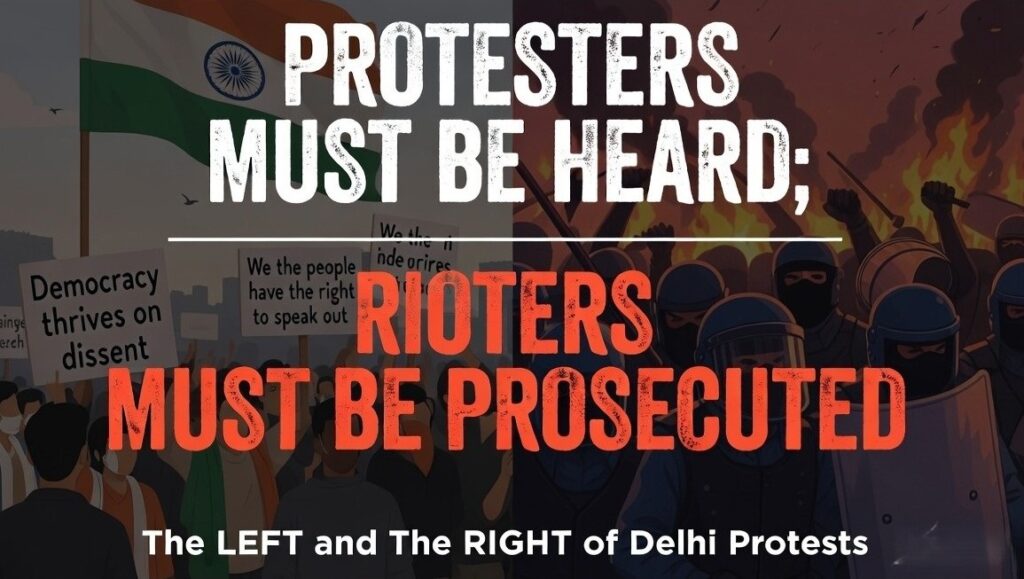
A democracy reveals its true character not in how it treats the compliant, but in how it treats the defiant. Every republic eventually faces a version of the same test: can it tell a citizen exercising dissent apart from a mob exploiting it? India is facing that test now, in city after city, and on the visible evidence, the State keeps failing it , not by cracking down too hard, but by quietly deciding it is easier to appease disorder than to confront it.
The Constitution Draws a Clear Line
There is nothing ambiguous in the text. Articles 19(1)(a) and 19(1)(b) guarantee every citizen the right to speak freely and assemble peacefully a right nobody seriously disputes, and one worth defending without qualification. But the same Constitution binds that liberty in the same breath: Articles 19(2) and 19(3) permit reasonable restrictions in the interest of public order and security, while Article 51A(i) imposes a duty on every citizen to safeguard public property, not destroy it. The Supreme Court has reaffirmed this consistently for over five decades — through Himat Lal K. Shah (1973), Ramlila Maidan (2012), Mazdoor Kisan Shakti Sangathan (2018), and the Shaheen Bagh ruling (2020). Each judgment, decades apart and under different benches, arrives at the same conclusion: peaceful assembly is protected; arson, obstruction, and intimidation are not. There is no constitutional grey zone in which burning a bus or blockading a hospital becomes protected speech simply because the person responsible also carries a college ID. A protesting student is a citizen exercising a right, worthy of protection. A rioting student is still a rioter, and the campus gate offers no exemption from the Penal Code. Age and enrolment are not legal defences for the act itself.
Innocence as a Costume
What is most troubling is not that violence occasionally erupts within large gatherings that risk has existed within every mass movement in history. What is new, and more corrosive, is the speed and discipline with which that violence is now repackaged as virtue before the dust settles. A cordon of camera phones rises before the first stone is thrown; a hashtag campaign is drafted before the first arrest is made. The “student” identity, once earned through genuine sacrifice in movements like the anti-Emergency protests of the 1970s, now functions less as a description of fact and more as pre-emptive legal armour worn not because it is always true, but because it reliably works. It works because institutions, universities, and even courts, wary of being branded authoritarian, frequently choose ambiguity over scrutiny, and silence over a clear verdict.
Contrast this with movements that built lasting moral authority through restraint. The nationwide grief following the Nirbhaya case moved millions without a single act of arson. The Anna Hazare mobilisation sustained its discipline for weeks under real provocation. Those movements earned legitimacy precisely because they refused to burn what they were trying to build. What is unfolding now inverts that formula entirely: legitimacy is claimed in advance, restraint is discarded on delivery, and the burden of proof is quietly shifted onto anyone who dares to question the label.
Surrender, Not Overreaction
The deeper danger, then, is not a State that cracks down too hard on rioters , it is a State that negotiates with them. Every time an administration quietly withdraws a case, drops charges, or offers concessions to a group because it turned violent rather than in spite of it, it teaches a lesson far more durable than any single policy announcement: disruption outperforms due process. A bus set on fire draws a ministerial visit within hours; a written appeal, filed patiently through proper channels, draws only a form letter months later. This is not tolerance it is the systematic training of an entire political culture in the grammar of coercion, a lesson that outlives any news cycle and will be relearned by the next group, of any ideology, watching closely.
The cost of that cowardice does not fall on the politicians who authored it. It falls on the police, ordered to hold the line and then abandoned there , praised for standing down, punished for enforcing the law they swore to uphold.
The Line Was Already Drawn
The Constitution settled this distinction in 1950, and the courts have sharpened it in ink, not pencil, ever since. The only institution still treating that line as negotiable is the government charged with enforcing it. So the question must be asked without flinching: is India governed by law, or by whoever shouts loudest and burns the most? A State unwilling to answer that clearly, before the next fire is lit, has already surrendered more ground than any mob could ever seize by force.
About The Author



Good analysis