
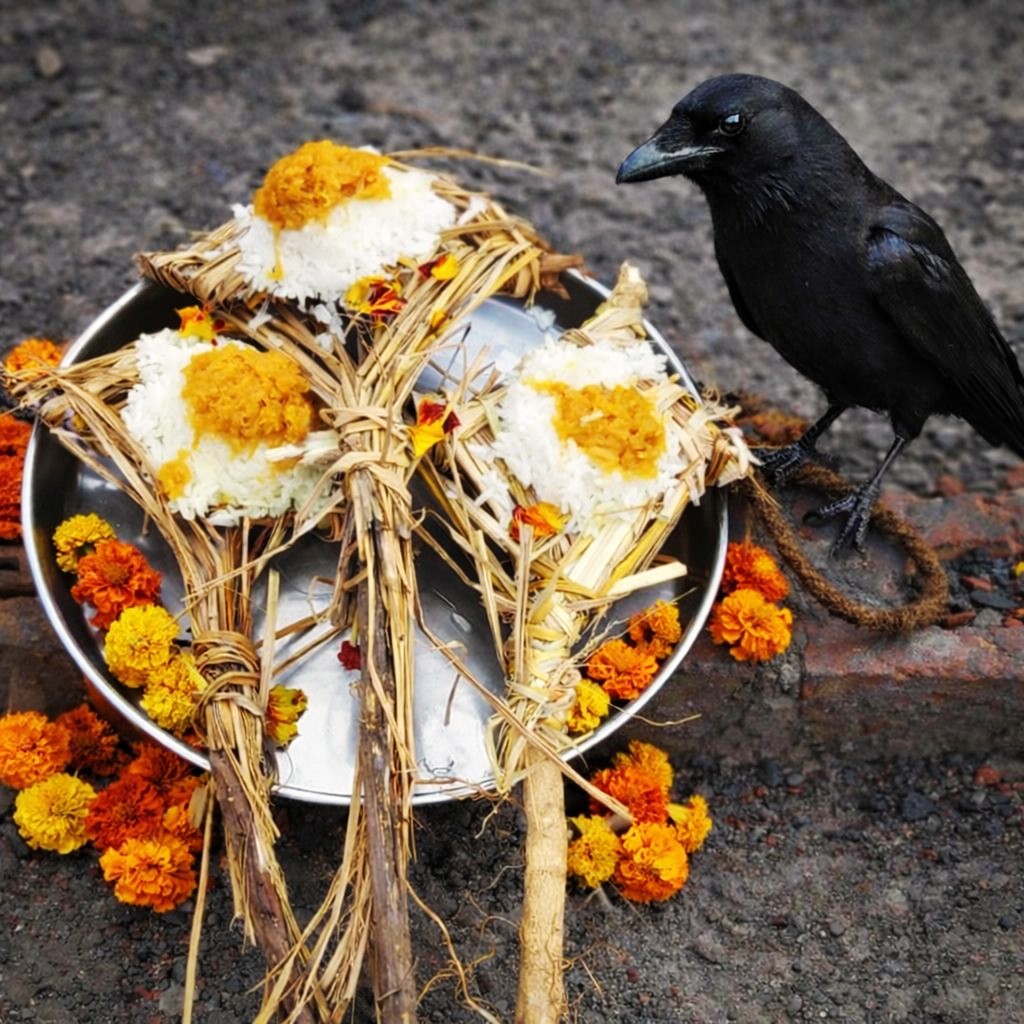
What if the deepest truths of Sanatan Dharma rest not in temple stones, but in the beak of a crow?
Nestled in the Himalayan sanctum of Kashmir, birthplace of Shaiva Advaita and Abhinavagupta’s luminous philosophy, the Kashmiri Pandits stand alone as custodians of Kaw Punim. This radiant festival, observed on the full moon of Magha, typically February, threads an unbroken lineage from ancient Kashmir’s Shaivite civilization to the eternal journey of Shri Ram across cosmic time. In an age of cultural dissolution, only these Pandits sustain this living bridge, embodying Vedanta’s essence: the non-dual unity of atman, ancestors, and the divine dwelling in every feathered form. What once was a much-awaited and sacred ritual is more of a symbolism in exile.
At the heart of this mystery lives Kakbhushundi, the crow-sage immortalized in Tulsidas’s Ramcharitmanas. Cursed into avian form by Sage Lomasha for a moment’s pride, he won Shiva’s grace and became an eternal Kak, witness to eleven Ramayanas and sixteen Mahabharatas. Blessed with mastery over time itself, Kakbhushundi chose to remain a crow forever, narrating Rama’s lila and fusing Shaivism with Vaishnavism in profound devotion.
But why a crow? In Sanatan wisdom, crows are pitru-messengers, vehicles of Yama, bridging yugas and unseen realms. To feed them invokes ancestral peace, wards off calamity, and echoes Kashmir’s Trika philosophy: all existence is Shiva’s sacred play.
Kaw Punim unfolds as poetic communion. Dawn breaks with women, keepers of this timeless rite, preparing khichri, rice-moong dal elixir, rice, and modur sweets, offered untasted until crows partake. Rooftops and courtyards become living altars; children’s voices rise in evocative invocation:
Kaw Bhatt Kawo, Khechrey Kawo,
Gangabala Sharana Karith,
Gurey Mechey Tyoka Karith.
Walbha Saney Larey Pyeth,
Dal Bata Khyene.
Meaning – O learned crow, khichri eater! Ganga-bathed, tilak-adorned, descend to our hearth for dal and rice.
A Kaw Paet, a polished wooden marker hung prominently, distinguished Pandit homes, signalling sanctity amid Kashmir’s rich cultural tapestry. This tradition springs from Kashmir’s golden Shaivite era, 8th to 12th centuries, when visionaries like Vasugupta revealed the Shiva Sutras, unveiling non-dual realization. Crows symbolized prana’s flow, ancestors as eternal witnesses. Daily offerings preceded the festival itself, embedding Vedantic reverence for all living beings. Even in exile after 1990, scattered across India, Pandits recreate it, urban rooftops echoing Valley winds, Delhi flats becoming Kashmir once more.
Yet Kaw Punim transcends ritual feeding: it breathes cultural resurrection. It honours nature’s divinity, renews pitru-paksha bonds, and revives Kakbhushundi’s wisdom, devotion persisting through cosmic cycles. Scholarly texts within the Kashmir Shaivism corpus link it to pralaya-renewal rites, where crows herald cosmic rebirth itself.
What stirs deepest curiosity: In Kakbhushundi’s cosmos of eleven Ramayanas, could the Kashmiri Pandits’ unwavering Kaw Punim hold keys to rediscovering our own timeless Ram? Their steadfastness, through valley upheavals and forced migrations, confirms them as true guardians of Sanatan, preserving Vedanta’s living essence against oblivion’s tide.
While Shree Ram and Mahadev hold the center of the global Sanatan epoch, the pivot still lies in the civilisational chasm of Kashmiri Pandits. What matters is whether the young generation of Kashmiri Pandits, born post 1990 still get to witness this definitive page of the most unique civilisation? Will they, in coming years, get a glimpse of eternity perched on a rooftop; beak aglow with sacred rice, a question wrapped in devotion, waiting for those curious enough to listen.
About The Author



Very informative 👍