
While we celebrate Digital India, 2.7 hours of daily screen time is systematically destroying our toddlers’ cognitive development and nobody’s watching
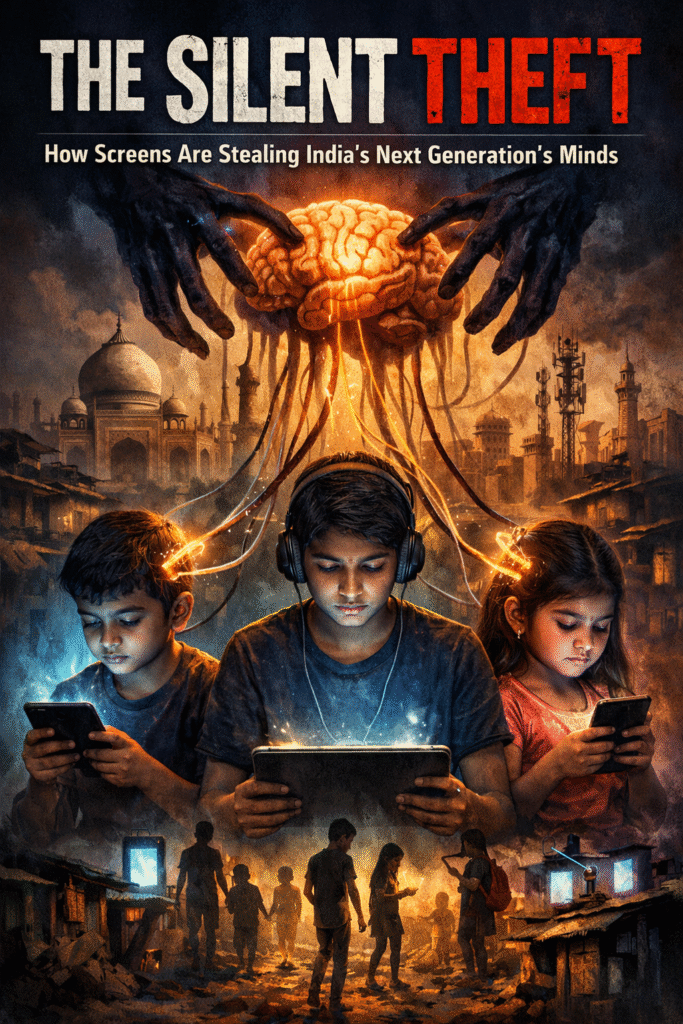
A three-year-old sits motionless in a Bangalore apartment, eyes glazed, finger swiping through endless YouTube shorts. Her parents celebrate,she’s finally quiet. What they don’t see is her brain rewiring itself, neural pathways pruning instead of proliferating, synaptic connections withering before they fully form. This isn’t just one child’s story. It’s 118 of every 177 Indian toddlers, with 66.67% of children aged 0-4 years exposed to excessive screen time, a cognitive crisis unfolding in millions of homes while parents scroll beside them.
For the first time since the 1800s, a generationGen-Zis measurably less intelligent than their parents. Dr. Jared Cooney Horvath’s testimony to the US Senate confirmed what neuroscientists feared: Gen-Z is “officially the first group to ever score lower than the generation before them, declining in attention, memory, reading and math skills, problem-solving abilities, and overall IQ. The decline began around 2010—precisely when smartphones invaded childhood.
India’s numbers tell a darker story. Average screen time among preschoolers reaches 2.7 hours daily, with only 17.2% meeting recommended guidelin. Among school children, 53.7% have excess screen exposure . Yet paradoxically, while only 0.54 million of India’s 1.48 million schools use digital learning systems the Digital India Education Program aggressively pushes tablets into classrooms,repeating Sweden’s failed experiment.
The commonality is global: Gen-Z spends over 9 hours daily on screens, with excessive exposure linked to lower performance in language and thinking assessments . India mirrors these patterns but faces unique vulnerabilities—massive digital divide, limited parental awareness, aggressive edtech marketing, and government policies prioritizing digitalization over developmental science.
The research reveals a devastating truth: human brains evolved for face-to-face learning, not fragmented screen stimulation. More than half a teenager’s waking hours are spent staring at scre, training brains for shallow processing, not deep thinking. Excessive screen time alters gray and white matter volumes, increasing risk of mental disorders and impairing memory acquisition potential precursors to early-onset dementia.
Solutions exist, demanding immediate action. Sweden reversed course, banning phones from schools, returning to textbooks, and implementing nationwide screen time guidelines: zero for children under 2, maximum 1 hour for ages 2-5, and 1-2 hours for ages 6-12 . Denmark, Norway, and Netherlands followed.
India must act decisively: mandate comprehensive screen time guidelines through the Indian Academy of Pediatrics framework; ban smartphones in schools nationwide; shift Digital India Education toward balanced technology integration; launch massive public awareness campaigns; incentivize outdoor play infrastructure; regulate edtech marketing to children; and fund longitudinal research on Indian children’s cognitive development.
Every hour a child spends hypnotized by a screen is an hour their brain doesn’t spend building the neural architecture for critical thinking, creativity, empathy, and resilience. We’re not just raising a generation with lower test scores we’re potentially creating millions of young adults vulnerable to manipulation, unable to focus, incapable of deep work, and ill-equipped for the complex challenges ahead. That three-year-old in Bangalore? She could become a brilliant scientist, artist, or leader but only if we rescue her brain now, before the damage becomes permanent. The question isn’t whether we can afford to act. It’s whether we can afford not to. Our children’s minds and our nation’s future hang in the balance.
About The Author