
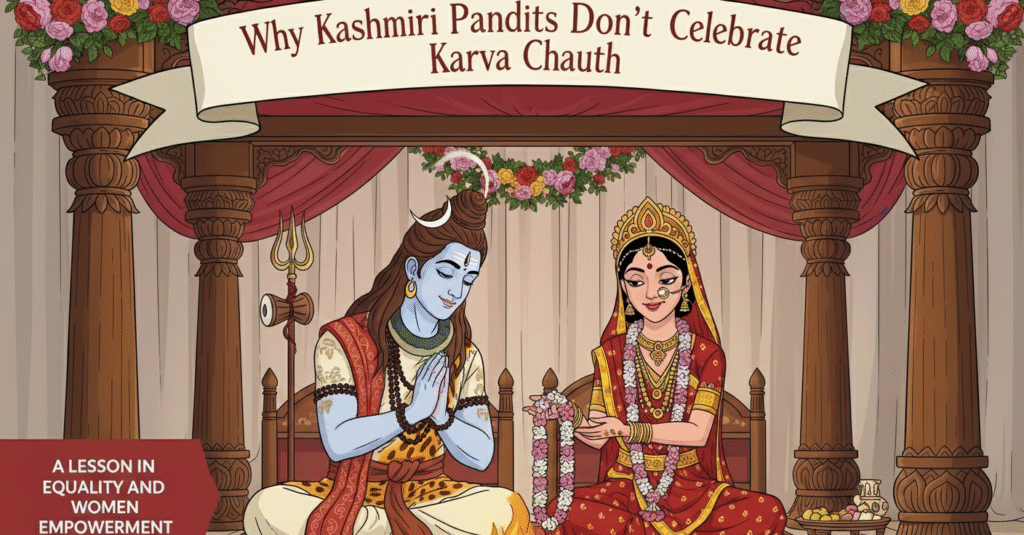
When the autumn moon rises and millions of Indian women break their day-long fast, gazing at their husbands through sieves, one community remains conspicuously absent from this pan-Indian ritual. Kashmiri Pandits don’t celebrate Karva Chauth,not from oversight, not from cultural drift, but from profound theological logic that challenges our very understanding of marriage, mortality, and divine partnership.
The Logic of Karva Chauth: Love Born from Fear
To understand Kashmir’s absence, we must first decode Karva Chauth’s presence elsewhere. This ritual emerged from India’s north-western warrior cultures :Punjab, Rajasthan, Haryana where men rode to battle with uncertain return. The logic was existential: a woman’s security, identity, and survival were entirely contingent upon her husband’s life. The fast became protective magic, a wife’s devotion transmuted into her husband’s armor.
The ritual’s architecture reveals this anxiety. The sargi (pre-dawn meal from mother-in-law), the day-long hunger and thirst, the moon-viewing through a sieve, the husband offering the first sip of water,each element reinforces a single theology: the wife preserves, the husband survives, and their bond is forged in dependency. It’s beautiful in its devotion, poignant in its vulnerability, and historically logical for communities where widowhood meant social annihilation.
But what if your civilization never encoded that dependency? What if your marriage theology began from a different axiom entirely?
The Kashmiri Counter-Logic: When the Bride is Parvati
Kashmir’s matrimonial philosophy doesn’t start with human relationships,it starts with cosmic ones. Every Kashmiri Pandit wedding is a deliberate reenactment of Shiva and Parvati’s marriage, the primordial union that predates human civilization itself. This isn’t metaphorical homage; it’s theological claim: the bride is Parvati incarnate, the groom is Shiva manifest.
Consider the logical cascade: If the bride is Parvati, the Shakti, the active force of creation, the power without which Shiva is Shava (corpse), then she cannot simultaneously be dependent on her husband’s mortality. Parvati doesn’t fast for Shiva’s life; she sustains his life. She is not the preserver; she is the generator. The feminine isn’t auxiliary to the masculine; it’s co-equal, co-eternal, co-divine.
The Ardhanarishvara form half Shiva, half Parvati,codifies this into iconography. God itself demonstrates that neither masculine nor feminine has primacy; both are required for completeness. The Kashmiri Shaiva texts make this explicit: Shiva without Shakti is inert consciousness; Shakti without Shiva is directionless energy. Marriage isn’t protection contract,it’s cosmic balancing.
The Ritual Logic: Symmetry as Sacrament
This theology permeates Kashmiri wedding rituals with surgical precision:
Posh Puza begins with worshiping the Divine Mother, not as intercessor but as primary deity. Feminine divinity isn’t supplementary; it’s foundational.
Devagaan songs explicitly address the bride as the goddess descending. She isn’t given away like charity (no kanyadaan),she arrives as divinity choosing partnership.
Athavasa purification occurs simultaneously for both bride and groom in separate locations. Neither waits for the other; neither is superior. The symmetry is absolute and intentional.
Jaimala exchange happens mutually. Neither garlands first; neither accepts subordinately. This is sambandha divya,divine conjunction between equals.
The logic is inescapable: if your entire wedding theology positions bride and groom as cosmic equals, then rituals of dependency become theological contradictions.
What Kashmir Preserved That Others Lost
Here lies Kashmir’s uncomfortable gift to modern discourse: the revelation that gender equality isn’t progressive achievement but civilizational memory. Karva Chauth emerged when societies organized around male mortality and female dependency. It made sense for warrior cultures, agrarian patriarchies, feudal structures where women’s lives were genuinely contingent.
But Kashmir’s intellectual tradition, producing philosophers like Abhinavagupta, mystics like Lalleshwari; maintained a different memory: that partnership precedes hierarchy, that equality is origin not destination, that the feminine is sovereign not subordinate.
Kashmiri widows retained property rights, temple access, and white garments, not through reform but through theology. A widow isn’t a “failed wife”; she remains Shakti. Death doesn’t terminate divinity.
The Question for Everyone Else
As Karva Chauth becomes Instagram aesthetic and #CoupleGoals content, Kashmir asks us to examine the logic we’re celebrating. Is it love or is it beautiful dependency? Is it devotion,or is it sanctified anxiety?
Kashmir doesn’t judge those who fast. But it offers an alternative logic: marriages founded not on protection but on completion, not on survival but on cosmic partnership, not on dependency but on mutual divinity.
In the end, Kashmiri Pandits don’t need Karva Chauth because their entire matrimonial system already contains what it seeks,and transcends it. When you’re reenacting the first wedding of the world, you need not borrow rituals from ages that forgot what marriage meant.
The moon rises. Somewhere, women fast and pray. In Kashmir’s memory, Parvati and Shiva dance :equal, eternal, complete.
About The Author


Thought, philosophy, and logic wonderfully articulated. Leaves no doubt and clarifies why KPs need not follow the borrowed ritual, even in exile. God Bless.
Thank you for your encouragement sir
Excellent explanation. But Fact is also that KarwaChowth has become popular today owing to the only glamourised display of affection, dedication, entertainment & cheer attached to it. It is more like a community festival with an annual couple renewal program.
Otherwise where have we learnt that a Fast is broken in restaurants ? Wearing shoes? Onion garlic feast ?
So today its not much of Spiritual importance in KarwaChowth. It is simply a celebration of love and bonding…..with mkts iteneries only increasing with time.
Kashmiri Shavism has deep spiritual roots. Our Shivratri Fast by both spouses is itself an example of inseparable devotion and equal energy exchange without fear.
Thank you !!!
KC is celebrated only in Northern India . Gujarat , Maharashtra or South India doesn’t have such festival. It is mainly the festival of Punjabis ( living anywhere, HP, Haryana, Jammu etc) and punjabis dominated the film industry, hence it gained importance in our Hindi films . But your article on KP is very much apt and the equality of man nd women , Shiva and Parvati is worth knowing. Thanks
Thank you Ma’am !
Good one.
Excellent
Thank you ma’am!
I was always wondering why KP’s don’t celebrate KW. Your article has answered my query aptly. Thanks a lot.
Thank you sir !