Beyond worship lies reunion; the intimate story of how Bengalis welcome Goddess Durga not as deity, but as beloved daughter
In the pre-dawn darkness of Mahalaya, when the world sleeps under autumn’s gentle embrace, millions of Bengali hearts beat in unison with an ancient rhythm. Like rivers flowing toward the sacred Ganges, families gather around crackling radios, their voices joining the ethereal chants of Chan dipath that have echoed through generations since the early 1930s. This is not merely a festival; it is the soul of Bengal awakening to welcome its beloved daughter home.
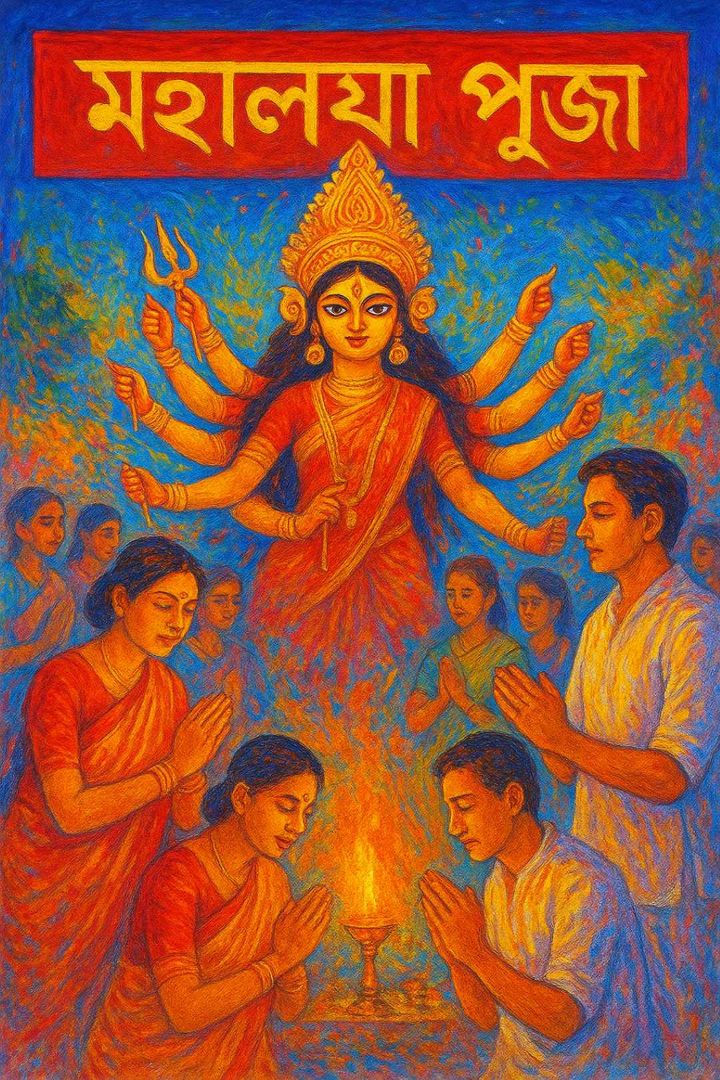
The story of Mahalaya unfolds like petals of a midnight lotus, born from celestial desperation. When demon Mahishasura’s arrogance shattered the heavens and darkness threatened to consume dharma, the trinity: Brahma, Vishnu, and Mahesh, breathed life into a divine storm. From their combined radiance emerged Durga, the invincible mother, her ten arms wielding justice like thunderbolts.
But for Bengalis, Durga is not merely the universal Divine Mother, she is their beloved daughter returning home. While the world may worship her as the supreme goddess, the cosmic force that governs creation, Bengali hearts beat with parental pride and longing. She is the daughter who left for her marital home in Kailash with Shiva, and Mahalaya marks her annual homecoming to her maa-er bari (mother’s house). This intimate relationship transforms worship into welcome, ritual into reunion.
Mahalaya is also a bridge between worlds, a day when the veil between life and death grows gossamer-thin. As devotees perform Tarpan, offering water and rice to their ancestors, the air itself seems to shimmer with the presence of departed souls. Like autumn leaves returning to earth, the spirits of our forebears descend to receive our love, transforming grief into blessing, memory into benediction.
The rituals of Mahalaya paint morning in sacred hues. Families wake before dawn’s first blush, gathering like moths drawn to tradition’s flame. The radio becomes a temple, and Birendra Krishna Bhadra’s voice, the golden throat of Bengal, transforms humble living rooms into hallowed halls.
In workshops across Bengal, artisans breathe life into clay with reverent fingers, painting the eyes of Durga Ma, the moment when divinity awakens in earthly form. This ritual, called “Chokkhu Daan,” is like watching a mother’s first glance at her child, tender yet fierce, protective yet liberating.
And then, like a clarion call piercing the morning mist, comes the soul-stirring invocation that awakens every Bengali heart:
“Jaago Ma… Jaago Durga… Dashaprohorinodhaarini Kaali
Jaago Tara, Ma Jaago Jagadhatri…”
These sacred words, flowing like honey from countless throats, don’t merely call upon the goddess,they summon her presence into every home, every heart, every corner of Bengal. The prayer becomes a bridge between the earthly and divine, each syllable a heartbeat in the collective soul of the community.
Since that transformative broadcast in 1932, Akashvani has become Bengal’s spiritual clock tower, marking not just time, but culture’s passage through generations. Grandmothers who first heard those sacred verses as young brides now listen alongside great-grandchildren, weathered hands teaching tiny fingers to fold in prayer.
This is our inheritance, this dawn vigil that transforms ordinary mornings into pilgrimages. In a world racing toward digital tomorrows, Mahalaya remains our anchor to something eternal.
As Durga Ma prepares to descend from Kailash, riding her lion through clouds of incense and devotion, she finds us waiting, not just as worshippers, but as her children who have never forgotten the way home. This year brings special celestial blessings, as Bengal’s beloved daughter and our Durga ma arrives on an elephant and will depart on a human (Nara),both auspicious signs that promise prosperity, rainfall, peace, and harmony to her earthly home.
In Mahalaya’s gentle embrace, we discover that tradition isn’t a chain binding us to the past, but wings that carry our culture toward tomorrow’s dawn. For in this sacred convergence of myth and memory, ritual and radio waves, we find not just our goddess, but ourselves eternal children waiting at the threshold of home.
News Trust India wishes Shubh Mahalaya to all.
video curtsey : DD archives
About The Author