
Beyond the Battle Lines: What a Cold January Morning in 1963 Teaches Polarised India
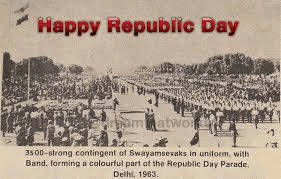
There is a story India refuses to tell itself.
Not because it is obscure. Not because the evidence is thin. But because it is inconvenient to nearly everyone : the left, the right, the liberal, the nationalist. It punctures too many comfortable mythologies simultaneously. And so, by unspoken consensus, it has been allowed to dissolve into the sediment of forgotten history, swallowed whole by a nation too polarised to digest what it actually means.
It is time to excavate it. Loudly. Without apology. And without letting either side claim it as a trophy.
The Wound That Exposed the Architecture
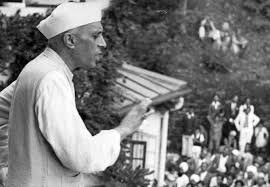
October 1962. China does not merely defeat India , it humiliates her. The Indian Army does not retreat; it collapses. Nehru, the great architect of non-alignment and civilisational confidence, is broken by the betrayal. Delhi convulses. The machinery of the Nehruvian state that carefully constructed apparatus of democratic institutions, planned economy, and secular nationalism buckles under the first serious test of existential pressure.
The state reaches for its instruments. They are not enough.
There are not enough trained hands. Not enough organised bodies. Not enough civilian infrastructure to absorb the shock of wartime mobilisation. The republic, for all its institutional ambition, has a structural gap at the civic level — the yawning distance between the government’s reach and the ground’s reality. And in that distance, in that dangerous, exposed silence between state capacity and national need, a different kind of citizen steps forward.
RSS volunteers appear at Delhi’s traffic intersections not summoned, not contracted, not waiting for a government circular. They appear because a nation is in crisis and they have been trained, for decades, for precisely this kind of moment. They move to railway stations. They coordinate civil defence. They hold the logistical seams of a capital city together while the bureaucracy scrambles to catch up.
No salary. No directive. No committee convened to deliberate whether this was the appropriate moment to serve.
They simply showed up. And that, in the winter of 1962, was everything.
The Architecture the State Could Not Build
Let us be precise about what this reveals because this is not a story about virtue. It is a story about institutional design, and it demands analytical honesty rather than political convenience.
The RSS had spent decades constructing something that democratic governments, by their very nature, struggle to build: a decentralised, ideologically motivated, civic-level volunteer network capable of activation within hours. While political parties calibrated their messaging and bureaucracies processed their approvals, swayamsevaks were already on the ground. Their organisational infrastructure was not a product of state funding or electoral incentive. It was the product of long, patient, ideologically driven civic investment the kind that only voluntary movements, not governments, can sustain across generations.
This is a structural observation, not a political endorsement. The RSS’s ideology can be and is legitimately contested across the full spectrum of Indian democratic debate. But organisational capacity is not ideology. It is a fact. And in October 1962, that fact mattered more than any position Nehru held or the RSS contested. The state, to its lasting credit, recognised this.
That recognition is the most underappreciated act of statesmanship in independent India’s early history.
The Morning That Rewrote What Was Possible
January 1963. Republic Day. Rajpath.
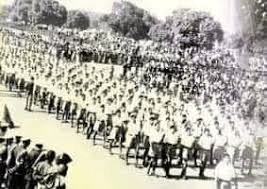
Thousands of RSS volunteers march in the national parade past the constitutional leadership of India, in full public view, on the most ceremonially charged day the republic observes. Nothing about the political relationship has been resolved. Nehru has not revised his assessment of RSS ideology. The RSS has not softened its critique of Nehruvian secularism. The civilisational disagreements between them about national identity, the role of religion in public life, the very idea of India remain as fundamental and irreconcilable as ever.
And yet the state extends recognition. Publicly. Ceremonially. Unambiguously.
That is not weakness. That is the rarest form of political strength the institutional confidence to separate a movement’s ideology from its civic contribution, and to honour the contribution without capitulating to the ideology. It is the mark of a state secure enough in its own foundations to acknowledge excellence in its adversary. It is, in the truest sense of the word, the mark of a civilisation that intends to survive.
History swallowed this moment. It should not have. It must not continue to.
The Witness History Did Not Forget – Even If We Did
There is one more thread to this story. One that removes any remaining doubt about whether this moment actually happened and about what it meant to those who witnessed it firsthand.
On the 31st of March, 1998, late Prime Minister Atal Bihari Vajpayee rose in the Lok Sabha and, in the course of his address to the nation’s highest legislative chamber, fondly and deliberately recalled this very incident. He spoke of Nehru’s decision to invite RSS volunteers to march in the 1963 Republic Day Parade — not as a political point, not as partisan ammunition, but as a testimony to a moment of genuine national grace that had lodged itself in his memory across three and a half decades.
(Atal ji’s speech, in his own words: https://www.youtube.com/shorts/OnqABhYymck)
Think about what that means. Vajpayee a man who had lived through the ideological battles of that era from the opposite trench, who understood better than almost anyone the depth of the chasm between the Nehruvian Congress and the RSS chose to remember this moment not with bitterness, but with admiration. He did not weaponise it. He did not trivialise it. He honoured it for what it was: proof that India, at its best, is capable of something larger than its arguments.
That a Prime Minister from the RSS’s own ideological tradition chose to publicly celebrate Nehru’s magnanimity rather than erase it is itself a lesson in statesmanship that contemporary politics, on every side, has comprehensively failed to absorb.
If Vajpayee could salute Nehru’s courage across the full width of their ideological divide, what exactly is our excuse?
The Distance Between 1963 and Now
Now look at where we stand.
Contemporary India has constructed, with remarkable thoroughness, a political culture that makes exactly this kind of recognition nearly impossible. The operating logic of today’s polarisation is binary and totalising: if you acknowledge your opponent’s competence, you have endorsed their worldview. If you accept their help, you have surrendered your principles. If you march beside them, you have become them.
This is not merely intellectual poverty. It is civilisational fragility dressed up as conviction.
A democracy that cannot mobilise across ideological lines in a moment of genuine national need is not a democracy that has found its identity it is a democracy that has confused its arguments for its foundations. The arguments are real. The disagreements are legitimate. But they are not the foundation. The foundation is the shared willingness, when the country bleeds, to ask not who is marching beside you, but whether the march is necessary.
In 1963, a wounded, humiliated, politically divided India asked the right question. The answer walked through Delhi’s streets in khaki, stood at its traffic intersections without being asked, and marched down Rajpath without demanding credit.
In 2025, we seem incapable of even formulating the question.
The Demand History Makes of Us
This is not nostalgia. Nostalgia is comfortable and useless. This is a structural argument about democratic resilience the kind built not in parliaments or prime-time debates, but in the long, unglamorous, ideologically uncomfortable work of civic cultivation across enemy lines.
The march that history swallowed must be spat back out not as a political weapon, not as revisionist ammunition for any camp, but as a mirror. A hard, unsparing mirror held up to a nation that has forgotten what maturity looks like, what statesmanship demands, and what survival actually requires.
The 1963 Republic Day Parade was a single, clear-eyed act of national acknowledgment the state declaring, in the most public terms available, that service rendered in good faith deserves recognition regardless of the banner under which it was rendered. That act required something in dangerously short supply today: the institutional confidence to distinguish between an adversary and an enemy, and the political courage to honour one without becoming the other.
Every generation inherits a republic. Not all of them deserve it.
About The Author


Well articulated and thought provoking, reminding the citizens of the unity in diversity. Attending to the need of the Nation is what matters. NATION should come first. Diversity in a Democracy has to learn not to rock the boat which is used to sail through the course of our existence. Let us pool our diverse and unique strengths to build the Nation.