
1,658 deaths in 2,000 cases by 2024 and a licensing system that has never once measured the one variable behind them:Absent Mental Health Evaluation.
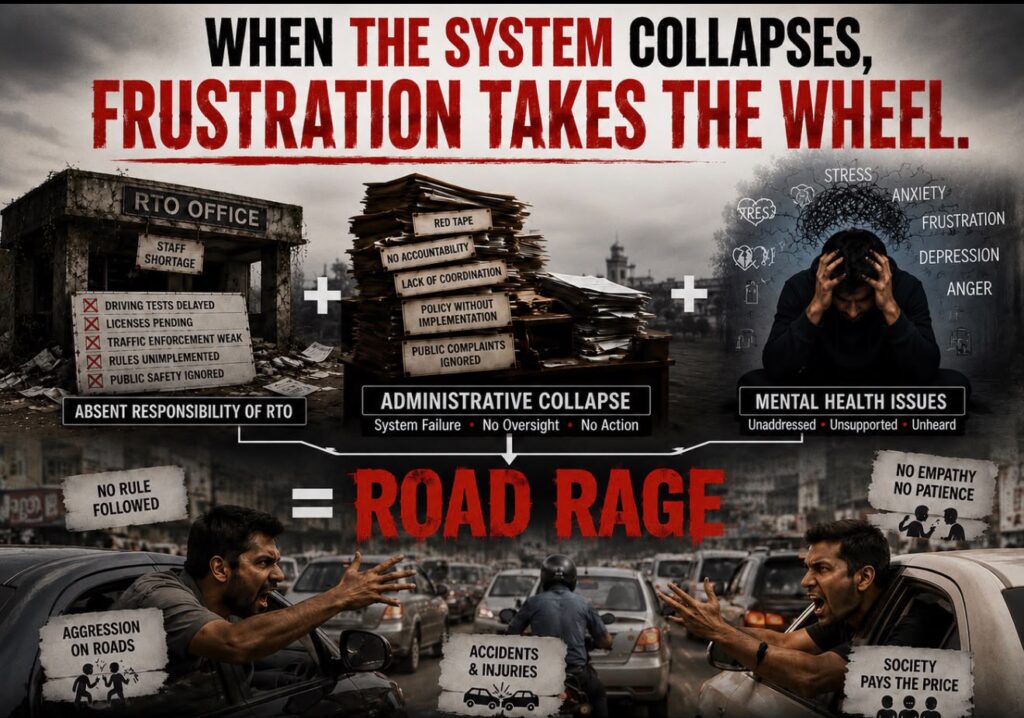
He didn’t hit the man by accident. He reversed onto him. Then he did it again. This is not hypothetical; it is footage that exists, filmed on a Delhi NCR road, over a dent no bigger than a fist. Somewhere in the space between “you scratched my car” and “I will kill you for it,” an ordinary commuter turned a Maruti into a murder weapon, and nobody stopped him because nobody was ever asked to check, before handing him the keys, whether he was capable of making that leap.
This is the sentence that should embarrass every transport authority in the country: in Delhi NCR, a two-tonne machine capable of ending a life in under a second is handed to any adult who can parallel-park, on the same afternoon he applies for it. No psychologist screens him. No panel questions him. The only qualification tested is whether his hands can steer, never whether his mind can hold together the moment someone disrespects him at a red light. And so, every year, a fresh batch of untested tempers is set loose on roads engineered for maximum friction: heat, gridlock, honking, and now, weapons on wheels.
This Is a Mental-Health Event, Not a Traffic Offence
If you refer to and study the several research papers and studies conducted in India on these road events, they consistently point to a combination of factors: anger-proneness, repeated exposure to traffic violations, congestion, and hot, humid weather converging to trigger an aggressive response in certain drivers. So the question must be asked firmly who is actually responsible for this? Is it the government, for failing to regulate who gets behind the wheel? Is it society, for normalising road aggression as “just how Delhi drives”? Is it the family, for never instilling discipline or emotional control in the first place? Or is it simply the weather, an excuse we reach for because it’s easier than admitting the system failed? Or do we, as a society and a state, actually want to fix this forever , not manage it, not explain it away, but end it?
Indian studies on driver anger are precise on this point: honking, wrong-side overtaking, humid heat and congestion measurably spike anger scores in “high-angry” drivers, who then respond with verbal abuse, refusal to yield, and physical aggression a response profile that mirrors clinical descriptions of impulse-control failure under stress, not casual rule-breaking. Younger drivers score higher on anger; personality traits predict both aggression and crash involvement. Strip away the traffic setting and what remains is a person whose emotional regulation collapses under provocation ,the road is simply the stage on which a pre-existing mental vulnerability gets triggered. Delhi logged 5,387 accidents and 1,412 deaths in 2022, climbing to 5,715 accidents and 1,457 deaths in 2023, and 1,658 fatalities from 2,000 cases by 2024 a trajectory that tracks a psychological problem being treated as a purely infrastructural one.
And yet the Regional Transport Office the single gatekeeper standing between this vulnerability and a two-tonne weapon checks none of it. Its entire licensing process tests one thing: can you steer, brake, and park. It has never once asked whether the applicant can hold his temper at a red light. That omission isn’t a technicality; it is the accountability vacuum at the centre of this crisis. An RTO official who issues a license today carries zero downstream responsibility for what that license-holder does on the road tomorrow, because the process was never designed to measure the one variable that actually predicts road-rage risk.
Splitting the RTO in Two
The fix is structural, not sentimental. The licensing authority should be split into two independent arms. First, a rotating panel of psychologists, psychiatrists and behavioural experts sitting under a separate administrative head so it can never be quietly influenced by the RTO it reports into interviews and assesses every applicant for stress-handling, impulse control and temperament, grading them Safe, Moderately Safe, At-Risk, or High-Risk. Only after this report exists should the RTO proceed to test driving ability. Once a documented mental-fitness rating sits on file, the RTO can finally be held accountable not for a person’s driving skill, which is easy to test, but for having let a documented high-risk profile onto the road, which is not.
Consider the standard we already accept elsewhere: a soldier who fires accurately on a training range is not sent to the front line on that basis alone. His stress-handling is honed, tested and re-tested precisely because everyone knows that firing under real threat is a different act altogether from firing in a controlled room. We trust that soldier with a weapon not because he can shoot, but because his mind has been drilled to hold together when it matters. No Delhi driver armed with a car capable of killing as efficiently as a rifle is asked to clear any equivalent bar. This is precisely why UAE drivers, even after high-speed collisions, are documented standing calmly by their vehicles waiting for the police to arrive and issue a damage report no mechanic will touch a car without one, and fleeing or assaulting turns a traffic dispute into a criminal case with jail time and deportation on the table. It isn’t that Emirati drivers are calmer people; it’s that their system dispenses fast, certain, equal justice, and their learner’s licence process is famously rigorous, often taking the better part of a year. Compare that to India, where a learner’s licence can be obtained in weeks and, as anyone who has dealt with an RTO agent knows, sometimes for the cost of a few notes handed under the counter.
Driving and Driver’s License Must Be A Privilege, Not a Right – And an Increasingly Expensive One to Get Wrong
This isn’t hypothetical laxity. It shows up as visible ignorance on the road: drivers who don’t know that incoming traffic from the right has priority, that vehicles climbing an incline must be let through first, or basic lane discipline rules a genuine test would have caught in minutes. When a licensing process can’t even certify knowledge this elementary, it has stopped being a test and become a formality. Driving was never meant to be a right; it is a conditional privilege, granted because a person is judged fit to operate a machine that can kill. That logic mattered less when few people drove. It is existential now, with metros, Tier-1 and Tier-2 cities alike swarming with private cabs, radio taxis, e-rickshaws, delivery two-wheelers and autos, a vehicle density that makes every uncertified temperament on the road a compounding public risk. The privilege needs to be made harder to earn precisely because it has become harder to avoid encountering someone who hasn’t earned it.
A scientifically designed pre-driving licence evaluation integrating psychometric, cognitive and mental health assessments can transform road safety by identifying high-risk behaviours before individuals enter the road network. Evaluating emotional regulation, impulse control, judgment and risk perception alongside driving skills promotes responsible, defensive driving and reduces road rage, accidents and fatalities. Better driving habits improve fuel efficiency, lower emissions, and contribute to climate change mitigation while reducing healthcare, insurance and infrastructure costs. A robust licensing system fosters civic responsibility, strengthens public trust in governance and creates safer roads, sustainable mobility and a more disciplined transport culture. Effective driver licensing is therefore a cornerstone of a safer, greener and more prosperous society.
The Question Nobody in the Mob Answers
And here is the final, damning irony: road rage resolves nothing. It doesn’t repair the dented bumper, doesn’t compensate the injured, doesn’t impose a lawful penalty on whoever was at fault. It delivers no justice and no redress only injury, sometimes death, and a viral video. If road rage achieves none of what an actual remedy would, its persistence proves it was never about the collision at all. It was always about an untreated mind finding an outlet, on a road that never asked if that mind was fit to be there.
(AI-generated image)
About The Author