Applications crash from 40,000 to a mere 2,000 as bureaucratic maze, missing layout plans, and a portal that can’t even list all 1,511 colonies leave ownership rights on paper alone.
Guest Author: Maharaj Shah
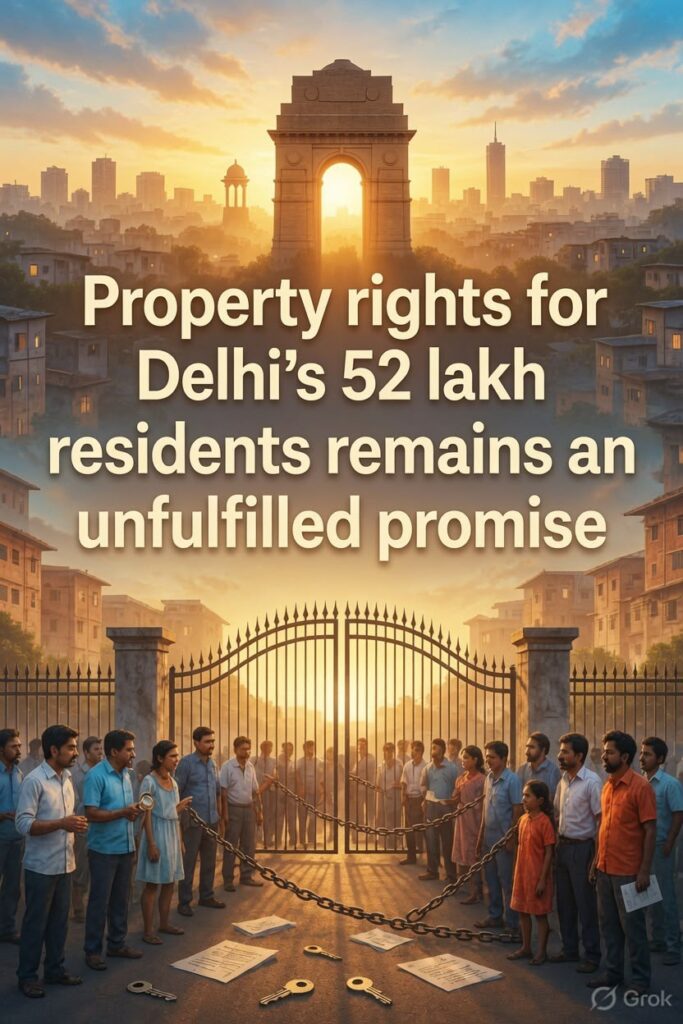
The PM-UDAY Act was passed by Parliament and came into force in December 2019 with the stated objective of conferring ownership rights on nearly 52 lakh residents living in 1,511 unauthorized colonies in Delhi. Before that, in 2008, the Congress government had issued provisional regularisation certificates to these colonies, raising hopes that residents would finally receive legal ownership of their properties.
Unfortunately, despite the initiatives of two successive governments, the core objective has remained elusive. The residents have still not received meaningful and enforceable property rights because of serious deficiencies in the policies and their implementation.
I have been consistently trying to draw attention to the glaring shortcomings of the PM-UDAY Scheme. Regrettably, while millions of people continue to struggle with these issues, the mainstream media remains preoccupied with politics, crime, and shallow entertainment. Matters that directly affect the lives of ordinary citizens seldom receive sustained coverage.
The implementation of PM-UDAY has been disappointing. Between December 2019 and April 2026, only about 40,000 residents applied for property rights. The Delhi Development Authority (DDA) issued conveyance deeds and authorisation slips to these applicants. However, many later discovered that these documents did not resolve the most fundamental issue—the absence of approved layout plans. Without approved layout plans, the conveyance deeds failed to provide complete legal certainty, leaving many residents disillusioned and discouraged.
The situation has deteriorated further. Since April 2026, only around 2,000 applications have reportedly been submitted. This dramatic decline reflects the growing frustration of residents with a process that is cumbersome, slow, exhausting, and offers little assurance of a meaningful outcome.
The problem lies not with the residents but with the system itself. The entire procedure is unnecessarily complex, involving multiple government agencies and layers of verification that make it almost impossible for ordinary citizens to navigate efficiently.
Even the MCD’s Swagam portal, which is meant to facilitate the process, does not display all 1,511 notified unauthorized colonies during registration. Such glaring administrative and technological deficiencies make it unfair to blame residents for the poor response to the scheme.
In my view, if the Government is genuinely committed to granting property rights, it must adopt a far simpler and more practical approach. All notified unauthorized colonies should be declared freehold, irrespective of whether they stand on government or private land. Residents should be permitted to register their properties through the competent court by producing documents such as the General Power of Attorney (GPA), Agreement to Sell, Possession Letter, Money Receipt, Will, and other relevant ownership records.
The only technical verification required should be a GIS-based confirmation that the property falls within the officially delineated boundary of the notified colony. Once this is established, there should be no further bureaucratic hurdles.
The Government must also remove all legal and administrative encumbrances that obstruct the implementation of the PM-UDAY Act. Unless the process is fundamentally simplified and the deficiencies are rectified, the promise made to nearly 52 lakh residents of Delhi will remain unfulfilled.
The time has come to move beyond announcements and statistics. What the residents of Delhi’s unauthorized colonies need is not another policy promise, but genuine, enforceable, and hassle-free property rights.
Note: The Author, Mr Maharaj Shah, is a senior academician, writer, Producer, and Director who has held several distinguished faculty positions in media at leading educational Institutions and Universities. Views are personal

About The Author