Why the new Ramayana risks becoming a spectacular event and an ordinary success
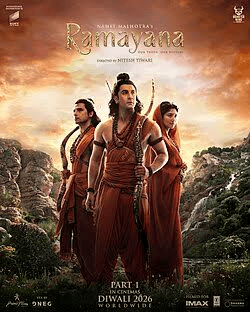
The most dangerous rival to the new Ramayana is not Shah Rukh Khan’s King, Marvel’s Avengers: Doomsday or the monumental world of Dune. It is an ageing television serial whose images have faded less than its audience’s affection.
Ramanand Sagar’s Ramayan, first broadcast in 1987, set a benchmark that contemporary filmmakers can easily misread. Its achievement was not just bringing a revered story to television. It found a production language that let audiences inhabit that story: emotionally direct performances, recognisable relationships, patient storytelling, and music that travelled beyond the episode into everyday life. Its technology aged. Its relevance survived.
That is the challenge facing Nitesh Tiwari’s adaptation, because improving how a world looks is not the same as deepening how it feels. My advance assessment is sceptical. The film may command a formidable opening and still deliver a lukewarm outcome against the scale of its expectations. This is neither a forecast of financial failure nor a review of an unseen film. It is a warning about misalignment between what is being advertised, the emotional character of the story, and the conditions that lasting theatrical success requires.
What the old serial understood
Sagar’s production was not flawless, and older technology carries no moral superiority. The serial’s attractions simply never depended on hiding its limits. Its emotional offer was clear: duty, separation, devotion, sacrifice and consequence. A palace matters because leaving it costs something. A forest matters because exile alters relationships. A battle matters because the audience knows what was endured before the first weapon was raised. Without that foundation, a grander palace is merely more architecture.
The epic certainly permits spectacle. Its deepest dramatic resource, however, is power disciplined by obligation. The question is not what Rama can do but what he accepts he must do, and at what cost. A film that makes its characters more formidable while making their conflicts less intelligible has not modernised the epic. It has simplified it.
A ₹5,066-crore thought experiment
The 2020 lockdown rerun shows how durable that approach was. Contemporary reporting put the first four transmissions at roughly 170 million viewing instances and 6.9 billion viewing minutes. A later April 16 broadcast reportedly drew 77 million. Suppose each of those viewings had cost a ticket at PVR INOX’s reported July–September 2026 average of ₹298, which is a multiplex benchmark and not a national average. On that basis, the first four transmissions equal ₹5,066 crore in hypothetical ticket value, and the April 16 broadcast equals ₹2,294.6 crore. A Tilak upload of Ravindra Jain’s “Mangal Bhavan Amangal Hari” has about 10 million views, which would equal ₹298 crore. That upload is labelled a “Shri Ram Leela Special”, though, so it is not a verified extract from the serial.
These figures are illustrations, not revenue, and they should not be added together because the periods, audiences and works overlap. Free viewing does not prove anyone would pay for a ticket, and confinement and nostalgia clearly helped. The central fact still stands. Audiences spent enormous amounts of time with visibly dated material from a show nearly forty years old. They felt no suspense about the effects or the events. What drew them was recognition, an emotionally legible relationship with a familiar story. A new adaptation therefore faces a harder question than “Can we show this more convincingly?” It must ask whether it can make the story worth experiencing again, in this particular form.
A song can outlive a spectacle
Television gathers people around a schedule. On-demand viewing lets them return to a single fragment: a scene, a song, a devotional moment. Not every chaupai in the serial is a measurable hit, and the serial did not originate verse it inherited from the Ramayana and the Ramcharitmanas. What it did was place music inside the story’s emotional structure, so that songs expressed grief, reverence and reassurance instead of decorating scenes. A thunderous score makes a scene feel important for five minutes. A composition listeners return to outlasts the scene itself. The new film may achieve this, but no campaign can prove it in advance. Visibility can be purchased. A habit must be earned.
The wrong lesson from the blockbuster
Ramayana need not refuse the ambition of Baahubali, RRR or Kalki 2898 AD. The error lies in treating that ambition as a transferable formula. Nor do some stories suit CGI while others do not, since the Mahabharata or The Odyssey can be diminished just as easily. The real issue is emphasis. Exile cannot be merely a route to grander landscapes, and Sita cannot be only the reason for a rescue. Hanuman’s devotion cannot shrink to the scale of an entrance, and Rama’s restraint cannot vanish beneath yet another triumphant image. If those things happen, the result is a costly illustrated summary of a story audiences already know.
Adipurush is a warning rather than a verdict on the genre. Audiences have not rejected every technologically ambitious retelling of a sacred story. They do require a visual interpretation to earn their acceptance, and spending more does not settle questions of tone or character. Being “better than the last attempt” would be an impoverished standard. The real benchmark is the expectation Sagar’s serial has satisfied for decades.
The ninety-day illusion
At this point the artistic problem becomes a commercial one. Some forecasts assume thousands of screens, steady occupancy and an uninterrupted ninety-day run, which treats available time as if it were guaranteed earning capacity. In practice, screens shift, and a film can slide from several prime-time shows to a single inconvenient slot. An honest forecast lets the number of shows, their quality and attendance fall together. It also separates gross collections from what exhibitors, distributors and producers actually keep, and reported negotiations involved revenue shares that changed week by week. Trade reporting also raised concerns that a runtime of about three hours and fifteen minutes could reduce daily shows at some single screens.
The calendar adds pressure. Avengers: Doomsday and Dune: Part Three are reportedly set for December 18, Angry Birds Movie 3 for December 23, King for December 24 and Jumanji: The Open World for December 25, though dates may change. These films target partly different audiences, yet all of them compete for showtimes, premium formats and attention. No rule says King will strip 60–70% of Ramayana’s screens. Exhibitors simply back whichever film earns more from a given slot. A well-attended holdover survives this competition, while a weakly attended film loses shows regardless. That is why audience endorsement has a commercial value that advertising cannot sustain.
PVR INOX is optimistic that a strong slate will grow attendance, and that is fair, but a good season for cinemas does not guarantee a good outcome for every film. The film could follow one of three paths. It might be a front-loaded event that fades fast, a respectable hold that falls short of exceptional expectations, or a genuine breakout. If spectacle leads the film, the second path looks likeliest, with a real risk of the first. A breakout needs what no campaign can prove in advance, which is that the film moves people.
What remains when the machinery stops
Sagar’s Ramayan is not untouchable, and nostalgia should never censor reinvention. Its lesson is more demanding: the right approach keeps its value long after the technology ages. The new film will be tested in its quietest moments. Can a farewell hold attention without orchestral insistence? Can Sita’s experience register beyond the rescue? Can Rama’s choices feel difficult rather than predetermined? If they can, the technology will magnify something alive. If they cannot, it will magnify the absence. A powerful opening can hide that absence for a weekend, but not for ninety days.
A billion pixels can build a kingdom.
They cannot make an audience miss it.
About The Author