
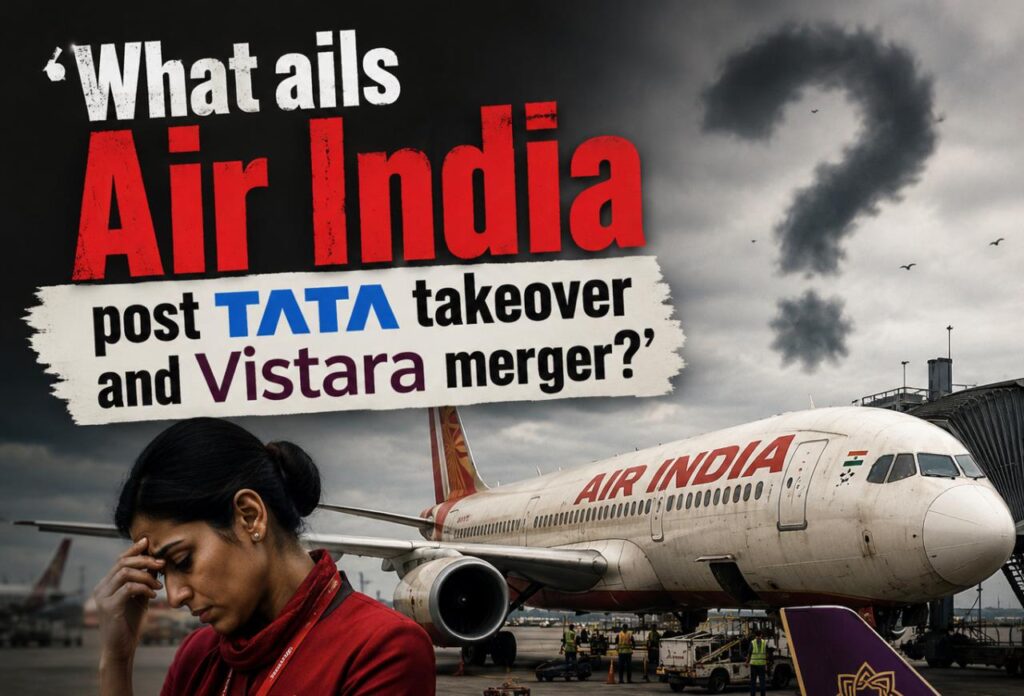
Here is a moment, small and maddening, that tells you everything. You sit at the Air India booking page frequent flyer number entered, identity confirmed, loyalty status recognised and the countdown clock begins. Seconds draining away while the airline that holds your passport details, your travel history, and your accumulated miles asks you to type your city, your state, your pincode, your country. One field at a time. As if you had never flown before.
This is not a complaint. It is a diagnostic. Vistara had solved this years earlier enter your frequent flyer number and the system recognised you instantly, filled your details, moved you forward without friction. That was not a feature. It was a philosophy. And its disappearance from Air India’s booking experience, post-merger, is the clearest possible signal that something has gone badly wrong in what was supposed to be India’s greatest aviation transformation.
When Tata completed the Vistara merger in November 2024, the strategic logic was compelling and the division of strengths was obvious. Air India brought backend scale a vast network, historic slots, international routes, and the infrastructure of a full-service national carrier with deep Europe operations. Vistara brought customer delight , a lean operating culture, intelligent booking systems, premium service instincts, and organisational nimbleness that made passengers feel genuinely valued. The merger was supposed to combine both: Air India’s reach with Vistara’s refinement. Instead, what has visibly happened is the reverse. Air India’s legacy weight has absorbed Vistara’s lightness, and customer delight the one differentiator Vistara reliably delivered has quietly taken the backseat. The quality of experience, by measurable evidence, is not improving. It is decreasing.
The numbers make this impossible to dismiss. Air India is running annual losses of approximately ₹28,500 crore. It is negotiating with Airbus and Boeing to defer deliveries of as many as 500 previously ordered aircraft, pushing back large payments due upon each arrival. Routes are being pruned. Airport launches postponed. Pakistan’s airspace closure, the US-Iran conflict disrupting international flight paths, and a weakening rupee have compounded the damage , but these are external shocks. Airlines with strong operating cultures absorb external shocks more efficiently than airlines still assembling one. The geopolitical storm did not create this fragility. It exposed it.
The question these numbers demand is not whether the turnaround is difficult. It is whether Tata’s Air India has been fixing the right things, in the right sequence, with the right people in charge.
Here is where the diagnosis sharpens and where named decisions matter. Tata approached Air India first as a corporate transformation project rather than as a safety-sensitive, operationally intensive airline. The early leadership composition made this unmistakable. Nipun Aggarwal, appointed Chief Commercial Officer, came from an investment banking and Tata Sons background, having been central to the acquisition itself. Dr. Satya Ramaswamy became Chief Digital and Technology Officer directly from Tata Digital. The HR function perhaps the most consequential role in shaping frontline airline culture was led first by Dr. Suresh Dutt Tripathi from Tata Steel, then by Ravindra Kumar G.P. from Tata Motors. None of these executives lacked capability. What they lacked was aviation as a formative instinct. And in an airline, instinct is not a soft asset. It is the operating system.
The IT story reinforces this imbalance sharply. Widely circulated claims suggested Vistara operated with as few as 56 people in its IT function a figure that, on scrutiny, appears to refer to a separate entity called Vistara IT Solutions rather than the airline’s internal department. Similarly, the often-cited figure of 1,200 people at Air India’s Kochi tech centre appears to describe planned seating capacity, not confirmed headcount. The deeper issue, therefore, is not raw numbers but what those numbers were pointed at. Air India’s technology investment was heavily anchored in customer-facing digital experience : apps, chatbots, cloud migration rather than in the maintenance systems, crew scheduling platforms, and safety-critical operational workflows that determine whether an airline actually works. That misalignment between where technology was deployed and where it was most needed is a precise reflection of the broader strategic error.
There is one detail that captures this dislocation more vividly than any organisational chart can. Air India’s technology centre in Kochi cited as housing a team of approximately 1,200 people is reportedly led by a technology head operating out of San Francisco. This is not, by itself, a disqualifying arrangement; remote and distributed leadership is a reality of modern enterprise. But in an airline, where technology must be intimately calibrated to operational ground reality terminal conditions, baggage system failures, check-in disruptions, crew management exceptions , the distance between leadership and execution carries a different weight than it does in a software company. When the person setting the technology agenda is twelve time zones and a continent away from where that technology is being stress-tested daily, the risk is not incompetence. It is a gradual, almost invisible misalignment between what the system is built to do and what the operation actually needs it to do. Whether that gap exists at Air India is a question only an internal audit can answer but the question itself deserves to be asked, openly and without defensiveness.
Aviation specialists were eventually brought in Capt. Klaus Goersch in a senior operations role, Jayaraj Shanmugam as Head of Global Airport Operations. But the very need for these later corrections confirms what the early appointments implied: that airline-native depth was underweighted in the phase when culture, habits, and institutional reflexes were being reset. You cannot recover that window entirely. The habits formed in the first years of a transformation tend to persist.
The safety record converts strategic concern into genuine alarm. Regulatory notices, pilot fatigue violations, and overdue equipment inspections had already signalled that the transformation had not penetrated Air India’s engineering and control environment the invisible layer of an airline that passengers only notice when it catastrophically fails. Then came the fatal crash, the gravest reputational crisis of the Tata era. No quantity of redesigned apps or AI-powered service tools neutralises a weakness in maintenance culture. The decision to defer 500 aircraft is not merely financial. It is a confidence signal a quiet acknowledgement that the operational foundation is not yet ready to support the ambition so boldly ordered.
Tata’s Air India is not failing for lack of capital or intent. It is failing because the transformation has consistently prioritised what is easy to announce over what is hard to build brand narrative over operational nerve, digital investment over engineering depth, managerial renewal over aviation-cultural renewal. In absorbing Vistara, Air India gained its routes and registrations but not the operating temperament that made Vistara admired: the leanness, the accountability clarity, the reflexive respect for the customer’s time that meant a booking form never asked you what city you lived in.
Premium airlines are built from the inside out from the engineering bay outward, from the rostering system upward, from frontline crew instincts into the experience a passenger finally receives. Until Air India places aviation-native judgment at the center of its people systems, engineering leadership, and operational control, the merger’s promise remains structurally inverted: backend scale, yes customer delight, retreating.
The pincode field is still waiting. And ₹28,500 crore is still asking a question that a chatbot cannot answer
About The Author


We need bold analytical approach to critical issues, which matters to the Nation and the Public. The article exactly deals with that. A timely input.