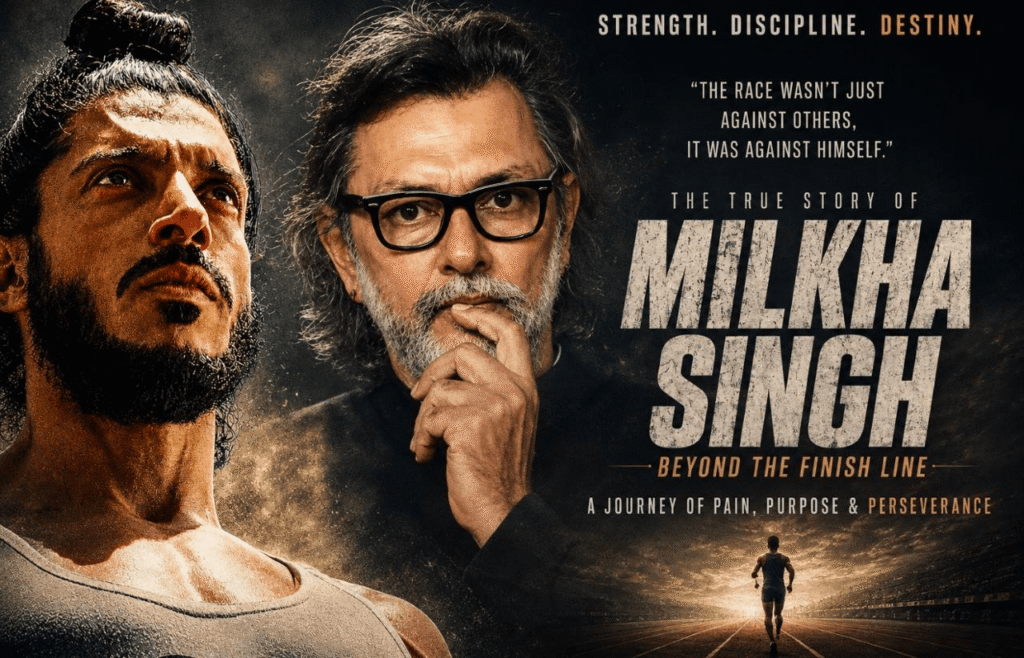
There is a particular kind of film that resists the categories built to contain it. Bhaag Milkha Bhaag is routinely filed under “sports biopic” or “inspirational drama.” These labels are not wrong. They are simply insufficient. It is the way calling The Godfather a “gangster film” is technically accurate and critically useless.
What Rakesh Omprakash Mehra has made is something rarer. It is a director’s film in the fullest sense. Every frame, every cut, every silence carries the unmistakable fingerprint of a singular authorial intelligence.
Trauma, memory, guilt, national rupture and personal redemption are not separate threads in this film. Mehra fuses them into a single continuous nervous system..
What separates serious cinema from accomplished entertainment is often invisible to a casual viewer: the treatment of characters who are not the protagonist. Mediocre films use supporting figures as furniture , present to move plot, absent of interior life. Mehra refuses this shortcut entirely. Every character who enters this film arrives with psychological weight and dramatic necessity, as though each had been written as the hero of their own unmade film and then, out of narrative economy, folded into Milkha’s.
Pawan Malhotra’s performance is a study in restraint, the kind of work that announces itself through withholding rather than display. But the emotional gravity of the film rests, I would argue, with Divya Dutta. Hers is among the great performances by an actress in modern Hindi cinema not because it demands attention, but because it is built entirely on suppression. She plays a woman confined within patriarchy’s invisible architecture, a woman whose voice has been quietly confiscated by circumstance long before the story begins, and whose only remaining freedom is the fierce, uncomplicated love she carries for her younger brother.
Mehra understands something that too few directors trust: that cinema often speaks most powerfully through what it withholds. Watch the sequence in which she gently coaxes her brother while her husband taunts her, bitterly, over her father’s refusal to migrate before Partition. at the same time drawing a temporary partion. On the page this is an ordinary domestic scene with undertone of marital rape. Under Mehra’s direction it becomes a devastating meditation on displacement, inherited grief, and the slow violence of resentment passed down through a household. Later, her face freezes in horror as she realises her brother has witnessed her humiliation and here Mehra demonstrates a rare directorial faith: that trauma is best communicated not through spectacle, but through the silent collision of two people’s eyes. A boy’s innocence ends without a line of dialogue. A woman’s dignity fractures without a single raised voice. This is filmmaking of supreme, almost austere confidence, the kind one associates with Bergman’s interiors or the domestic silences of Ozu, translated into an idiom entirely its own.
The film’s structural intelligence becomes clear once you notice what it refuses to do. No scene exists merely to advance plot mechanics. Each sequence is a complete dramatic unit in itself ,a short film embedded within the larger design , while simultaneously deepening everything around it. Mehra directs with the precision of a marksman: every beat calibrated, every pause deliberate, every silence carrying measurable weight. Nothing is fired for shock. Every scene lands because its target was identified with surgical clarity long before the camera rolled.
This is where the film’s true genius resides ,not in its narrative arc, which is, after all, the well-worn shape of triumph-through-adversity, but in performance direction. Farhan Akhtar’s physical transformation earned deserved acclaim, yet the more remarkable achievement is behavioural: Mehra extracts performances built not from dialogue but from mannerism, instinctive gesture, the subconscious rhythms of a body carrying unspoken history. Nothing here reads as performance. Everything reads as observed life.
Consider the film’s smallest and most astonishing moment: Milkha, absent-mindedly, stirring milk with his fingers. In lesser hands this detail would vanish, unnoticed. Mehra turns it into memory made visible deprivation, habit, longing, and emotional residue compressed into a gesture lasting seconds. This is the difference between competent craft and genuine cinematic intelligence: the capacity to locate enormity inside the microscopic.
Technically, the film refuses the linear triumphalism that burdens so many sports narratives. Memory arrives fractured, obeying trauma’s own illogical grammar rather than chronology’s tidy one. Past and present collide organically, so that Milkha’s victories remain permanently haunted by Partition’s ghosts. The screenplay understands, correctly, that the real race is never against the runner in the next lane, it is against memory itself.
Score, cinematography and editing do not sit beside the narrative; they breathe inside it, amplifying psychological states rather than merely decorating them. Every department appears to answer to a single governing vision, an increasingly rare achievement in an industry built on compromise.
The highest compliment available to any director is that he makes the audience forget they are watching a film at all. Mehra achieves precisely this. He takes hold of the viewer from the opening movement and does not release them until the frame goes dark. We do not observe Milkha Singh’s story from outside it. We inhabit it.
If there is a fault, it is one of duration , the film could shed ten or fifteen minutes without weakening its architecture. But this is a minor charge against a work this considered, and great cinema has always claimed the occasional right to linger.
‘Bhaag Milkha Bhaag’ is not an isolated triumph but the mature expression of ambitions visible far earlier, in ‘Aks’. Released into a Hindi film landscape still dominated by formulaic romantic escapism, ‘Aks’ was a psychological thriller of unsettling moral ambiguity, closer in spirit to international auteur cinema than to the conventions of its own industry. Even with Amitabh Bachchan and Manoj Bajpayee at its centre, what lingers from that film is not star power but directorial presence , Mehra’s command of atmosphere and psychological tension overshadowing two of Indian cinema’s most towering actors. It is fitting, and revealing, that Bachchan is said to have asked Mehra, on first reading the script, what he had been consuming while writing it less a joke than a recognition that this was an imagination operating outside the register of mainstream Bollywood entirely.
The abiding irony of Mehra’s career is that his sustained critical recognition has never matched the calibre of his craft. His filmography is selective, the work of an artist perhaps more at home in contemplation than in relentless output. Yet cinema, as an art form, tends to reward restless collaboration and continuous experimentation. One wonders whether Mehra’s own artistic philosophy one that prizes discovery, movement, reinvention might yet be served by greater creative frequency and a wider circle of collaborators.
Few contemporary Indian filmmakers command this level of cinematic architecture. Fewer still understand that the medium’s deepest power lies not in spectacle but in the act of making an audience inhabit another human being’s interior life. ‘Bhaag Milkha Bhaag’ achieves exactly that transforming biography into memory, sport into psychology, and history into lived, breathing experience.
It is for this reason that the film deserves to be discussed not merely among India’s finest sports dramas, but among the finest achievements of Indian cinema itself.
About The Author