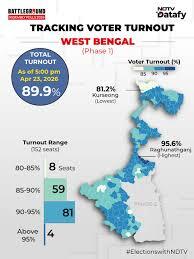
The morning of April 23, 2026, dawned over West Bengal like a courtroom drama given a sky. Long before sunrise, voters were already forming queues outside 152 constituencies from the misty tea gardens of Jalpaiguri to the volatile paddy fields of Murshidabad. An 85-year-old woman standing in line at Jalpaiguri was not merely casting a vote; she was filing a rebuttal to months of chaos.
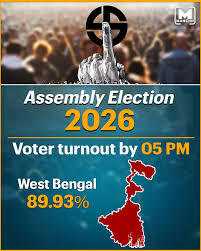
By 3 PM, West Bengal had recorded a staggering 78.77% voter turnout in Phase 1 , and the state pushed past 82% by 5 PM a number that is less a statistic than a statement of democratic fury.
The SIR: Surgery or Sabotage?
To understand why this turnout feels electric, one must understand the storm before it. The Special Intensive Revision (SIR) of electoral rolls removed nearly 91 lakh names from a pre-SIR electorate of about 7.66 crore, shrinking the voter base by roughly 12% to around 6.75 crore. Political analyst Yogendra Yadav called it an unprecedented situation in India’s electoral history, stating that 27 lakh people had been denied their voting rights wrongly.
The SIR triggered panic among illegal Bangladeshi immigrants in border areas like Hakimpur, Basirhat, who reportedly fled back to Bangladesh, fearing detection under door-to-door verification. At the same time, anxiety gripped Hindu refugees particularly the Matua community who struggled to meet the “legacy linkage” requirement tracing their names to the 2002 electoral roll. The political rhetoric allegedly contributed to multiple unnatural deaths and suicides.
Yet defenders of the exercise note that similar large-scale revisions occurred across India 74 lakh deletions in Tamil Nadu, 46 lakh in Bihar arguing West Bengal’s revision was a structural necessity given its 2,216 km porous border with Bangladesh.
The data resists simplistic “anti-Muslim” framing; one reported tranche showed over 97% of deletions were Hindus, and Matua-dominated belts in North 24 Parganas saw significant deletions that hurt BJP’s own base.
The Day Itself: Charged, Clashing, Consequential
Clashes erupted in Domkal, Nowda Islampur, Raninagar in Murshidabad, Kumarganj in Cooch Behar, and Suri in Birbhum though security forces intervened swiftly to restore order. At Dubrajpur in Birbhum, locals alleged that EVM votes cast for TMC were being registered for BJP, triggering fresh tensions.
A Salute to the Election Commission
Against this backdrop of fire and fog, the Election Commission of India deserves genuine credit. The 60% turnout recorded within the first six hours was credited to the Commission’s awareness campaigns and unprecedented security arrangements. central forces across volatile constituencies, managing EVM malfunctions in real time, and keeping the booth process largely intact in a state with West Bengal’s combustible history that is no small feat. The Commission held the ring when the ring was on fire.
What this turnout ultimately proves is that Indian democracy’s greatest safeguard is not the roll , it is the voter. Despite deletions, suspicion, and sporadic violence, Bengal’s people walked in, waited, and voted. The ballot, battered but breathing, survived another day.
About The Author