
From zero to space-grade in one move: India’s first indigenous processor isn’t just a chip, it’s a declaration of war on tech dependency
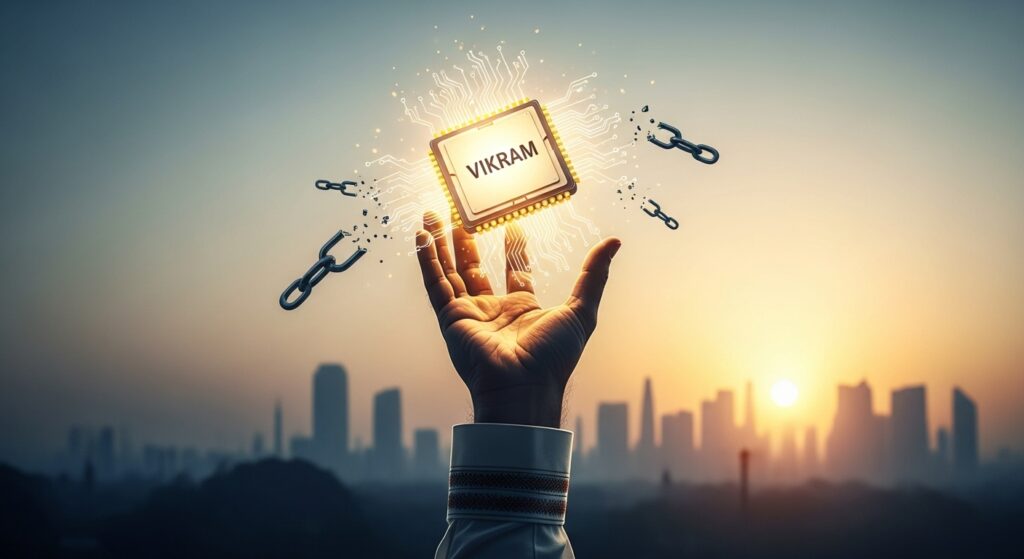
While global powers fought over Taiwan’s chip factories, India quietly achieved what seemed impossible: building processors that survive in space. September 2025 will be remembered as the day tech colonialism died and nobody saw it coming.
The Silent Revolution That Shook Silicon Valley
September 2, 2025. As geopolitical tensions escalated around Taiwan Strait, a different kind of revolution was unfolding 4,000 miles away in New Delhi. Prime Minister Narendra Modi stood before a crowd at Semicon India 2025, holding what appeared to be an ordinary microchip. But this wasn’t just any chip, it was India’s declaration of independence from three decades of technological subjugation.
The Vikram-32 processor, gleaming under the conference lights, represented something unprecedented: a completely indigenous 32-bit microprocessor that had already proven itself in the harshest environment known to humanity, outer space. While the world’s attention fixated on Taiwan’s vulnerability and China’s ambitions, India had executed the most audacious technological heist in modern history.
“If the last century was shaped by oil,” Modi declared, “this century belongs to the chip.” But these weren’t just words, they were a battle cry that echoed through every boardroom from Silicon Valley to Shenzhen.
Breaking the Chains: From Dependency to Dominance
For thirty years, India lived under what can only be described as technological apartheid. Despite producing the world’s finest engineers, the nation remained a digital colony—designing chips for others while importing every processor it needed. The Vikram-32 didn’t just end this humiliation; it obliterated it.
Developed by ISRO’s Semiconductor Laboratory, this isn’t your typical commercial processor. It’s a space-grade marvel engineered to withstand temperatures from -55°C to 125°C conditions that would destroy conventional chips within seconds. The first batch has already been validated in space during PSL missions, proving that India didn’t just build a chip; it built a weapon against technological colonialism.
The Architecture of Liberation
The Vikram-32’s custom instruction set architecture represents something revolutionary: complete technological sovereignty. Unlike processors that rely on foreign instruction sets, Vikram-32 speaks its own language, one designed entirely in India, for India’s needs. Its support for the Ada programming language isn’t coincidental; it’s strategic. Ada’s legendary reliability makes it the backbone of mission-critical systems worldwide, from air traffic control to missile guidance systems.
The $160 Billion Gambit: India’s Manufacturing Blitzkrieg
While analysts debated Taiwan’s future, India was executing a manufacturing blitzkrieg that makes D-Day look like a minor skirmish. The India Semiconductor Mission, armed with ₹76,000 crore, triggered investments worth ₹1.60 lakh crore across 10 facilities. This isn’t gradual development, it’s economic warfare.
India’s Semiconductor Arsenal: The New Industrial Powerhouses
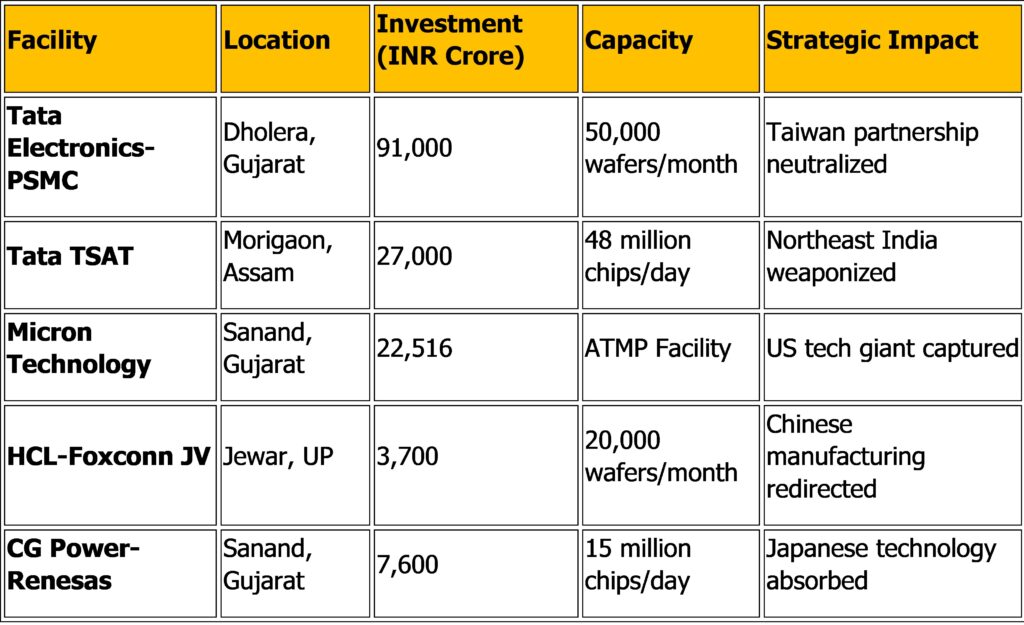
This geographic distribution isn’t random its strategic genius. Gujarat emerges as India’s semiconductor fortress, while Assam’s inclusion transforms India’s north-eastern frontier into a high-tech battleground. Every location chosen serves dual purposes: economic development and strategic depth.
The Numbers That Terrify Competitors
The scale of India’s ambition becomes clear in the raw numbers:
- 34,381 GPUs deployed, one of the world’s largest compute facilities
- 85,000 skilled professionals being trained for semiconductor design
- 45,000+ students already enrolled across 100 institutions
- ₹100/hour subsidized GPU access versus $2.5-$3/hour globally
- 1 lakh engineers targeted for nationwide training through SMART Labs
These aren’t just statistics, they’re the building blocks of a technological superpower that nobody saw coming.
The AI Integration: Beyond Traditional Warfare
India’s semiconductor strategy reveals its true genius in the seamless integration with artificial intelligence. The ₹10,300 crore IndiaAI Mission isn’t separate from the chip strategy, it’s the same weapon system. While competitors focused on either semiconductors OR artificial intelligence, India built both simultaneously.
The Indigenous GPU Masterstroke
Perhaps the most audacious element of India’s strategy: indigenous GPU development within 3-5 years. Success here would position India among an elite group of nations capable of designing both general-purpose processors and specialized AI accelerators. It’s not just catching up, it’s leapfrogging.
The AIKosha platform, featuring 1,400+ datasets and 217+ AI models, creates an ecosystem where Indian chips and Indian AI models work in perfect harmony. This vertical integration threatens the entire global tech stack.
Global Disruption: The Domino Effect
India’s breakthrough sends shockwaves through established power structures:
Taiwan: No longer the sole guardian of advanced chip manufacturing
China: Faces a democratic alternative to its authoritarian tech model
United States: Confronts a strategic partner that’s also a technological rival
South Korea: Watches its memory chip dominance challenged by Indian innovation
The transition from silicon-based to silicon carbide semiconductors, combined with 3D glass packaging technology, positions India not just as a competitor but as a technology leader in next-generation applications.
The Human Capital Revolution
India’s secret weapon isn’t factories or funding, it’s people. The nation that exports software engineers to Silicon Valley is now keeping them home to build indigenous semiconductors. The C2S program reaching 278 academic institutions and 72 startups doesn’t just train engineers; it creates an army of chip designers.
Collaborations with Lam Research, IBM, and Purdue University ensure knowledge transfer while building indigenous capabilities. It’s technological osmosis, absorbing global expertise while maintaining strategic autonomy.
The Defence Dimension: Chips as Weapons
The Vikram-32’s space-grade capabilities hint at something more significant: India’s entry into defence semiconductors. Silicon carbide chips for missiles, radars, and space systems aren’t just products, they’re strategic assets that no external power can compromise or control.
This defence angle transforms semiconductors from economic tools into national security assets, making India’s chip independence a matter of survival rather than merely prosperity.
The Road Ahead: From Revolution to Empire
India’s semiconductor journey has evolved from import substitution to technological imperialism. The establishment of 3-nanometer design centres in Noida and Bengaluru signals India’s intention to compete at the absolute cutting edge.
The pragmatic approach to AI regulation, emphasizing innovation over restriction, creates a competitive advantage over nations paralyzed by regulatory uncertainty. While others debate AI ethics, India builds AI capability.
Conclusion: The New World Order
The Vikram-32 chip represents more than technological achievement; it’s the death certificate of technological colonialism. India’s transformation from chip importer to space-grade processor manufacturer signals a fundamental shift in global power dynamics.
As the world grapples with supply chain vulnerabilities and technological dependencies, India offers something revolutionary: an alternative that combines democratic values with technological sovereignty. The semiconductor revolution isn’t just changing India; it’s changing the world.
The age of silicon slavery is over. The era of technological self-determination has begun. And India just fired the first shot in the liberation war.
About The Author