
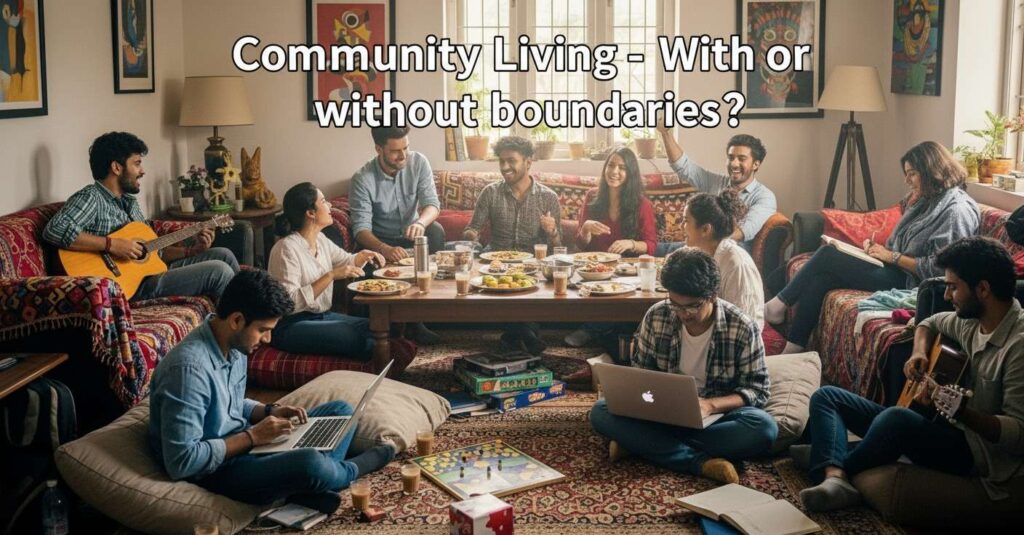
How Community Living is Reshaping Urban India
In the corridors of contemporary India’s bustling metropolises, a quiet revolution is unfolding, one that would make our grandmothers both proud and perplexed. The traditional axiom “a single grain cannot break the oven” is being reimagined by a generation that refuses to accept isolation as the price of independence.
What began as tentative experiments in live-in relationships has evolved into something far more profound: the systematic reconstruction of community in an age of unprecedented urbanisation. This isn’t merely about splitting rent or sharing Netflix passwords. We are witnessing the emergence of India’s “new villages”, intentional communities that blend ancient Indian collectivism with millennial pragmatism.
The Numbers Tell a Compelling Story
The data reveals the magnitude of this transformation. India’s community living market is poised to more than double from $6.67 billion to $13.92 billion by 2025 across the top 30 cities, according to Cushman & Wakefield. This isn’t speculative growth, it’s driven by concrete demand from 440 million millennials, making India home to the world’s largest cohort of this generation.
Consider Annu, a Delhi-based engineer who epitomises this shift. Sharing her flat with three friends, she articulates what millions are experiencing: “Here everyone has their own privacy, but there’s also relief from loneliness.” Her observation captures the delicate balance this generation seeks, autonomy without alienation.
The statistics are equally striking. Colliers projects that demand for community living beds will surge from 210,000 in 2021 to 450,000 by 2024. With occupancy rates consistently hovering between 85-90% and monthly rents ranging from ₹10,000 to ₹35,000, these spaces aren’t just filling a housing gap, they’re creating a new lifestyle paradigm.
Beyond Economics: The Psychology of Shared Spaces
While affordability drives initial adoption, particularly relevant as urban rents have surged up to 9% in major cities during 2024, the retention speaks to deeper human needs. IKEA’s Life at Home report reveals that 67% of community living residents report improved mental health, citing reduced loneliness, lower stress levels, and enhanced social connections.
For India’s 40% migrant millennial workforce, these arrangements offer more than shelter; they provide belonging in unfamiliar cities. In tier-2 cities, where 55.78% of student accommodation comprises shared rooms with rents between ₹8,000-₹15,000, community living has become the bridge between educational aspirations and financial reality.
The Shadow Side of Collective Living
Yet this social experiment isn’t without friction. Privacy erosion, lifestyle conflicts, and the eternal challenge of equitable responsibility-sharing create daily negotiations that would test any relationship. The simple act of choosing compatible roommates, understanding work schedules, cleanliness standards, and social boundaries, has become a crucial life skill that few were taught to master.
These challenges illuminate a broader question about modern relationships: as we become more selective about our intimate partnerships, are we simultaneously becoming more tolerant of casual cohabitation? The luxury community living segment, growing at 17.2% annually according to FICCI and JLL, suggests that even affluent Indians are choosing community over solitude.
Ancient Wisdom, Modern Application
Perhaps most intriguingly, community living represents a return to, rather than departure from, Indian traditions. The joint family system that sustained generations and the Gurukul tradition that blended education with communal living offered blueprints for collective existence that prioritised both individual growth and communal harmony.
The difference lies in choice. Where previous generations inherited their communities through birth or tradition, today’s Indians are curating theirs through conscious selection. This shift from assigned to chosen family structures reflects broader changes in how Indians approach commitment, career, and social obligation.
The Future of Urban Relationships
As we approach 2025, when millennials will constitute 75% of the workforce, their preferences for flexibility over rigid commitment are reshaping not just housing but the very architecture of Indian society. Marriage ages are rising, career prioritisation is increasing, and the definition of family is expanding beyond blood relations to include chosen communities.
This transformation raises profound questions: Are we witnessing the evolution of Indian social structures or their gradual dissolution? Is the movement toward community living a mature response to urban realities, or a sophisticated form of commitment avoidance?
Navigating the New Normal
For those considering this path, the rules are still being written. Success requires careful attention to financial compatibility, lifestyle alignment, and clear boundary-setting around cleanliness, expenses, guest policies, and privacy expectations. The art lies in creating enough structure to prevent conflict while maintaining sufficient flexibility to accommodate individual growth.
Community living in modern India represents neither wholesale rejection of tradition nor blind embrace of Western individualism. Instead, it offers a third path, one that honours our collective heritage while adapting to contemporary urban realities. The question isn’t whether this trend will continue, the numbers make that inevitable, but how thoughtfully we’ll shape it to serve both individual flourishing and social cohesion.
In reimagining the village within the city, India’s millennials aren’t just solving a housing crisis. They’re pioneering a new form of chosen family that could well become the template for urban living across the developing world. Whether this experiment ultimately strengthens or fragments our social fabric will depend largely on how wisely we navigate the delicate balance between individual freedom and collective responsibility.
The ancient grain, it turns out, never needed to break the oven alone. It just needed to find the right community to help it rise.
About The Author