An artist who treats rejection as invitation, failure as fuel, and simplicity as rebellion. Four decades later, the art world still can’t figure him out. Neither will you-until you read his story. Prepare to meet your new favourite contradiction.
The Human Kaleidoscope
Turn a kaleidoscope once-a village boy emerges. Turn again-an international artist appears. Once more-a philosopher, a cook, a storyteller. Meet the human kaleidoscope whose four-decade journey from rural roots to global recognition redefines what it means to be authentically, impossibly multifaceted.
Village Roots, Global Routes
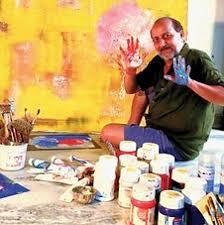
Meet a man who defies every attempt at definition-a walking paradox wrapped in paint-stained clothes and crowned with an infectious smile. Narendra Pal Singh is simultaneously a jester and a poet, a street performer and a profound philosopher, wealthy in spirit yet humble in manner. He is the human equivalent of a kaleidoscope: turn him slightly, and an entirely different pattern emerges.
Your first encounter with this extraordinary soul leaves you deliciously bewildered. Like trying to capture quicksilver in your palm, forming an immediate impression of Narendra feels nearly impossible. When you meet him, he’ll discuss everything under the sun politics, philosophy, the price of onions except his art. It’s as if he’s deliberately hiding his deepest treasure behind a curtain of everyday conversation.
Picture this: you arrive with a recorder, prepared for a formal interview about his paintings, only to find yourself seated at his kitchen table while he serves you food prepared by his own hands. The questions you’ve carefully crafted suddenly seem secondary to the warmth radiating from this man who treats feeding strangers as a sacred act.
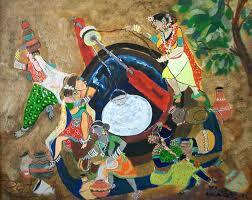
This talkative, endlessly enthusiastic soul who seems more circus performer than serious artist creates works that whisper secrets about the feminine divine, that breathe life into ancient mythological tales, that emerge from deep research into forgotten human values like flowers blooming in an abandoned garden. His conversations meander like rivers you never know when they’ll form a scarf, a sweater, or perhaps socks from the same ball of yarn.
And his colours! Oh, his colours are like emotions given physical form. Search the galleries of the world—from the Louvre to the Metropolitan—and you’ll struggle to find canvases that sing with as many hues as Narendra’s. His abstract paintings don’t just hang on walls; they engage in intimate conversations with viewers, sharing stories that can only be felt, never fully explained. Look closely, and you’ll discover the pulse of society, the heartbeat of culture, dancing between brushstrokes.
In the space of a single conversation, this Delhi-dwelling artist transforms into TunTun, the youngest child from Konanpur village on the Bihar-Jharkhand border. After knowing him for a decade, I can confidently say that the Narendra Pal who has exhibited in Delhi, Chicago, Berlin, Barcelona, South Korea, Prague, Italy, and London—the one whose abstract paintings have touched unexplored corners of human experience across nearly four decades of artistic journey—can only be truly understood by first meeting TunTun.
TunTun was his mother’s darling, the boy who helped her create rangoli patterns on festival mornings, who sang folk songs with a voice clear as mountain streams, who fell in love with cooking by watching his mother transform simple ingredients into love on a plate. This same TunTun, after completing his intermediate science studies, faced his first rejection from Patna’s Fine Arts College simply because he came from a science background.
But TunTun’s determination burned brighter than his disappointment. The second time around, he deliberately failed chemistry—a calculated sacrifice to prove to the principal that his future lay not in scientific formulas but in the alchemy of art. The strategy worked. TunTun got his admission and eventually evolved into Narendra Pal, making his way to Delhi with dreams tucked into his paint box.
Through my eyes, Narendra Pal’s paintings represent a miraculous marriage between art and science. Whether you examine his “Remains of Yesterday” series, the powerful “Nayika” collection, or the wisdom-filled “Panchatantra” works, you’ll discover a systematic approach—a formula born not from textbooks but from the heart’s mathematics. It’s as if TunTun from Navaada regularly injects the artist Narendra Pal with doses of village essence, cultural memory, folk art traditions, and those gloriously vibrant colors that refuse to be tamed.
Pick up any of his paintings, regardless of which corner of India you call home, and you’ll find something achingly familiar staring back at you. This is what makes Narendra Pal’s art transcendent
it speaks a universal language written in local dialects. I confess: I am no art critic. Perhaps I lack the sophisticated vocabulary to properly “read” paintings. But ninety percent of the population shares this limitation, and yet Narendra’s work moves us all. Like me, they glimpse the “folk” narrative woven into his canvases, they recognize the collective unconscious of their people reflected in abstract forms. Narendra’s journey extends far beyond the typical artist’s trajectory. Across nearly four decades in the world of colors, his has been a story of human resilience, a testament to the truth that remaining simple in a complex world requires navigating countless complications. His mature body of work bears witness to this paradox, celebrating the beautiful struggle of authenticity in an increasingly artificial age.
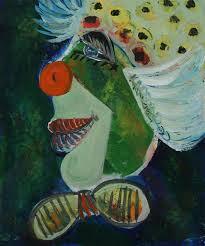
In a world that often demands we choose between being profound or playful, intellectual or emotional, Narendra Pal Singh refuses such limitations. He embodies the radical idea that an artist can be all things while remaining fundamentally, genuinely himself. His paintings don’t just decorate walls they democratize beauty, making the profound accessible and the complex emotionally resonant.
To understand Narendra Pal Singh is to understand that the greatest artists are often the ones who never quite fit into the boxes we create for them. After four decades of making his mark in the world of colors, he remains the one who serves you homemade food before showing you his masterpieces, who stays TunTun even as the international art world recognizes him as a master, who paints with the colors of his childhood while addressing the complexities of contemporary existence
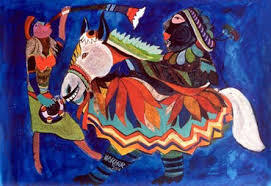
In an age of manufactured personas and calculated authenticity, Narendra Pal Singh stands as a reminder that true artistry springs from the audacity to remain genuinely, unapologetically human.
About The Author