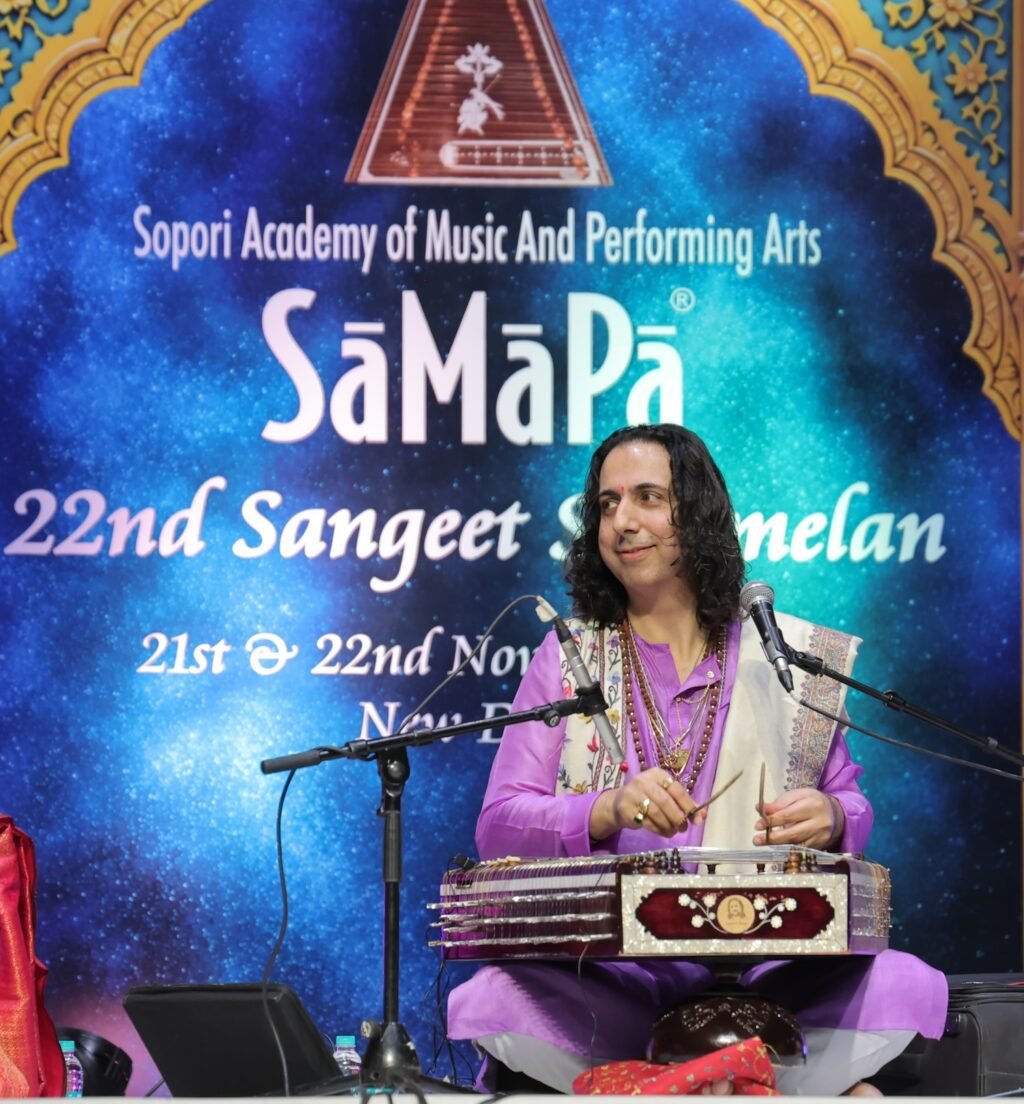
Pandit Abhay Rustum Sopori at the 22nd SaMaPa Sangeet Sammelan, Kamani Auditorium, New Delhi.
At the 22nd SaMaPa Sangeet Sammelan in Delhi, the santoor maestro rendered one of Hindustani music’s most formidable ragas on an instrument long thought unable to carry it, and the hall rose to its feet.
New Delhi: For generations, the slow, swaying oscillations at the heart of Raga Darbari Kanada were counted among the things the santoor could not do. Pandit Abhay Rustum Sopori set out to change that. At the 22nd SaMaPa Sangeet Sammelan, held at Kamani Auditorium, he presented an elaborate Darbari on the santoor and opened a new chapter in the instrument’s evolution. The audience answered with a standing ovation.
Why Darbari is the hardest test
Darbari Kanada is known as the “King of Ragas”. Tradition links it to the court of Emperor Akbar in the 16th century and to the legendary musician Miyan Tansen. It is a late-night raga of regal bearing, depth and meditative weight, and it is widely regarded as one of the most demanding to render. Its character rests on deep, slow, controlled oscillations, called andolan, of the komal Gandhar and komal Dhaivat. On an instrument played with mallets on struck strings, achieving those oscillations had long been seen as close to impossible.
The technique behind the breakthrough
Through years of research and experiment, Pandit Sopori developed a way of executing intricate oscillations across all octaves of the santoor, while keeping the raga’s classical character intact. He builds on the Sopori Baaj, the style created by his father and guru, Pandit Bhajan Sopori, revered as the “Saint of Santoor” and the “King of Strings”. That style brought the nuances of vocal gayaki and instrumental tantrakari, such as meend, gamak, taan and zamzama, to the santoor. Pandit Abhay Sopori credited his father for raising the instrument to a level where such exploration became possible.
Also read: Akhilesh Yadav to take final call on SP-Congress seat-sharing, says Samajwadi Party leader
He is the present custodian of the centuries-old Sopori Sufiana Gharana of Kashmir.
What was played
Pandit Sopori presented Darbari in the traditional Dhrupad manner, with an elaborate Aalap, Jod and Jod Jhala. Pandit Rishi Shankar Upadhyay accompanied him on the pakhawaj. He also played the rare Raga Pancham Malkauns, featuring one of his new compositions, “Aao Re Aao Re Sajna”, with Pandit Mithilesh Jha on tabla. His disciples Anoushka Majumdar and Poushali Dutta joined on Sur Santoor and tanpura.
SaMaPa presented the festival in collaboration with the Ministry of Culture, Government of India, Indian Railway Finance Corporation (IRFC), Oleevia and Bloom.
Who was in the audience
The festival drew scholars, musicians and public figures. Among those present were immunologist Dr Pran Talwar, actor Chandrachur Singh, SaMaPa Chairperson Dr Aparna Sopori, business consultant Sohrab Sopori, broadcaster Dr Rafeeq Masoodi, and vocalists Shameem Azad, Pandit L. K. Pandit and Vidushi Sumitra Guha. Former Doordarshan Director General Satish Nambudiripad, Ministry of Culture Director Aneish Rajan and India Habitat Centre Director Dr K. C. Suresh attended, along with Ustad Wasifuddin Dagar, Ustad Rafiuddin Sabri, Ustad Asghar Hussain, Pandit Chetan Joshi, Ustad Mohsin Ali Khan, Pandit Ajay P. Jha, Prof. Rita Kaul, Moti Kaul and Pandit Rupak Kulkarni.
Why it matters
The recital was more than a performance. It is a contribution to Indian musicology that opens new avenues for future santoor players. A raga that once marked the edge of the instrument’s range may now become part of its repertoire.
About The Author

The day’s verified news, in your inbox
One short email every morning with our original reporting. Free, and you can unsubscribe at any time.
Prefer WhatsApp? Get our top stories on our channel.
Follow us on WhatsApp