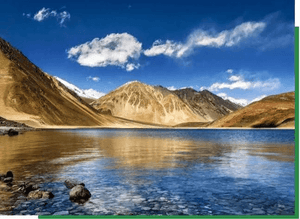
Glaciers down 28.8%, snow cover nearly halved, three in four water bodies shrunk or gone. A 2026 study shows the Valley’s water bank running dry, while the cure has sat in government files for over a decade.
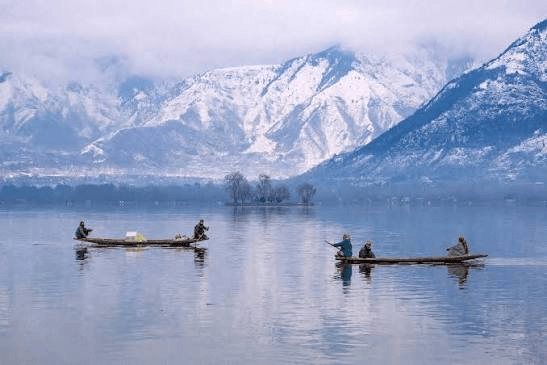
Think of Kashmir as a household living off an inheritance. For centuries, its savings were held in ice: glaciers and snowfields that banked winter precipitation and paid it out, drop by drop, through the dry summer months. Today the household is spending faster than ever, building on its own fields, and making no deposits. The account is not empty yet. But a new study shows the balance is falling, and the bank may soon stop honouring withdrawals.
That study, “Paradise under Pressure: Human-Driven Ecological Change in Kashmir, 1971–2026” by Dr. Ashish Kaul, was published in the International Journal of Humanities & Social Science: Insights & Transformations (Vol. 11, Issue 2, 2026). It reads policy documents, glacier science and community testimony side by side, and its verdict is blunt. Kashmir is shifting from a resilient mountain system to a fragmented, stressed one. Some ecological thresholds, it warns, could be crossed permanently before 2050.
The timing matters. Srinagar recorded 37.4°C in July 2025, its hottest July day since 1953. That was not a freak event in a stable system. It was the latest symptom in a pattern the state’s own files have documented for years. Above the Valley, the ice is going. Below it, the concrete is coming. The study’s central argument is that these two forces are now feeding each other.
The evidence: seven documents, one direction
Kaul draws on seven documents, among them the state’s own climate action plan and a satellite-based glacier study. Read together, they describe a pattern that is hard to argue with.
| Indicator | Change | Period and detail |
|---|---|---|
| Glacier area | –28.8% | 1980–2018: 101.73 to 72.41 sq km |
| Snow cover | –45.7% | 1990–2022: about 7,000 to 3,800 sq km |
| Built-up area | +560% | 1972–2020, much of it on floodplains, wetland margins and paddy land |
| Population | +274% | 4.62 million to about 17.3 million (former state of J&K as a whole) |
| Tourism | +1,500% | 1975–2025 |
| Peak heat | 37.4°C | Srinagar, July 2025: hottest July day since 1953 |
| Water bodies | ~74% shrunk or dried | Since 1967, per a government audit cited in the paper |
Source: Kaul (2026), drawing on official and scientific documents. Population figures cover the former state of J&K, not the Valley alone.
One figure turns this from an environmental story into a survival story. Roughly 65% of the water used in Kashmir comes from snow and glaciers. Every square kilometre of lost ice is a withdrawal from the Valley’s water bank, and nobody is making deposits.
The lakes tell the same story at street level. The state plan cited in the study describes Dal and Wular shrinking to roughly half their size in about fifty years. These are not activist projections. They are findings from the government’s own files.
A sponge being cut to pieces
The paper’s central image is a sponge. Wetlands, snowpack and forests soak up floods, store water and release it slowly. Each filled wetland and each vanished snowfield removes a piece of that sponge. The next flood, heatwave or dry spell then lands on a system with less capacity to absorb it.
What makes the picture alarming is that the damage compounds. The study traces feedback loops that are frightening in their simplicity:
- Warmer winters mean less snow.
- Less snow means weaker summer flows.
- Weaker flows concentrate sewage in shrinking lakes.
- Urban heat pushes up demand for cooling.
- Scarce irrigation nudges farmers from paddy toward more profitable orchards, and the cycle tightens.
The last loop deserves attention. Paddy fields are not just farms; they are seasonal wetlands that recharge groundwater and hold floodwater. When they turn into orchards or housing colonies, the sponge loses another piece. The 560% growth in built-up area, much of it on exactly this land, means the Valley is not only losing water. It is losing the very terrain that once managed it.
This is why the Valley’s crises arrive together. Heat, flood risk, water shortage and polluted lakes are not separate files. They are the same failing system seen from different angles.
The villain is not ignorance
The study’s sharpest finding concerns power, not physics. The state’s own climate plan diagnosed encroachment, untreated sewage and tourism overload more than a decade ago. The reports of 2024 and 2025 still describe the same problems. In medical terms, the patient has been diagnosed repeatedly and treated almost never.
“Kashmir’s problem is less a shortage of knowledge than a shortage of implementation.”
The scientists the paper draws on go further. Water shortage in a region this water-rich, they argue, reflects poor governance rather than genuine scarcity. And the action plans that exist lack village-level detail, so they rarely reach the places where wetlands are filled and streams are piped.
This reframing matters for the present debate. It shifts the question from “What is happening?” to “Why has nothing been done?” The Valley does not need another report. It needs accountability for the ones it already has.
Three futures to 2075
The synthesis the paper relies on models three pathways. The gap between them is the gap between a managed decline and a collapse.
| Pathway | Projected warming | Ecological outcome |
|---|---|---|
| Business as usual | 3.5–4.5°C | 50–70% wetland loss |
| Moderate intervention | 2.5–3.5°C | Between the two extremes |
| Ecological restoration | Near 2.0–3.0°C | Partial recovery |
The study stresses a point of climate justice: Kashmir did little to cause global warming. But local choices on land, water and tourism will decide how hard that warming lands. Global emissions are beyond the Valley’s control. Its wetlands, floodplains and construction permits are not. That is the one lever still in its own hands.
What government must do, and how to hold it to account
The paper’s recommendations are clear. Below, they are framed as a mandate officials can be measured against. The annual review cycles are suggested benchmarks for policymakers, not figures from the study.
- Bind tourism to carrying capacity. Set legally enforceable visitor and construction limits at Gulmarg, Pahalgam and Sonamarg, published openly and reviewed every year. Voluntary guidelines have not worked.
- Ring-fence wetlands and paddy land. Impose strict protection on wetlands, floodplains and paddy land, with a freeze on conversion until a verified map of what remains is made public.
- Treat the sewage. Make real sewage treatment the first call on funds for Dal, Wular and the river system. A lake cannot be saved while it is used as a drain.
- Write the plan village by village. Replace statewide documents with village-level climate plans owned by the communities that live with the consequences.
- Make implementation measurable. Appoint an independent body to track glaciers, snow cover, wetland area and built-up land annually, and publish the results. If the same diagnosis keeps being repeated, the failure is one of accountability.
The clock is running
Every indicator the research examines points the same way, and none points toward recovery. Glaciers are shrinking, snow cover has nearly halved, lakes are choking and concrete is spreading across the land that once absorbed the Valley’s floods.
The documents exist. The diagnosis is more than a decade old. What Kashmir lacks is another decade to waste. If thresholds are crossed before 2050, as the study warns, no future plan will buy them back. The inheritance will be gone, and the household will have only itself to blame for how fast it was spent.
The clock is running, and the government’s hand is on it.
About The Author