A veteran of Bengal’s administrative trenches on regime change, cadre reckoning, and what endures when the ballot boxes cool.
Dr Shefali Chaturvedi, Managing Editor of www.newstrustindia.com, in conversation with Dr Sanjeev Chopra
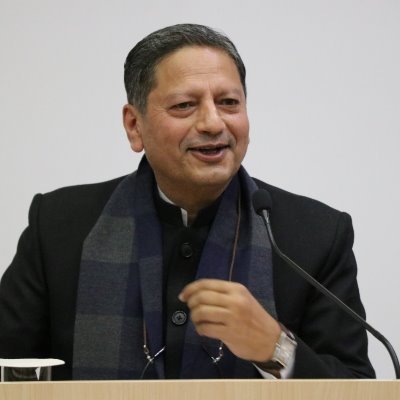
The ballot boxes have barely cooled in West Bengal, and already the corridors of Writers’ Building hum with a different anxiety who stays, who goes, who survives the tide. At moments like these, few voices carry more weight than Dr. Sanjeev Chopra-1985-batch IAS, former Director of LBSNAA, and one-time Additional Chief Secretary of West Bengal. He has watched regimes rise and fall from both the field and the apex. What he tells us next is not history. It is a map.
NTI ( NewsTrustIndia): Thank you for agreeing to speak with us. Given the seismic political churn West Bengal has witnessed in recent years, we would like to begin with your overarching assessment ,what has it been like to serve as an IAS officer of the West Bengal cadre across regimes?
SC ( Dr.Sanjeev Chopra) : Thank you for your question. Well, I served the GoWB in three phases, field postings from 1986 to 1994 , as an Assistant Magistrate in Purulia and Darjeeling, as SDO in Kalimpong and Ghatal, as ADM of Cooch Behar, CEO of Himul and SJDA and then as DM of Murshidabad. The next phase was from 2007 to 2010 – I was Secretary to the Government in the Departments of Food Processing and Horticulture, and later Secretary of Agriculture. For a brief period, I held dual charge of both, and also as Secretary to the Governor of WB when the regular incumbent was on long leave. My last posting was as ACS for Agriculture and allied sectors from January 2016 to March 2018- and then as DG ATI and ACS for Industry till December of that year.
Well, like all cadres, there are pluses and minuses in the WB as well. But we must remember that WB is among the largest states in the country – in term of population. We have 42 MPs. Diversity is built into the geography, culture, religious practices and the political traditions of the state. Therefore there will be no such thing as a uniform experience of an IAS officer , especially for those who have had postings away from Kolkata. Let me explain . Now there is the inner core ,Kolkata and the surrounding districts – Howrah, Hooghly, Nadia, N/S 24 Parganas, East and Est Midnapore and Burdwan. The districts of Birbhum ,Bankura and Purulia are tribal, and close to Bihar : Purulia was in fact part of the old Manbhum district of Bihar and it came to WB only after the SRC of 1956. Then we have the districts of Malda and Mushidabad , both of which had been allotted to east Pakistan (now Bangladesh). North Bengal had Malda, Uttar and Dakshin Dinajpur, Jalpaiguri, Alipurduar, Darjeeling and Kalimpong .
NTI: Your postings span some of the most administratively complex theatres in the state. From your widely-read series on Left-Wing Extremism, it is evident that you were at the frontline of the administrative and police response to the GNLF agitation. Could you take us through that journey?
SC : Each posting is unique. Thus the first phase of training was in Puruliya and Darjeeling – the two districts were as apart as chalk and cheese. Puruliya was backward tract where leprosy was endemic, and poverty was extreme. When I got my first posting as an Assistant Magistrate in the tribal belt of Puruliya , I was quite excited . I went to the library to read up the gazetteer , and I discovered that the Tropic of Cancer passed through the district !
But the extreme poverty in this district came as a cultural shock. But this was also the district where I saw very positive work on the ground – in the eradication of leprosy, in the ICDS centres, under JRY, under the MWS, and in the implementation of Operation Barga. After six months in Puruliya, all of us were sent to Alipurduar for our settlement training camp. This is where the DM Darjeeling came to address us – and seek volunteers for Darjeeling for many officers, especially those with Bengali surnames had been forced out of the district. Given my background – I had grown up in the PAP and BSF campuses of Jalandhar cantonment – I opted for it immediately. The contrast with Purulia was so marked. And thus began my tryst with the GNLF. Here again, the main thrust was to open communication with the stakeholders , and resume the development works
You see, our postings shape our perspective and world view . If you are in the state capital or its surrounding districts, you are likely to get one singular view of how the administration runs. When you work across several districts – you realize that even within the state, there is ample diversity – and the hold of the ruling party is often tenuous at the margins. In the case of Bengal, several chief secretaries – both during the Left front and the TMC regime -were those had limited exposure to North Bengal, or the tribal belt of Jhargram and Puruliya Probably , they formed an impression that all of West Bengal is a monochrome On the other hand, there were officers like us who were mainly posted either in North Bengal or the tribal belt . Naturally our impressions are different.
NTI: Was West Bengal a cadre of choice for you or one of circumstance?
SC : Well, you have touched a raw nerve. Ours was the first batch which was denied the option of choosing our cadres. The background to this was the violent agitations in Punjab, Assam, Nagaland and J&K, and the government did not want officers from these states to work in their home cadres. Thus was started the roster system – many of us went to the Supreme court – we had engaged Soli Sorabjee but then it was too difficult to fight the state, but many of those who did not have the top ranks were in fact happy with this randomized draw of lots. But I was okay with the decision for two reasons . Our Law faculty D Banerjee was from this state, and he really gave us a very positive vibe about the state. Moreover , one was familiar with the left ideology and leadership because one had interacted with many Communist party leaders at JNU . So one was not unnerved by the prospects of working for the Left .
NTI: Drawing on your direct experience under both dispensations, how would you contrast the governance character of the Left Front and the Trinamool Congress regimes?
SC : LF was ideological, TMC was personality based . But both drew their street power from their committed cadres. After their first terms , both regimes were only focused on remaining in power whatever the cost. There were similarities as well. Both were focused on Kolkata and the surrounding districts . Both were clear about not yielding even an iota of political space in these districts and such is the constituency delimitation that the North Bengal districts have only 54 seats in a 294 member assembly. So North Bengal does not really matter ‘politically’ . Here the majority MLAs are not from the ruling party, the district administration has the necessary space to operate. Officers who have worked in North Bengal- in general have been less enamoured of the CMO . For the one threat that the CMO often held out was a ‘posting to North Bengal’ as if it was some kind of a faraway land – which it was, if one looked at it from the perspective of the Howrah, Hooghly and Kolkata.
NTI: The Chief Secretary is traditionally regarded as the institutional anchor of the All India Services in any state. In your assessment, have West Bengal’s Chief Secretaries been able to discharge that leadership role effectively? Were they able to fulfil their role
SC: Well, there was a problem ; and I would say it was a big problem for with few exceptions almost all recent Chief Secretaries were either not empaneled /did not opt to work in the GoI. This is a serious ‘structural flaw’- for when officers work in the Centre , they get an idea of how polices are made, how every ministry guards its turf, how cabinet notes are made, how ‘supplementaries ‘ to ‘starred questions’ are prepared, how parliamentary committees have to be faced, how international treaties have to be interpreted, how multilateral negotiations are held – so on and so forth. WB officers faced a double jeopardy: in the first instance, they were not allowed to apply for deputation – this often delayed their empanelment. And even after they were empaneled , the state government would deny them permission to join. So many of our bright officers with experience at UN, WTO and other multilateral agencies – were just not allowed to go the Centre. Well, this was a problem in the LF regime as well but it was not as insurmountable as during the TMC regime . Even with the third highest cadre strength in the IAS, WB has only one secretary at the Centre, and even he will superannuate within the next few weeks. Hopefully, by then we would have some of our officers in Delhi for the posting as Secretaries.
NTI: You also served on inter-state deputation to Uttarakhand, where you had a particularly distinguished tenure as Industries Secretary. What did that experience reveal to you about Uttarakhand’s work culture and political-administrative ethos?
SC : I must say that working in Uttarakhand was a great experience . It was a very good coincidence that just when I was about to complete my tenure at the LBSNAA, and preparing to revert to the state, the GoI asked for officers within the service bracket of 6-16 years, already on deputation to GoI about their willingness to serve in any of the three new states of Chhattisgarh, Uttarakhand and Jharkhand. As the Academy had been in touch with the state government in the adapting/creating new legislation for the state, I had been working quite closely with Dr RS Tolia (who later became the CS), I opted for Uttarakhand.
While we will talk about my experiences as the Industries Secretary of the state in in another interview, let me reflect on how it shaped my administrative experience. There were ‘political differences,’ but no ‘political untouchability’. Legislators from both parties would certainly spar with each other in the Assembly, but there was friendly banter. The CM and the Speaker would host. ‘ get -togethers’ before, during and after Assembly sessions, and all legislators, secretaries and HoDs were invited, and this allowed for friendly interaction. Competition was not animosity. However when I returned to the state after a long deputation period – from 1995 to2007, I observed that the political parties were treating each other in the most inimical manner. The cordiality – which I saw in Uttarakhand -was missing. There were multiple fissures- between the CPM and the TMC on the one hand, and within the LF – between the CPM and their coalition partners. Cabinet meetings in Uttarakhand – both under Bhagat Singh Koshiyari and ND Tiwari involved a frank exchange of ideas – and though one could see the underlying motivations, decisions were taken after many pros and cons had been examined. Though the CM had the last word, modifications and alterations were possible.
NTI: And against that backdrop, how did West Bengal differ — both in tone and in institutional functioning?
SC : Well, in WB , cabinet meetings – both during the LF and MB had become a mere formality. They were over before they began. When ministers stopped asking questions -there was no need for officers to do any background reading. All one needed was to convince MB – and in any case, the CMO was not an evolved intuition like the PMO. It was at best a grievance redressal cell, and a nodal point to check on CMs announcements. Policy making had been reduced to whims of the CM- and one clear idea was to opposed anything and everything which the GoI said, even if it was good for the state. And as many state officers had never worked in GoI, they also found it difficult to find ways and means to finding a middle path.
NTI: How does a civil servant forge consensus and deliver outcomes when the State and the Union are positioned at ideological opposites?
Well, you can, And this is the precise reason why we need the All India services.
Let me illustrate with an example. As I had worked in the agriculture and horticulture sector – in two state governments – Uttarakhand and West Bengal as well as the Union government. I knew how important the PMFBY was – and also that no state government would be able to do it on its own. So when the state agriculture minister was making he point that the credit will be taken by the PM, I told him ( and the CM)that the state was also contributing equally to this – and so we can have the CM write to all the farmers about this, and also about all the other initiatives in agriculture – including rural agri marketing hubs and a dedicated portal for farmers.
NTI: With a fresh political mandate and the prospect of institutional recalibration, what changes do you now anticipate for the cadre, for Centre-State coordination, and for the officers themselves?
Quite a few. Her antipathy to the Government of India had reached alarming proportions – for example, she would refuse to meet even secretaries to Government of India on official visits to the state. Normal courtseies that had to be extended were denied. We had to send relatively junior officers for GoI meetings as she did not trust her own secretaries. We were not allowed to be part of international delegations if the GoI was organizing them. Many opportunities were thus lost.
In the first instance, the backlog of officers wanting to move to Governemtn of India on deputation should be cleared. The three All India services IAS, IPS and IFS – must have their fair representation in the top positions in the central organizations.
Again, officers wanting inter cadre deputation / transfer on account of the established policy of spouses being posted together, or on account of medical/family emergencies will find it easier to organize their personal professional careers. This will lead to a virtuous cycle – good for the state, good for GoI and good for the officers as well. As a former President of the State IAS Association , and the working president of the All India IAS Association , I hope that the change of guard is a good augury.
About The Author