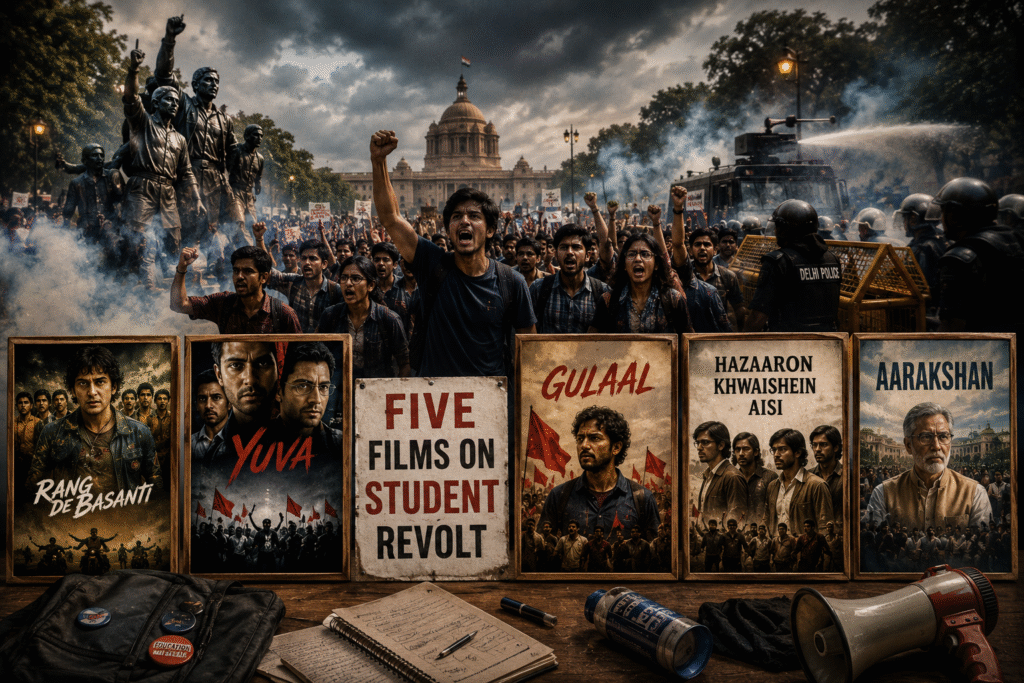
As Jantar Mantar burns with tear gas and slogans this July, with Gen Z’s Cockroach Janta Party demanding accountability over the NEET-UG paper leak and Sonam Wangchuk fasting from a hospital bed in solidarity, it’s worth remembering that Hindi cinema has long been drawn to this same tension: idealistic students colliding with an unmoved system. Here are five films that got there first.
1. Rang De Basanti (2006)
Rakeysh Omprakash Mehra’s tale about the political awakening of a group of jaded urban youths remains the genre’s high-water mark. The film follows a young filmmaker who casts college students to play freedom fighters in her documentary, and after realising the corruption in government, the students take matters into their own hands. Its afterglow was real: the movie is widely credited with inspiring actual youth-led candlelight protests against state policy in its wake.
2. Yuva (2004)
Mani Ratnam’s ensemble drama revolves around three separate lives connected by one common thread: student politics. Set in Kolkata, it traces how campus elections and youthful idealism get entangled with real-world criminality and compromise.
3. Gulaal (2009)
Anurag Kashyap’s film, set in modern-day Rajasthan, delves into the state’s student and secessionist politics. A law student who is a Rajput gets drawn into a local leader’s campaign for a Rajputana separatist movement, and the film becomes a study of how student politics can genuinely shift the world around it, while exposing the flaws in governance and unequal access to democratic rights.
4. Hazaaron Khwaishein Aisi (2005)
Sudhir Mishra’s film follows JNU-era student radicals of the 1970s as their revolutionary idealism runs headlong into the Emergency and the compromises of adulthood, an early template for the “campus dreamer becomes disillusioned adult” arc that later films borrowed heavily from.
5. Aarakshan (2011)
Prakash Jha’s drama uses a college principal and his students to examine caste-based reservation and the rot inside India’s coaching-and-education economy, a plot that, watched today, reads almost as prologue to this summer’s paper-leak protests.
Fourteen years after Rang De Basanti convinced a generation that outrage could become action, Jantar Mantar is asking the same question the screen once did: does the fire still lead somewhere real, or just burn out?
About The Author