
The government’s own paperwork admits as much: the Capital’s most privileged zone grew too large to justify, and nobody ever bothered to measure the rest.
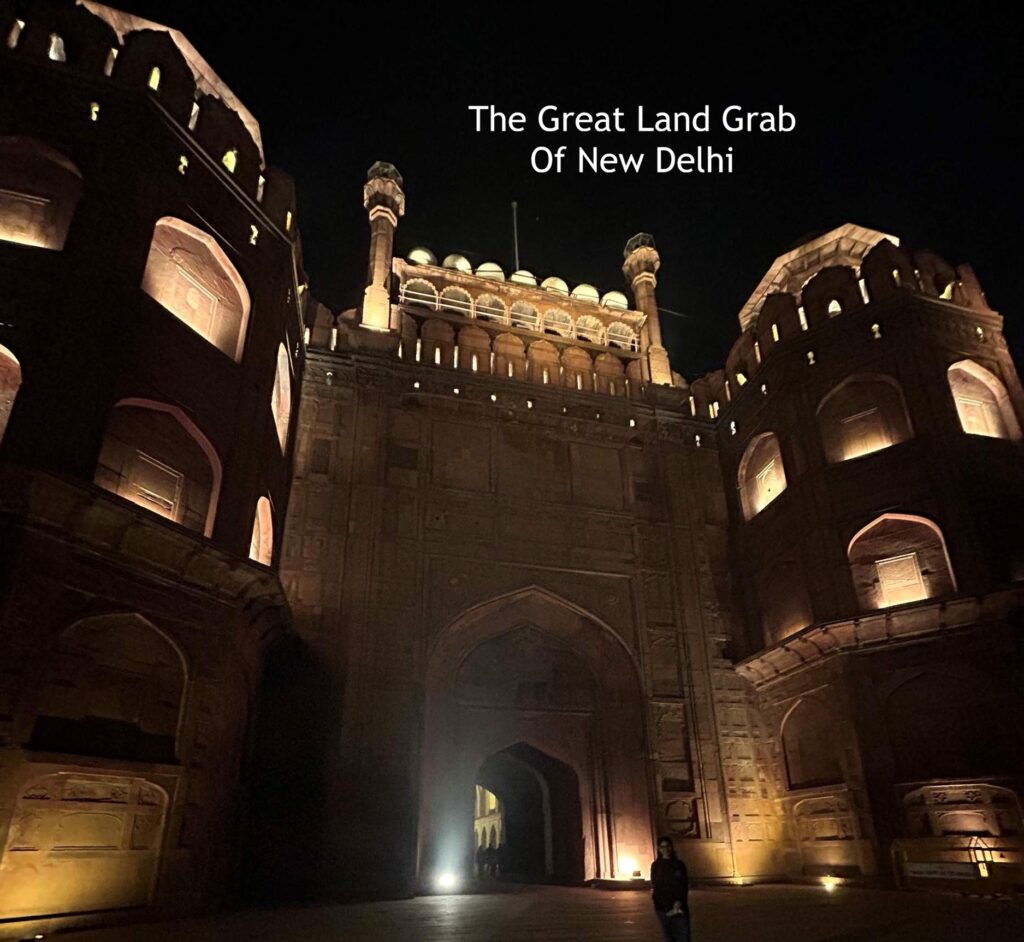
THE CAPITAL SITS ON LAND WORTH A DOZEN AIIMS-LIKE HOSPITALS, EDUCATIONAL INSTITUTIONS, PUBLIC AMENITIES, AND NO ONE HAS EVER COUNTED IT
The government’s own auditors caught its own land agency asleep at the wheel. They found the government’s own land agency struggling to account for and manage one of the most valuable public land banks in the country. And the government’s own planners, in an official LBZ review, recorded that the Lutyens’ Bungalow Zone had already expanded from 25.88 sq km to 28.73 sq km before proposing that it be rationalised back to 23.60 sq km.
There is a version of Delhi that most of its twenty million residents will never enter. It has no traffic. Its roads are wide enough to land aircraft on. Its buildings sit one, sometimes two storeys tall, surrounded by more green space per resident than any hospital, school or housing colony in the city could dream of. It is called the Lutyens’ Bungalow Zone, and it occupies some of the most expensive, most connected, most fought-over real estate on the Indian subcontinent.
The Confession Buried in a Government File
Governments rarely confess to their own excess. Delhi’s did, quietly, in a planning document few outside the bureaucracy ever read.
That is not a marginal correction. It is an official admission that nearly 7,100 acres of India’s most coveted urban land by most published estimates, over 90 percent of it under direct central government ownership had drifted into a planning envelope too large to justify, much of it still tied up in low-density bungalows, ministries, institutional compounds, and manicured open space. In plain terms, roughly 1,268 acres of it, an expanse larger than New York’s Central Park, were identified for rollback from an already oversized central land regime. And even that figure may understate the problem: no consolidated public audit tells us how much more premium land across the wider capital remains underused, fragmented, or locked into low-yield official occupation.
Read that again. The state itself decided its most rarefied real estate had become too large, too rigid, and too locked into a colonial-era template to serve a modern capital of over thirty million people. That is not an activist’s opinion. That is the government’s own paperwork.
The Capital That Lost Track of Its Own Empire
Here is the more uncomfortable truth: nobody not the Delhi Development Authority, not the Land and Development Office, not the CPWD, not the Delhi government itself can produce a single, consolidated figure for how much land the state controls across this city. Ownership is scattered across DDA, L&DO, CPWD, defence holdings, public sector undertakings, autonomous bodies, and a sprawling, largely unaudited universe of trusts, foundations, societies, clubs, guest houses and institutions that received public land decades ago and were never meaningfully checked on again.
The Comptroller and Auditor General’s own audit of DDA’s land management found exactly the pattern you’d expect from an estate this size and this old: weak land records, poor allotment control, and little follow-up on how land was actually being used once it left government hands. Translation: a portion of Delhi’s crown-jewel land bank may be sitting idle, under-built, or quietly repurposed, and the institutions meant to track it cannot say with confidence how much, or where. This is not a story about corruption. It is a story about scale, memory and neglect — a capital so land-rich it stopped counting.
537 Acres of Proof: The Reform Delhi Already Pulled Off
Sceptics will say central Delhi’s land cannot be touched too sensitive, too symbolic, too politically radioactive. Delhi’s own government redevelopment machine has already proven them wrong.
The GPRA colony redevelopment programme seven government housing colonies spanning roughly 537 acres — has been quietly replacing 12,970 ageing, low-rise official dwellings with 24,917 modern units. As of March 2026, 2,722 new flats had already been handed over, with another 6,632 under active construction. This is not a hypothetical. It is a functioning, government-run demonstration that the capital’s oldest, lowest-density public housing stock can be rebuilt taller, denser and better, without triggering the constitutional or security crisis critics predict.
If the state can do this for its own civil servants’ housing, the far more urgent question is why the logic stops there.
The Hospitals That Were Never Built: Delhi’s Lost Arithmetic
Consider what “modest” redevelopment of central land could actually deliver, using the same planning benchmarks applied to India’s own hospital construction: a 500-bed hospital typically requires roughly 6.5 hectares, or about 16 acres.
Redeploy just 100 acres of underused central land a fraction of what sits inside the LBZ alone and the arithmetic suggests room for roughly six full-scale 500-bed hospitals. Free up 250 acres, and the number climbs toward fifteen, even after allowing for roads, parking and support infrastructure.
These are illustrative planning estimates, not government commitments, but they are drawn from real, publicly used space benchmarks, not guesswork. And they expose an uncomfortable truth: every acre of central Delhi locked into low-turnover bungalow living or dormant institutional allotment is an acre that is not becoming a hospital bed, a school seat, a teacher’s flat, or a public clinic for the citizens who actually pay for this city to run.
The Red Lines: What Stays Sacred
None of this is a call to bulldoze the constitutional core. The President’s Estate. Parliament. The Supreme Court precinct. The Prime Minister’s residence. Genuine security and diplomatic installations. Delhi’s protected heritage architecture and green canopy. These deserve, and require, permanence, proximity and protection. No serious reform agenda argues otherwise.
The target is not the symbols of the republic. It is the sprawl of privilege that grew up quietly around them the routine official housing, the underused institutional plots, the low-rise bungalow stock occupying land whose location value could fund and house public infrastructure many times over.
Having advised several of the country’s leading realty firms over the years, I have often wondered why optimum utilisation of space was never treated as a core planning criterion when Lutyens’ Delhi was conceived. It is high time we acknowledged that oversight and acted on it with the seriousness it deserves.
The Four-Step Fix Delhi Keeps Delaying
- Publish a single, GIS-mapped public land audit – every DDA, L&DO, CPWD, Delhi government, PSU, and major institutional allotment, with parcel size, title, occupancy and current use, in one public document.
- Classify every parcel into three honest buckets: non-negotiable constitutional and security land; heritage-protected land; and surplus or low-intensity land fit for redevelopment.
- Relocate routine official housing and non-sensitive offices to well-planned, transit-connected districts — Dwarka, Narela, and other NCR nodes — built with schools, clinics and green space from day one, on the GPRA model.
- Redevelop select central parcels only where public return is unambiguous: hospitals, schools, affordable housing, transit hubs, civic plazas, with value capture and mandatory public-use clauses, so the uplift benefits taxpayers, not just incumbent landholders.
The Reckoning
The evidence does not support a conspiracy. It supports something almost more damning: inertia. A government audit already found the state’s own land records in disarray. A government planning review already admitted the capital’s most privileged zone had outgrown its justification. A government redevelopment programme already proved that rebuilding public land taller and smarter is not just possible , it is already happening, 537 acres at a time.
What is missing is not capacity. It is will.
Delhi does not need to abandon its constitutional core, its heritage, or its security perimeter. It needs to stop letting inherited privilege quietly monopolise the most valuable soil in India while the city’s hospitals overflow, its schools run double shifts, and its middle class is priced out of the neighbourhoods closest to where the country is actually governed.
The land is there. The precedent is there. The audit trail is there, in the government’s own documents. All that remains is the decision to act on it
About The Author

Bewildered after seeing your post which is selt explanatory. Wonder how many public utilities could come up on such huge chunks of land to benefit a larger size of populace.
Govt itself seems to be acting as a waqf board assimilating and hording lands and it has been going on like eternally after independence but to whose avail is the larger question 🤔
True , this is the real picture of government
Very revealing. Administrative machinery has to wake up.