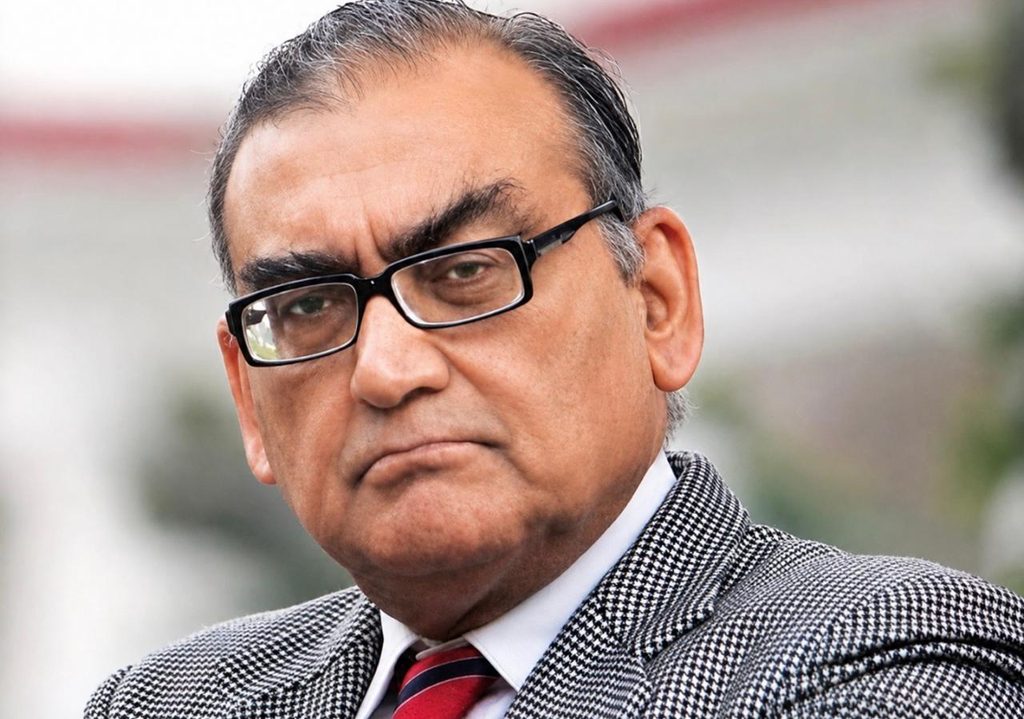
Justice Markandey Katju (retd)
In his Independence Day speech on 15th August 2026 from the Red Fort, Delhi, Indian Prime Minister Modi said that though armed rebels have been destroyed in India, ‘dimaaghi naxals’ (mental rebels) must be identified, isolated, and eliminated.
Prime Minister Modi did not explain whom he meant by the expression ‘dimaaghi naxals’, so I am giving my own interpretation.
According to me, ‘dimaaghi naxals’ are the dissenters in society, those who criticise the conventional beliefs and the existing state of affairs in the country, and are therefore the most dangerous people.
These are some examples of ‘dimaaghi naxals’ in history :
1. The Charvaks, or materialist and atheistic thinkers in ancient India
All books written by charvaks were destroyed by the orthodox people, who condemned them ( calling them ‘rakshasas’ or demons ), so we know their views only from the ‘purvapaksha’ ( preliminary chapter ) in the books of of their opponents (e.g. the book Sarva Darshan Sangrah by Madhavacharya ).
2. Gautam Buddha, Jesus Christ, and the Prophets
3. Mughal Emperor Akbar, who proclaimed the policy of Suleh-e-Kul, or giving equal respect to all religions and communities.
4. Martin Luther, who in his 95 theses, posted on the door of the Castle Church in Wittenberg, Germany in 1517, criticised the Roman Catholic Church for its corruption, thus leading to the Protestant Reformation in Europe.
5. Thomas Jefferson and others who wrote in the American Declaration of Independence of 1776 that all men are created equal, having the inalienable rights of life, liberty, and the pursuit of happiness.
6. The French political philosophers Voltaire and Rousseau, who condemned the feudal system then prevailing in France, and were thus precursors of the great French Revolution of 1789
7. The Polish scientist Copernicus who in 1543 propounded the heliocentric theory that the earth goes around the sun, rather than the other way around ( the geocentric theory, in which all people then believed ) which was then a dangerous theory as it was contrary to what was said in the Bible, and hence was a capital offence, for which one could be burnt at the stake by the Inquisition.
8. Lenin, who led the Russian Revolution of October 1917
9. Bhagat Singh, Chandrashekhar Azad, Surya Sen, Bismil, Ashfaqulla, Sukhdev, Rajguru, Khudiram Bose, and others who believed in armed struggle against British rule, instead of the method of ‘ahimsa’ or non-violent struggle preached by Gandhi.
10. The Hindi poet Kabir and the Urdu poets like Faiz and Josh. Also, the Bengali writers Sharad Chandra Chattopadhyaya and Kazi Nazrul Islam, and the Tamil poet Subramania Bharti
11. Scientists like Newton, Darwin, Rutherford, Max Planck, C.V. Raman, etc and mathematicians in ancient India and Greece like Aryabhatta, Brahmagupta, Bhaskar, Archimedes, Pythagoras, etc, and in modern times like Gauss, Euler, Ramanujan, etc
12.This humble self is of the considered view that India’s institutional architecture is showing unmistakable signs of decay, hollowing out and, in places, implosion. State institutions that ought to be the pillars of a functioning democracy increasingly risk becoming empty shells, while poverty, unemployment, child malnutrition, inadequate healthcare and deep social and economic inequalities remain stubbornly entrenched.
The country therefore needs not merely another political slogan or electoral rearrangement, but a mighty, united and peaceful people’s movement, one rooted in democratic participation, public accountability and a willingness to make meaningful sacrifices for fundamental change. The objective must be nothing less than a historic transformation of India’s political, economic and social order, leading to rapid industrialisation, productive employment, stronger public institutions and a sustained rise in the standard of living of every citizen.
The real revolution, after all, need not be one of violence; it can be a revolution of public consciousness, democratic mobilisation and institutional renewal, where power is ultimately returned to the people and governance is made answerable to those in whose name it is exercised.
Also, the British swindling called the Partition of 1947 on the basis of the bogus 2 nation theory must be annulled, and India, Pakistan, and Bangladesh must reunite under a secular government with modern-minded patriotic leaders determined to rapidly industrialise the country, make it a modern industrial giant ( like China ), and give our people decent lives.
About the Author :Justice Markandey Katju is a former judge of the Supreme Court of India and former Chairman of the Press Council of India, known for his outspoken views on social, political, and legal issues. He writes and speaks extensively on justice, secularism, and the socio-economic transformation of India.
Disclaimer :This is an opinion piece. The views, thoughts, and opinions expressed in the text belong solely to the author and not to News Trust India, its management, or its editorial board. News Trust India does not endorse, and is not liable for, any claims made by guest authors or columnists.
About The Author