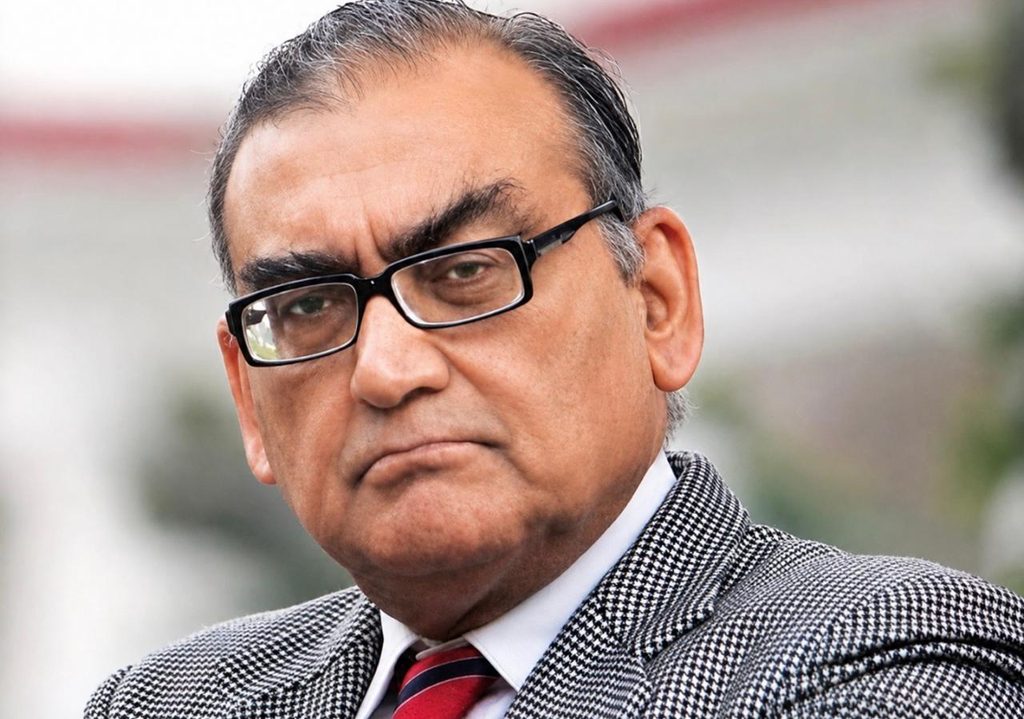
Justice Markandey Katju (retd)
Most of my time as an adult has been spent walking in the cracks of what once made up a single civilisation. This crack was created when someone drew a boundary around a part of India that separated it into two countries (Punjab), two currencies, two anthems and forced people to begin to heal or to remain unhealed on either side of that boundary. What I’ve found in those cracks are mostly tears. Occasionally I find a song. One of those songs is the favourite of mine sung by the late Pakistani singer Reshma.
Reshma was born in 1947 to a nomadic Banjara family travelling across the Rajasthan Desert. Her family migrated to what was now Pakistan, as did thousands of other families. The new boundaries were established quickly, in about five weeks. At some point during that process, she began singing. After growing up in Sindh surrounded by the dust and devotion of a Sufi Shrine, Radio Pakistan sent a talent scout to hear children sing. When he heard Reshma’s voice rising above the crowd of pilgrims, he immediately knew that the voice didn’t belong with them. She never learned how to read any words in the script she sang. She took with her hundreds of songs from the Punjabi and Siraiki folk canon. She held these songs in memory, just like her ancestors held everything they had, including their lives, on the backs of migrations from one unstable place to another.
My favourite song by Reshma comes out of a long line of songs in Punjabi Verse that tell the story of a woman who falls deeply in love with someone. To fall so deeply in love means she spends something that her family’s honour can not afford. And in exchange for falling in love, she gets nothing except to know that she fell in love. These songs follow the emotional structure of Heer waiting for Ranjha, Sohni swimming towards Mahiwal using an unbaked clay vessel she knows will disintegrate before she can reach him, and Sassi going across a desert for Punnu who has already been taken. In the Sufi tradition, this same posture is not romantic self-pity- it is ‘ishq-e-majazi , worldly love intentionally represented as preparation for ‘ishq-e-haqiqi, love of the divine. Like divine love, worldly love demands every possible thing you have and offers you nothing in return. The use of a unique word ‘Ve” in punjabi has a emotional undertone to it; used to describe a situation and even to address the loved one – a word that is used in pain and joy in equal measure. Reshma combined the pain and joy of eternal love, likewise, in equal measure. By the final line, she understands completely what she gave up. She knows there are countless other women who could have stood in her shoes. But by the last line she has stopped believing that even one hour of her own life remains hers to deny and yet continues to love.
In a metaphorical sense, I’ve always thought of this song as being the love that a revolutionary feels for his nation and people – a love that is typically secret, that doesn’t expect anything back, that the very people it supports may never recognise nor reward. Punjab has always required sacrifices in darkness.
Kartar Singh Sarabha died hanging at age 19 for a homeland that would eventually be divided into two separate countries within 30 years. He opposed the division of his homeland on the terms he would never live to see, and he wouldn’t accept. Bhagat Singh went to the gallows younger than Sarabha for a country whose border dividing its most important land would pass right through his beloved province. Both men expected no gratitude from their fellow citizens. They didn’t receive it in any form they would have desired. Their loyalty, similar to the women in this song, accounted for itself, and it requested no accounting from anyone else.
About the Author :Justice Markandey Katju is a former judge of the Supreme Court of India and former Chairman of the Press Council of India, known for his outspoken views on social, political, and legal issues. He writes and speaks extensively on justice, secularism, and the socio-economic transformation of India.
Disclaimer :This is an opinion piece. The views, thoughts, and opinions expressed in the text belong solely to the author and not to News Trust India, its management, or its editorial board. News Trust India does not endorse, and is not liable for, any claims made by guest authors or columnists.
Links and image curtsey youtube and the internet
About The Author