
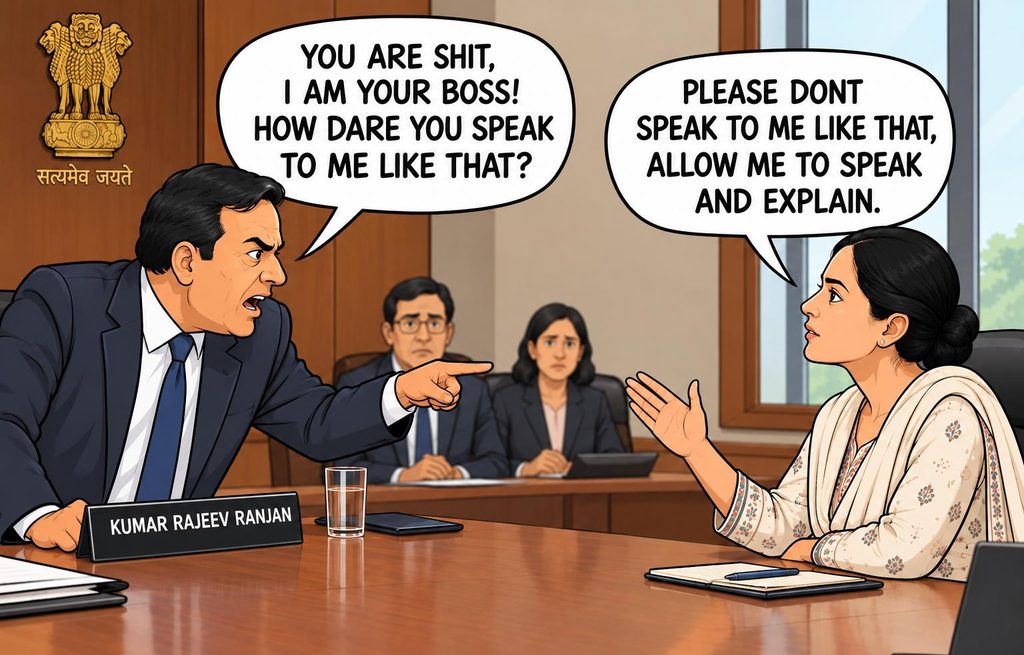
An alleged tirade against a woman officer raises a harder question. Who decides which officers hold power over others, and who watches them once they do?
“You are shit.” “I am your boss.” and “How dare you speak to me like that?” Words, allegedly from a man who once was arrested by CBI and appears to have a long tainted record of unlawful activities.
Those are the words attributed to IAS officer Kumar Rajeev Ranjan during an online review meeting in Jammu and Kashmir. They were allegedly aimed at JKAS officer Beenish Wani, who was midway through explaining her department’s work. Reports say the abuse was followed by an instruction to prepare her suspension. Whether any formal order was issued has not been established.
Words like these describe more than a bad temper. They describe a theory of power in which rank is ownership and a subordinate’s dignity is held on loan.
The room, the recording, the dispute
The confrontation reportedly took place on 14 October, during a review of Mission YUVA. Wani, Assistant Director of Employment and Counselling in Ganderbal, was setting out departmental work and the role of the National Rural Livelihoods Mission when the exchange turned.
Ranjan reportedly questioned whether the recording was authentic. The department says the circulating clips were selectively edited and that the full recording is with the National Informatics Centre. Wani is reported to have confirmed that the incident took place. On 16 October, the government appointed Mandeep Kaur, Commissioner/Secretary, Housing and Urban Development, to investigate within 15 days. She is to examine the original recording, hear witnesses and establish whether any disciplinary instruction followed.
An inquiry is the right first step. Context may explain a disagreement, but it cannot excuse abuse if the reported words are authenticated.
The man in the chair
Ranjan, a 2010-batch IAS officer, is today Administrative Secretary, Labour and Employment. In 2015–2016 he was Deputy Commissioner and District Magistrate of Kupwara, a period that falls within the arms-licence investigation.
What follows is a long paper trail:
- March 2020: Arrested by the CBI in the arms-licence case, then suspended.
- February 2021: Reinstated on a review committee’s recommendation and posted as Additional Secretary, Revenue.
- February 2024: Named in an Enforcement Directorate prosecution complaint covering 21 accused persons and entities. The Special Court in Jammu took cognizance on 12 February.
- November 2024: The Centre sanctioned his prosecution by an order dated 28 November, reported in January 2025.
- February 2025: The CBI searched premises in a separate disproportionate-assets investigation.
The record also shows what is absent: there is no conviction. Every item above is an allegation or a procedural step, and none is a finding of guilt. But reinstatement was not exoneration either, since the formal proceedings carried on.
What the licence case is, and isn’t
The wider investigation concerns alleged irregularities in more than 2.74 lakh arms licences across several districts between 2012 and 2016. Those are not licences attributable to Ranjan personally.
The ED alleges that licensing authorities, officials, dealers and intermediaries issued or renewed licences for ineligible applicants, bypassing procedure for money. The charge is the corruption of official power, which goes well beyond forged paperwork. The agency reports ₹4.69 crore in attached properties and ₹1.58 crore in cash, plus gold, seized across the wider case. Those totals cannot be pinned wholly on Ranjan, and the ED’s public statement gives no individual licence count or transactions for him.
Guilt belongs to the courts. Postings belong to the government.
The officer on the other end of the screen
Wani is a 2015-batch JKAS officer, and her designation is confirmed by Ganderbal’s official directory. The Deputy Commissioner Ganderbal’s official account has shown her explaining the Mission YUVA baseline survey and asking for cooperation with enumerators. A February 2026 public post places the Assistant Director of Employment at a self-employment outreach event, an entrepreneurship mela in Safapora.
That is programme work and public outreach. It is not an independently verified performance ranking, and it needs no embellishment. Dignity at work is not a prize for top performers.
Four questions for the government
Reinstatement explains how Ranjan’s suspension ended in 2021. It does not explain what came after: the ED complaint, the prosecution sanction, the second investigation, and a continued place in a powerful supervisory post.
The government owes the public answers to four questions:
- What reasons and conditions governed his reinstatement?
- Was his suitability reviewed after the 2024 and 2025 developments?
- What safeguards accompanied his continued supervisory authority?
- How will Wani and the witnesses be protected from retaliation?
These are demands for reasons, not for punishment without trial. Keeping a person in service and handing him authority over others are separate decisions, and the presumption of innocence shelters only the first from scrutiny.
What a review meeting is for
A review meeting exists to surface problems. When an honest explanation draws humiliation, and disagreement draws a threat to someone’s career, officers learn quickly to bring compliance and keep their candour to themselves. Government then gets worse information and makes worse decisions, and the cost lands on the people the schemes were meant to serve.
None of this is a war between the IAS and the JKAS. Standards of conduct must bind every cadre and every rank. The administration should preserve the evidence, examine any adverse action that grew out of the dispute, shield the witnesses, and publish the inquiry’s findings and its reasoned response as far as the law permits. A 15-day deadline means little if the conclusion vanishes into administrative silence.
“I am your boss” names a hierarchy. It gives no one ownership of another officer’s dignity, and no immunity from public scrutiny.
About The Author