
While the world chases the next algorithm, India arrives in Venice Biennale with cracked earth, suspended thread, and five hundred years of knowing.
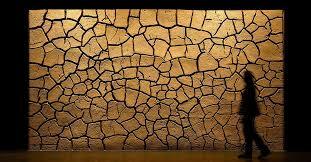
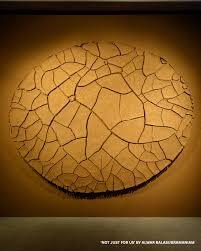
Before a single visitor arrives, the work has already begun. In a studio near Tirunelveli in rural Tamil Nadu, surrounded by paddy fields and the sounds of a landscape that predates recorded time, an artist lays wet earth on a wide surface and steps back. He does not paint. He does not carve. He waits for days, then weeks, then months as the sun draws water from the clay and the ground finds its own language: a language of fractures, of slow parting, of the quiet, irreversible eloquence of evaporation. As the surface dries, peacocks cross it and leave their prints. Monkeys pass through. Snakes trace their unhurried paths. Alwar Balasubramaniam preserves every impression. The earth, he says, recorded everything. When he finally lifts the finished panels and carries them to Venice, he has not made a sculpture so much as witnessed one.
This is the art that India has chosen to place at the 61st International Art Exhibition of La Biennale di Venezia, the world’s most scrutinised contemporary art stage. And in that choice unhurried, material, almost stubbornly handmade lies the most quietly powerful cultural statement India has made in years.
The National Pavilion of India, titled Geographies of Distance: Remembering Home, is installed within the Isolotto, a 14th-century warehouse in Venice’s Arsenale. Curated by Dr. Amin Jaffer and presented by the Ministry of Culture, Government of India, in partnership with the Nita Mukesh Ambani Cultural Centre and Serendipity Arts, the exhibition opened to the public with previews from 6 to 8 May, running until 22 November 2026. It brings together five contemporary artists whose only shared grammar is the refusal to rush.
Balasubramaniam’s two large-scale soil panels Drift and Not Just for Us sit on the Isolotto floor like excavated landscapes, their surfaces cross-hatched with fissures formed over months of drying in his rural Tamil Nadu studio. The cracks evoke drought patterns, ecological scars, and the indigenous philosophy where land is viewed not as property, but as ancestry, memory, and spirit. In a world of instant renders and AI-generated imagery, Bala’s process is almost scandalous in its patience. There is no shortcut. The earth decides when it is finished.
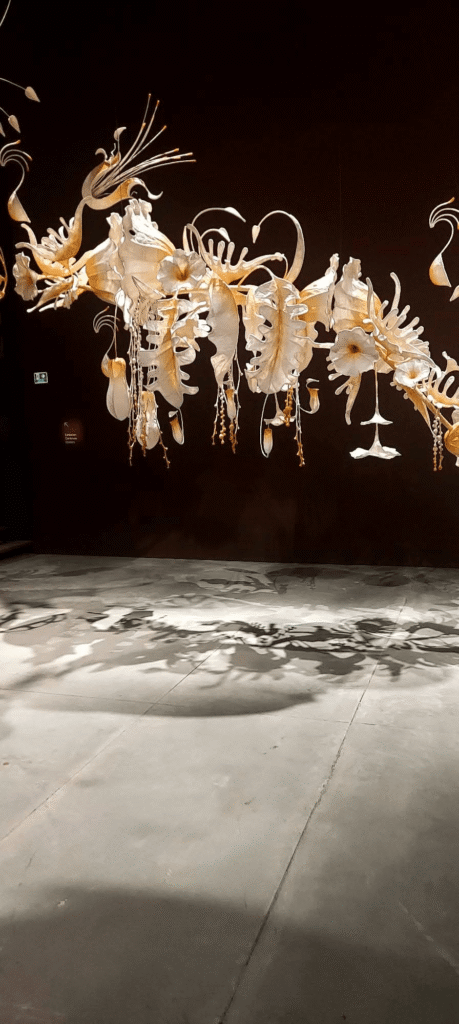
Nearby, Karnataka-based Ranjani Shettar suspends her installation Under the Same Sky above the pavilion floor — intricately crafted forms inspired by flowers and natural growth, made entirely by hand using traditional processes, appearing weightless, forming a conceptual garden that visitors move through. Working with handwoven cotton fabric, binder, steel, and lacquer across two decades of sustained practice, Shettar describes her method as composing an orchestra: individual phrases built in the studio, assembled on-site into a final movement of rhythm and crescendo. Each suspended element bears the trace of a hand that cannot be replicated, printed, or pressed.
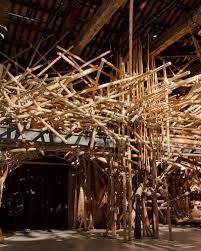
Then there is Asim Waqif’s Chaal , a monumental bamboo structure inspired by the temporary scaffolding systems seen across India’s urban landscapes, reflecting themes of labour, mobility, urbanisation, and the transformation of contemporary India, while drawing attention to bamboo’s deep cultural and ecological significance within tribal and rural communities across Northeast India, Central India, and West Bengal. Waqif has worked with bamboo for nearly thirty years. He has watched it hailed in Milan design studios as a wonder-material for sustainability while the artisans who mastered it over generations quietly lose students, lose commissions, and lose the argument to concrete. His installation does not resolve that irony. It builds it, pole by pole, into the ceiling of a medieval Venetian warehouse.
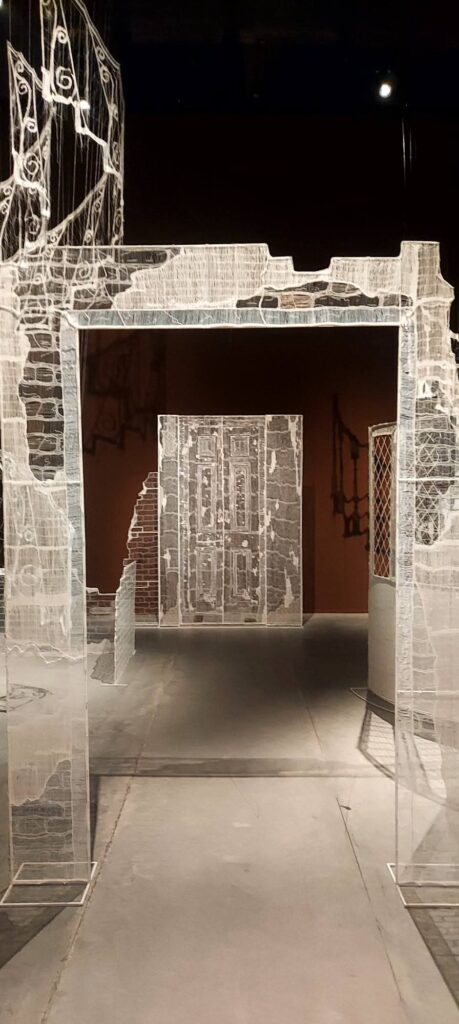
Sumakshi Singh’s Permanent Address , life-sized panels of embroidered silk, cotton, and nylon thread stretched on steel frames and spread over twelve metres reconstructs her demolished Delhi family home as a series of translucent membranes. Walls, grilles, doorways, the ghost of a staircase: all rendered in thread finer than hair, suspended in air where brick once stood. And from Ladakh, the pavilion’s youngest voice, Skarma Sonam Tashi, presents Echoes of Home: a mountain settlement recreated in papier-mâché from recycled notebooks and old newspapers, placed on a mezzanine that the viewer must climb toward the body enacting the longing the work describes.
Here is the paradox that makes the India Pavilion the most intellectually alive room at the Biennale: this is the same nation that gave the world UPI, that processes more real-time digital transactions than any country on earth, that launches spacecraft to the moon’s south pole and exports software architects to Silicon Valley. India is among the fastest-moving civilisations alive. And yet what it has chosen to say to the world, at the highest table of contemporary art, is this slowness is not backwardness. The hand is not obsolete. Time spent waiting for soil to crack is not time wasted.
Rather than treating indigenous and tribal culture as static or historical, the exhibition transforms ancestral practices into contemporary artistic language — through bamboo, earth, embroidery, and natural fibres, foregrounding philosophies long associated with India’s indigenous communities: sustainability, coexistence with nature, collective memory, and handmade labour. At a Biennale crowded with digital installations and geopolitical theatre, this is the quietest and therefore the loudest room in the Arsenale.
Art’s greatest purpose beyond beauty, beyond provocation is to hold still what the world is rushing past. In Venice in 2026, India holds still five truths the world is accelerating away from: that earth remembers, that thread preserves, that bamboo endures, that absence carries presence, and that the slowest hand sometimes draws the deepest line.
About The Author