
The Question a Mystic Asked Indira Gandhi Seven Days Before She Died.
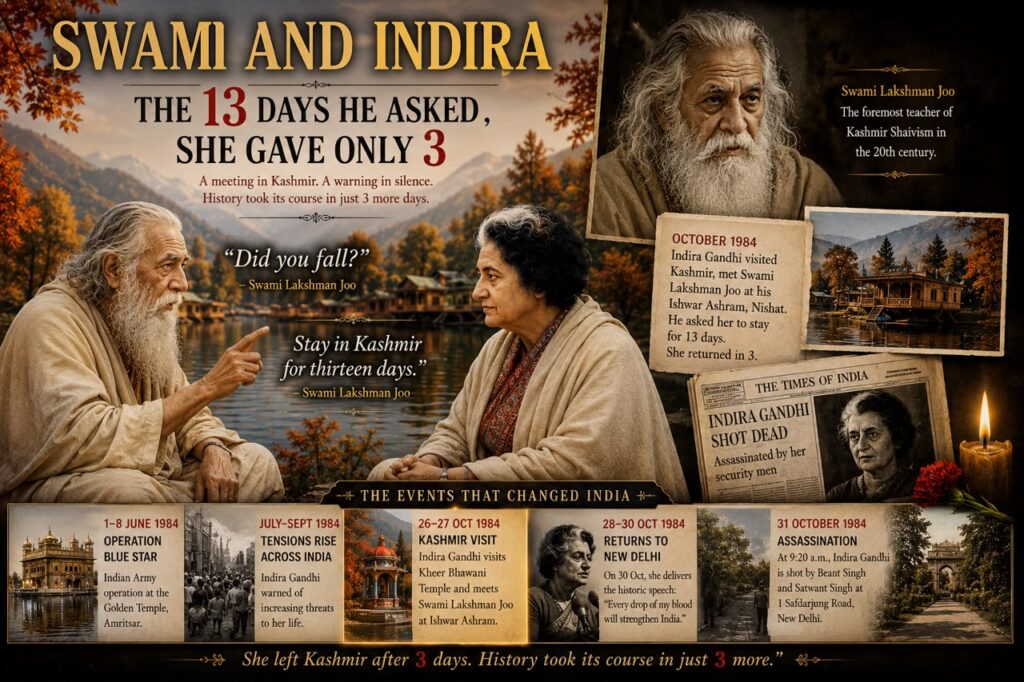
She walked into the ashram unannounced, without cameras, without the usual choreography of a Prime Minister’s visit. The old man looked up at her, not with the deference the room expected, but with something closer to recognition, as if he’d been waiting.
He didn’t greet her. He didn’t ask about Delhi, or the crisis convulsing the country, or the men she’d refused to remove from her own security detail.
He asked her one question.
“Did you fall?”
She went still. Then she said yes.
Seven days later, she was dead.
To understand why that question landed the way it did, you have to go back a few months to the summer of 1984, when India was already bleeding.
In June, the Indian Army had stormed the Golden Temple complex in Amritsar. Operation Blue Star was meant to end a siege; instead, it opened a wound. Bhindranwale was gone, but so was any illusion of calm the Sikh community’s grief was raw, and India’s intelligence agencies weren’t shy about naming exactly where the anger was likely to land: on the Prime Minister herself.
A Detour That Wasn’t on Any Itinerary
Officially, it was state business. But the people around her sensed it was something else.
She stopped first at the Kheer Bhawani Temple, sacred to the Kashmiri Pandit community, a shrine to the goddess Ragnya Devi — not a ribbon-cutting, but a pilgrimage.
Then she did something almost no sitting head of government does. She went to see a teacher.
Swami Lakshman Joo was, by then, the foremost living voice of Kashmir Shaivism — a non-dualist philosophy grown entirely out of the Valley’s own soil, as distinct from mainland Advaita as a dialect is from the language it split from. His Ishwar Ashram sat above the Dal Lake in Nishat, deliberately far from protocol officers and press pools.
A Prime Minister mid-crisis, weeks from an election, under a named and credible threat choosing to spend part of her last hours in Kashmir here, with him, tells you this wasn’t a courtesy stop. She was looking for something Delhi didn’t have.
What the Files Don’t Say
This is where the paper trail simply ends.
No transcript exists. No aide’s notebook records it. No government file mentions a single sentence spoken inside that ashram. What survives instead is older than any file, and in its own way, harder to erase: oral memory, carried across four decades by the Swami’s disciples and the wider Kashmiri Pandit community never archived, never once let go of.
“Did you fall?” he is remembered to have asked.
She had and she was visibly startled that he knew.
Then, the story goes, he asked her to do something simple and enormous at once: stay in Kashmir. Not for a day. For thirteen days.
She couldn’t. Delhi doesn’t wait, and neither did her schedule. She stayed briefly. Then she left.
Here’s the line that has to be drawn carefully, because it’s the whole point of the story: the meeting itself is verified – the date, the place, the two people in that room, beyond dispute. The dialogue is not. It exists nowhere on paper. It is oral tradition sincerely held, widely repeated, but not archival fact. That’s not a weakness in the story. It’s exactly why the story is still breathing four decades later. It lives in the space between what got written down and what a community simply refused to let disappear.
The Countdown Nobody Could See
Whatever passed between them in that ashram, it didn’t slow her down for even a day.
She flew back to Delhi and picked her schedule up exactly where she’d left it.
Day 5 – 30 October, campaigning in Odisha, she delivered a line history would later replay with something close to disbelief:
“Every drop of my blood will strengthen India.”
She had no way of knowing how soon, or how literally, that sentence would be tested.
Day 7 -31 October 1984, roughly 9:20 in the morning. She walked the short garden path connecting her residence to her office at 1 Safdarjung Road. Two members of her own security detail stood along that path , the same detail she had refused to alter.
Beant Singh and Satwant Singh opened fire at point-blank range.
She was rushed to the All India Institute of Medical Sciences. The doctors could not save her.
Her death didn’t end there. It detonated again waves of anti-Sikh violence tore through Delhi and other cities in the days that followed, one of the darkest chapters in India’s post-Independence history.
What the Record Keeps, What the People Keep
Four decades on, that meeting at Ishwar Ashram occupies a category almost nothing else does: confirmed in outline, unconfirmed in substance. No historian disputes that Indira Gandhi visited Swami Lakshman Joo in her final days in Kashmir. What was actually said between them lives in a different kind of archive entirely ,not a government record room, but the memory of a community that has spent generations guarding a story the state never bothered to write down.
This isn’t prophecy dressed up as fact, or conspiracy wearing history’s clothes. It’s something quieter, and arguably more durable , proof that the official record and a people’s lived memory don’t always tell the same story, and that the space between them is very often where the truest cultural memory survives.
Call it coincidence. Call it intuition. Call it faith.
Whatever it is, it has outlasted every government file ever written on the subject. And it still moves , through Kashmir, through the memory of its people , seven days, and four decades, after a Prime Minister walked out of an ashram for the last time.
The warnings weren’t abstract. Advisors told her plainly ,take the Sikh officers off your personal security detail.
She refused. In public, and on principle. To do otherwise, she believed, would be to let India’s secularism buckle the moment it was tested.
It was one of the most principled stands of her political life.
It was also, as it turned out, a decision with a countdown attached to it.
This is the woman who boarded a flight to Kashmir in the last week of October 1984 , carrying threats she knew were real, and a decision she refused to reverse.
(AI-generated image )
About The Author


Coming events cast their shadows before.
Though Swami ji had foreseen the coming catastrophe for her , she couldn’t avoid what is destined and had to perish.
Remember having just a few days before come to my Srinagar home from my ongoing technical degree from outside for a two weeks break when the incident happened. Those days almost every KP was christened a Congressee which was true to a great extent . After some jalsa- jaloos the stones were pelted on many a KP house , a soft target though the sentiment was that of grief.