Ramayana: Part One arrives with the loudest promotion in Indian film history. Whether it arrives in memory the way a 1987 television serial did is a separate question, and no amount of grandeur can answer it in advance.
The film’s fiercest rival is not a Hollywood franchise or a rival star. It is a television serial that first went out on Doordarshan in 1987, nearly forty years ago, made with effects that looked humble even then. The challenge becomes sharper with the latest superhit ‘Hanuman Ansh’ and inevitable with the dismal ‘Adipurush’.
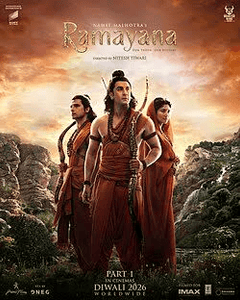
Ramayana: Part One arrives with large claims: the costliest Indian film ever, by its producer’s account; a release plan reported as a bid to beat the screen counts of Avatar and RRR; DNEG’s effects, IMAX cameras, a Hollywood-trained action team and a two-part design spanning two Diwalis. The serial can point to something no budget buys. People have kept going back to it.
The film opens worldwide on Thursday, 5 November, and I have not seen it; nor is this a film review. This is a pre-release judgement, drawn from thirty-five years in media and entertainment, and the forecast in it is a forecast. I expect a big opening and a major thinner afterglow than the claims promise: a response modest against the money spent and the size of what was said. I do not mean empty halls or disaster.
Making a familiar world look better does not make it felt more deeply. Claims are loans against the future, and a film repays them in only two currencies, takings and memory.
The Price of Duty
Start with what a Ramayana is. Valmiki’s Sanskrit epic. Tulsidas’s sixteenth-century Ramcharitmanas, which pours the story into devotion. Kamban in Tamil, Krittivasa in Bengali, and the Ramlila that still fills town squares every autumn. It is scripture, moral argument, performance, family saga and mass entertainment at once, and no single telling owns it. Ramanand Sagar’s serial, built mainly on Valmiki and Tulsidas, is one North Indian reading among many.
Nor is it a superhero saga in better costume. Rama’s greatness lies in the power he declines to use. That is maryada, an ethic of limits and restraint in which accepting loss is part of the duty. It is neither good manners nor obedience for its own sake; the epic keeps asking what obedience costs. Dharma does not mean easy righteousness either. It is a tangle of rival obligations, son against king, husband against ruler, promise against love, in which the right road is often the hardest one.
The epic has its wonders: a vanar who vaults the ocean, a demon king with ten heads, a golden city. Spectacle belongs to the story. It goes dead only when cut loose from the people who give it weight. A palace matters because someone has to leave it. Rama goes into exile to honour his father’s word, and Dasharatha, bound by that same word, dies of the grief. Bharata is handed a throne and rules in his brother’s name, as a trust. Lakshmana follows into the forest, and in many telling’s his loyalty is paid for in sleepless nights. Ma Sita insists on walking beside her husband; she argues, chooses and endures, a moral force in her own right and never merely the reason for a rescue. Hanuman’s strength is astonishing, but what moves people is the humility it serves. Some episodes, Sita’s ordeal and banishment above all, are read differently across traditions, and many scholars see the last book as a later addition. A film need not resolve them. It must make us feel what each person gives up, because a battle matters only if we know what has already been suffered.
Why the Serial Stayed
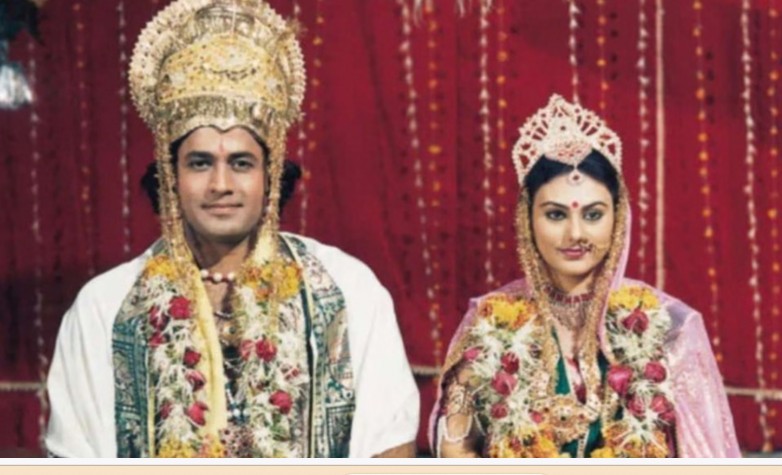
Sagar’s Ramayan was never flawless, and its seams show. Its staying power still needs explaining. The performances could be read at a glance: Arun Govil’s Rama, Dipika Chikhlia’s Sita and Sunil Lahri’s Lakshmana moved at the speed of feeling, not plot. It lingered over grief, argument and reunion, and its look was familiar to anyone raised on devotional storytelling. It was not cheap by the standards of its day; its limits are those of 1980s television, not of ambition. Nor was fame the issue. Govil, Arvind Trivedi as Ravana and Dara Singh as Hanuman were known before 1987. What matters is that for many viewers the roles outgrew the performers’ earlier lives. The actors did not wear the characters. They disappeared into them.
Then came 2020. With India under Covid lockdown, Doordarshan re-telecast the serial, and BARC reported about 170 million impressions across four episodes in the first weekend, the highest for any Hindi general entertainment programme since measurement began in 2015. The broadcaster later announced a world record of 7.7 crore viewers on 16 April, a claim fact-checkers disputed. The circumstances were exceptional: lockdown, free access, little else on offer, nostalgia, families at home together. I use the numbers for one narrow purpose, to show attention returning to a telling thirty-three years old. They are not ticket sales; yet any broad comparison to ticket sales would have pegged it at over Rs.2000 crores in India alone.
Music carried much of that memory. Ravindra Jain wove narrative, devotional verse, tune and repetition so tightly that the verses slipped off the screen, into prayer, recitation, humming in the kitchen. Tulsidas’s inherited chaupais, Jain’s compositions and a recurring musical idiom gave viewers phrases to keep. I cannot say every song was a hit; nobody has audited them. I can say that for many people the music and the memory of the serial are the same thing. The new film is not mute: A. R. Rahman is credited with the songs and Hans Zimmer, in his first Indian film, with the score. I have not heard them in a cinema, so I put it as a question. Will any tune from this film be asked for by a grandmother, hummed by a schoolchild, played by a devotee on a night train? A score that announces importance is one thing. A melody people choose to revisit is another. A credit promises craft. It cannot promise memory.
Stars, and What Money Has Bought Before
Stardom is the second weight. Ranbir Kapoor is Rama, Sai Pallavi is Sita, Yash is Ravana, Sunny Deol is Hanuman and Ravie Dubey is Lakshmana, a cast chosen with sharp commercial judgement. The doubts are fair ones. Can a viewer meet Rama without seeing the star? Can restraint survive a visual language built on heroic entrances? Will Hanuman’s service count for more than the actor’s arrival? Does Sita get an inner life, or become a picture of idealised beauty? These actors carry different screen histories. Sai Pallavi is known for naturalism, which could help. A Ravana played by a producing star may end up more thrilling than the man who defeats him. These are questions about performances I have not seen, not a verdict of miscasting.
Set the film beside what scale has and has not bought. Adipurush, released on 16 June 2023 with Prabhas as Rama, was reportedly made for more than ₹500 crore. Its producers claimed about ₹140 crore worldwide on day one and ₹395 crore gross in five; trade reports put the Hindi nett below ₹120 crore and recorded a Monday fall of around 78 per cent. Budget, claimed gross and nett are different things, and I have seen no audited profit figure, but the film was widely judged a letdown against its cost, with criticism gathered around its effects, dialogue and tone. Adipurush is a reason for vigilance, not proof that another film must fail. To escape the comparison, the new film needs one steady tone, dialogue that does not embarrass its own seriousness, and relationships that carry weight before the armies appear.
Now the other side. Kantara (2022), a Kannada film about a village deity and a family’s duty, was reported to have cost about ₹16 crore and passed ₹400 crore gross worldwide by late November 2022, by Taran Adarsh’s breakdown. Hanu-Man (2024), reported at ₹20 to ₹40 crore, used about 1,600 effects shots and earned an estimated ₹350 crore. Baahubali 2 (2017), reported at ₹250 crore, collected about ₹1,347 crore in India by Pinkvilla’s approximate list, carried by an oath, a betrayal and a queen mother’s command. The comparisons are loose, across different years and markets, but the direction is plain: returns followed feeling, not cost.
The purest case is this year’s own. Hanuman Ansh, released on 7 August 2026, follows the early life of Neem Karoli Baba, whom many devotees revere as a manifestation of Hanuman, and was reported to cost about ₹2 crore. It opened on roughly 250 screens and earned about ₹90 lakh in its first week. In its second it fell to about 40 screens. Then audiences began sending one another to it, and the distributor, Cinépolis India, widened the release to more than 2,000. Gulf News reported ₹300 crore in forty days, about ₹280 crore of it in India, making it the year’s third-highest Hindi grosser behind Dhurandhar 2 and Border 2, and roughly 150 times its cost. Reported totals vary, from about ₹215 crore to over ₹330 crore, and none is audited, but the return is extraordinary however it is cut. It had no star, no effects budget and no record screen plan. It had a sincere story told simply, in the register of people who believe it, and an audience that did the marketing.
The Ledger
Begin with where the film is strong. By Monday, 2 November, NewsBytes reported more than ₹75 crore in worldwide advance bookings: about ₹38 crore for the Hindi version in India and some $3.9 million overseas, including over $1.5 million from US paid previews, plus smaller Kannada and Telugu sales. The report names no source, and its India and overseas figures together exceed its headline total. Day-one forecasts are wide enough to be telling. Trade reports quoted by Sacnilk on 30 October said ₹65 to ₹75 crore net, and Sacnilk expected ₹85 crore within a range of ₹65 to ₹105 crore. Variety India carried talk of more than ₹100 crore, and the tracker Ramesh Bala ₹120 crore domestic. When serious estimates differ by nearly a factor of two, they are guesses. The benchmark, Dhurandhar: The Revenge, opened above ₹100 crore net and added ₹43 crore from paid previews, per Sacnilk, and on the first day of booking its advance sales ran more than 84 per cent above this film’s. What is also never brought forward is the massive tax deduction and multiplex share that reduced the reporting’s in region of 30%.
The projection shows how much room lies between a good opening and a great run. Set it beside the producer’s reported budget of more than ₹4,000 crore for both parts (other reports cite about ₹1,500 to ₹1,600 crore; none is audited) and about $40 million in reported marketing, $25 million of it Sony’s. I make no claim about break-even: a gross is not producer revenue, the budget covers two films, and music, streaming and satellite rights count. But a film priced this high needs more than a spectacular first weekend. It needs Part One to carry an audience into Part Two.
Then the plumbing. Sony is reported to be planning more than 50,000 screens overseas and about 9,000 in India, a plan, as Business Today noted, not a count. Hanuman Ansh began on 250 screens and earned the rest; this film has been allotted its screens in advance, and allotted screens are not chosen ones. Dharma Productions was reported to want a 60:40 split from single screens and non-national chains, against standard terms of 55 and 52.5 per cent with national chains; exhibitors offered up to 55. As of 30 October the talks were unresolved, and I do not know the outcome. A distributor quoted by Variety India said the reported runtime, about three hours fifteen minutes plus an interval, would cut single screens from five shows to four. That is one side’s claim, but it points to a real tension. The one real rival, Godzilla Minus Zero, was reported for 6 November in India, with a possible postponement, and would reportedly get at most one daily IMAX show at most venues. IMAX matters: under four per cent of this film’s shows brought nearly a quarter of early advance revenue, so takings can outrun attendance.
And the calendar flatters the opening. The first days sit inside the Diwali stretch, which Variety India calls a five-day extended weekend, so first-week figures say little about steady demand. The true tests are the second weekend and second week, when the festival crowds have gone. Opening-day curiosity, satisfaction, word of mouth, repeat visits, theatrical longevity, financial recovery and lasting influence are seven different questions, and a film can win one and lose the others.
The best evidence against my forecast deserves a fair hearing. Bookings are healthy and growing, and Sacnilk reported North American premiere sales up 27 per cent after the first viewer reactions. If the opening reaches the high end, my caution looks too gloomy. But advance sales measure curiosity, not satisfaction, and the same tracker records those early reactions as praising the visuals and Yash’s Ravana while finding the emotional side weaker. A handful of early reactions is selected by its nature, so I would not build on it, but it is this editorial’s worry exactly.
Where the Story and the Approach Part
My own reading, after thirty-five years in this business, rests on a few habits of the trade. Advance bookings are the marketing department’s scorecard; the second-weekend hold is the product’s. Heat can be manufactured, and warmth cannot. A film sold on records is sold on arithmetic, and audiences do not recommend arithmetic to each other. They recommend a scene, a song, the moment someone gave something up. Hanuman Ansh needed no marketing department because its audience became one.
That is the mismatch at the centre of this project. The story’s engine is renunciation: a crown refused, a throne held in trust, a life accepted in the forest. The approach is enlargement: record screen counts, IMAX seats priced above ₹2,700, action designed by names from Hollywood stunt and creature work, a score announced as an event. Each is admirable alone, but they pull in opposite directions. A telling built on restraint, sold at the pitch of maximum volume, risks asking viewers to feel a quiet thing through a loud one. The producers’ ambition is not in doubt. What I question is whether a machine tuned to astonish can learn to hush.
The best case against me runs like this. A new generation may respond to a different visual language. Technical excellence and emotional depth can coexist. Celebrated actors can vanish into roles. New music needs time to become familiar. Sagar’s achievement should not become a ban on reinvention. I accept all of it. My objection is to reinvention that treats a bigger canvas as a deeper feeling. The film need not copy the serial’s staging. It has to make its own telling matter.
What Silence Will Say
So judge the film in its quietest scenes. A departure: do we hear the door close? A refusal: does Bharata’s renunciation cost him something we can see? A promise kept at the price of a life. An act of service, with Hanuman kneeling instead of flying. A reunion that comes only after we have counted what it took. And a tune still with you after the theatre falls silent.
An audience can be made to look with budgets, IMAX and celebrity. It cares only when it decides to keep something. Sagar’s serial was given that gift and has seen it renewed for nearly forty years. Whether Ramayana: Part One earns the same will not be known on opening weekend.
A billion pixels can build a kingdom. They cannot make an audience miss it.
Sources: release and credit announcements reported by Variety India, Open, Esquire India and DT Next; advance-booking and forecast reports by Sacnilk (13, 22 and 30 October 2026), NewsBytes (2 November 2026), The Week, OneIndia and Variety India; screen plans reported by Business Today citing Hindustan Times and Sacnilk; budget reports from Hollywood Reporter India, Bollywood Hungama and others; BARC data as reported by Business Today and The Federal (2020); HuffPost India fact-check (2020); Adipurush coverage by PTI, Business Standard, Business Today and Khaleej Times (June 2023); Kantara figures via DNA India (Taran Adarsh breakdown, November 2022); Hanu-Man budget and gross as summarised on Wikipedia; Hanuman Ansh details via Gulf News (17 September 2026), ETV Bharat, NewsBytes and Wikipedia; Pinkvilla’s list of expensive Indian films (approximate). Tracker and unnamed trade figures are estimates, not audited results.
image curtsey : www, gita press, Sagar arts
About The Author