
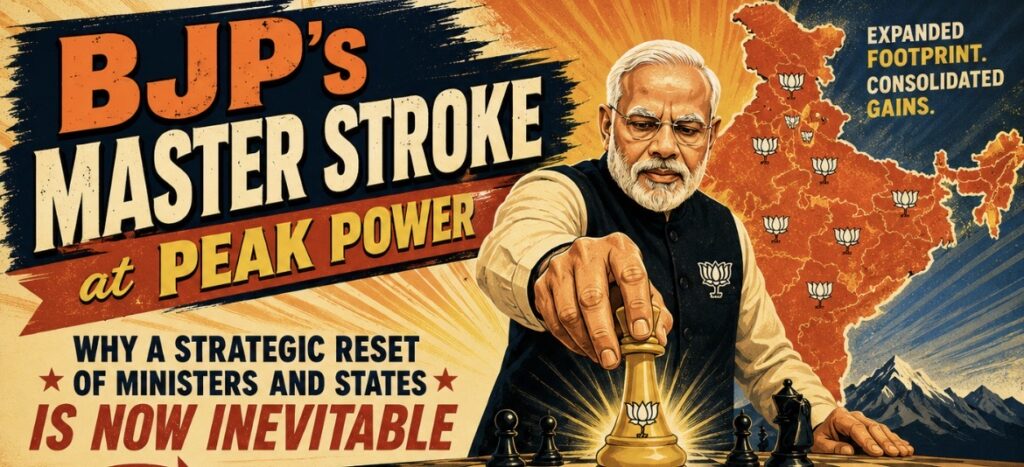
Why a Strategic Reset of Ministers and States Is Now Inevitable
The BJP is not battling weakness; it is wrestling with the far more dangerous burden of success. Aviation shocks, the NEET paper-leak fiasco, mounting oil-and-gas pressure, railways’ permanent exposure to public scrutiny, and the quiet strain of overloading its most trusted ministers have together exposed a deeper truth: a party at the peak of its power can also become most vulnerable if it fails to recalibrate in time. What may look, on the surface, like routine reshuffling could, in fact, be the BJP’s sharpest act of self-preservation before the next electoral battle begins. The BJP is not in a crisis of power. It is in a crisis of calibration. Having expanded its political footprint and consolidated formidable gains, the party now faces a harder, more disciplined task: ensuring that its Union cabinet, state leaderships, and organisational machinery remain fit for the next electoral phase, rather than resting on the laurels of the last. The evidence points unmistakably to a deliberate management reset, not panic. But precision is non-negotiable because a badly handled reshuffle can leave scars that outlast the headlines announcing it.
Why the Reset Is Needed
A party at the height of its strength often enjoys the rarest opportunity available in politics: the chance to fix structural weaknesses from a position of confidence rather than crisis. That is precisely where the BJP stands today. It can afford to rebalance portfolios, redeploy ministers into more productive roles, and refresh state leadership; all without the immediate optics of desperation. But strength carries its own trap. When a government leans too heavily on a small circle of trusted ministers across multiple sensitive domains, it becomes efficient on paper and fragile in practice.
That is the central issue at hand. The BJP’s next move is not merely about replacing personnel; it is about reducing systemic vulnerability before the next shock arrives. Understood this way, the coming exercise is best read as a consolidation of strength, not a confession of weakness.
The Cabinet Logic
The Union cabinet appears ripe for selective change, because several ministers currently carry portfolios that are simultaneously sensitive, highly visible, and politically exposed. Some are juggling multiple heavyweight responsibilities at once; a concentration of power that delivers surface efficiency but quietly manufactures single points of failure.
This risk is sharpest in ministries that are both technically intricate and politically unforgiving. Railways is the textbook case: operationally colossal, relentlessly visible, and unforgiving of even minor lapses. Aviation, though not always commanding daily headlines, turns politically explosive the instant flight disruptions, staff shortages, compliance failures, or safety lapses surface. Education is no less combustible; a single controversy here can metastasise into a full-blown national credibility crisis. And oil and gas remain perpetually sensitive, because price, supply, imports, and demand ripple instantly through every household and industry in the country.
The BJP must therefore confront a hard question: is the current portfolio architecture robust enough to absorb the next shock, or has power become dangerously concentrated in too few hands?
Aviation’s Warning
Aviation has emerged as a major cautionary tale with the takeover of Air India by TATA’s and the growth of IndiGo. In late 2025, IndiGo’s large-scale cancellations and operational breakdown triggered intense regulatory review and public alarm, forcing the DGCA and the Civil Aviation Ministry to intervene as passengers were stranded and new crew-rest rules came under fresh scrutiny. Earlier reporting had already flagged staff shortages as a looming threat to flight safety, with the regulator itself facing a significant capacity shortfall. Not to forget the tragic Air India crash at Ahmedabad, followed by a series of technical malfunctions.
This matters politically because aviation is, at its core, a confidence sector. When it falters, the public does not see merely an airline’s failure; it sees a governance failure. A ministry tethered to such a high-stakes sector cannot be treated as a symbolic posting or an afterthought. It demands dedicated bandwidth, built-in redundancy, and enough separation from other high-risk portfolios to prevent one breakdown from cascading into a wider embarrassment for the government.
This is why aviation must remain firmly within the BJP’s cabinet calculus, regardless of how the final portfolio map is redrawn. The lesson of the IndiGo crisis extends far beyond one airline; it is a lesson in how swiftly an operational flaw can metastasise into a full-blown political liability.
Education’s Credibility Crisis
The education ministry has weathered even sharper pressure. The NEET-UG fiasco and the accompanying paper-leak scandal ignited national outrage, drew the Supreme Court directly into the controversy, forced a CBI investigation, and ultimately compelled revised results and systemic review. Subsequent reporting suggested that, over the following eighteen months, the ministry quietly rolled back several major decisions, including NCERT-related changes and proposed UGC rules, after sustained public criticism and legal challenge.
This sequence has made education one of the most politically exposed portfolios in government today. Dharmendra Pradhan sits at the centre of that exposure. He is not simply a minister under scrutiny; he has, fairly or not, become the face of recurring reversals. Yet a more delicate truth deserves equal weight: if he is dropped too bluntly, the stigma could trail him for years, branding him a minister whose political trajectory has already crested.
This is precisely why responsible leadership would proceed with care. Pradhan should not be shielded if the leadership concludes the portfolio genuinely needs a reset. But neither should he be discarded casually in a manner that renders him politically redundant. The wiser path is redeployment, not humiliation; recalibration, not exile.
Oil and Gas Pressure
The oil-and-gas sector has also been carrying serious structural stress. Recent reporting points to slowing growth in petroleum-product consumption, persistent import dependence, and the enduring political sensitivity of fuel-driven inflation, softening demand, and sectoral volatility. Unlike aviation’s dramatic disruption or education’s headline-grabbing scandal, this pressure has built quietly, but it remains a genuine structural fault line.
This is where Hardeep Singh Puri enters the picture. He is among the BJP’s most trusted and visible ministers, currently holding both Petroleum and Natural Gas alongside Housing and Urban Affairs. That dual mandate only makes sense if the leadership believes one seasoned hand can manage the technical and political dimensions of both portfolios simultaneously. But it also means the system has concentrated considerable risk in remarkably few hands.
Puri is exactly the calibre of minister the BJP cannot afford to lose lightly. Should he be reassigned, it must be framed as structural recalibration; never as a public downgrade. A sudden demotion would manufacture needless stigma; a rational redistribution of load, by contrast, could preserve his value while meaningfully reducing cabinet fragility.
The Railways Lesson
Led by a highly competent Ashwini Vaishnaw, Railways remains among the most unforgiving ministries in government, carrying the simultaneous burdens of operational scale, public expectation, safety, and national symbolism. A single accident, delay, or service failure can swiftly become a referendum on governmental competence itself. This is not a ministry where political convenience should ever be allowed to override administrative caution.
Yet the risk here is not one of competence; it is one of complexity. Vaishnaw is widely regarded as among the most capable hands in the Union cabinet, and Railways has, under his stewardship, seen genuine momentum on modernisation and safety upgrades. The concern is structural, not personal: he simultaneously holds Railways alongside Information Technology and Communications; three vast, technically demanding, politically unforgiving portfolios at once. No minister, however able, can indefinitely sustain equal depth of attention across three high-stakes domains without something, somewhere, eventually being stretched thin. That is not a verdict on Vaishnaw’s ability today; it is a warning about institutional fragility tomorrow. The wiser course is to rebalance this load while the government still holds the political capital to do so calmly, on its own terms; rather than waiting for a lapse in any one of the three to force the government’s hand.
The lesson is unambiguous: ministries that touch the public’s daily life most directly, railways, aviation, education, energy, demand staffing and structuring of exceptional rigour. When failure strikes any one of them, it rarely stays contained within that sector. It becomes, almost instantly, a referendum on the government’s overall effectiveness. A genuine reshuffle, then, should not simply rearrange names on a chart. It should systematically reduce the odds that any single person or ministry becomes the lightning rod for multiple simultaneous crises.
The State Dimension
The same calculus extends to state leadership. Rajasthan is the most exposed, faction-heavy, politically delicate, and the state where the BJP could most plausibly judge that a leadership change or management correction is overdue. A fresh face, or simply a more forceful organisational hand, could help the party convert electoral victory into a durable, lasting command.
Madhya Pradesh is comparatively less vulnerable, but not entirely immune. It remains a stronghold where continuity carries real value; yet the party may still choose to fine-tune caste balance, regional equations, or administrative style if the long-term political dividend outweighs the short-term risk. Calibrated adjustment, not full replacement, is the more likely path here.
Odisha, by contrast, is the least likely candidate for an immediate change at the top. The BJP has only recently broken through in a state long dominated by a rival political order, and continuity is almost certainly the safer course. Replacing the Chief Minister too soon risks manufacturing unnecessary instability and diluting the symbolic weight of a hard-won breakthrough.
The Organisational Front
The BJP’s broader strategy extends well beyond ministries and chief ministers. In the wake of its breakthrough in Bengal, the party appears to be entering a deliberate phase of organisational strengthening. Punjab remains unfinished business, and the party is clearly treating it as a long-horizon project rather than a peripheral theatre, one demanding organisational rebuilding, booth-level expansion, and a deeper, more durable social coalition.
Some leaders may consequently be moved out of government and into dedicated party-building roles, where their skills carry greater strategic weight. Others may be drawn back into the cabinet if their electoral value remains intact. This is precisely why the reshuffle conversation cannot be flattened into a simple binary of promotion versus punishment; it is, at its core, a far larger exercise in machine design.
The Return of Old Faces
The BJP is also likely to weigh the strategic value of earlier ministers with renewed seriousness. Smriti Irani remains a plausible comeback figure; she retains strong public recall, proven campaign value, and the ability to function as a high-profile political asset. Rajyavardhan Rathore fits a similar logic: a disciplined public image paired with an appeal well-suited to a renewal narrative. There are faces like Raghav Chadha, Jyotraditya Scindia, Tejasvi Surya and Anurag Singh waiting in the wings for a central role. Shivraj Singh Chauhan, too, remains a formidable face, perhaps waiting in the wings. But the party will not restore every former minister out of nostalgia alone. BJP is not going to and must not look backwards. It will recall only those who genuinely strengthen the present arithmetic, leaving the rest to serve, for now, in quieter but no less necessary roles.
Observations
The BJP should treat this moment as a strategic opportunity, not an administrative chore to be managed reluctantly. Its present strength is more than sufficient to absorb a hard reset, but only if the leadership keeps its eye fixed on the true objective: resilience. The party must reduce portfolio overload, separate especially sensitive responsibilities where warranted, protect its most valuable ministers from becoming long-term political casualties, and pursue state-leadership changes only where they demonstrably strengthen organisational command.
The recent past offers warnings enough. Aviation showed how swiftly a flight disruption can snowball into a national crisis. Education showed how exam failures and paper leaks can curdle into lasting political liabilities. Oil and gas showed how quiet energy stress can erode public confidence without a single dramatic headline. Railways showed how operational lapses transform, almost overnight, into symbolic failures of governance itself. These are not isolated incidents; together, they prove, beyond a reasonable doubt, that over-concentrated ministerial structures are a genuine political hazard.
That is why the BJP’s next move must look like command, not churn; a party deploying its strength with intelligence and foresight, not one reacting out of nervousness. Get this right, and the reshuffle becomes the very mechanism that strengthens the machine for the battles ahead. Get it wrong, and it lays bare the cost of resting too much weight on too few shoulders.
( AI generated image)
About The Author

So True and Well written. Hope it reaches the right quarters.
Thank you sir