
Every city has a story. Some proudly display it. Others bury it.
Behind the gentle hospitality and postcard beauty of the City of Lakes lies a history that refuses to disappear. Its lakes reflect peace today, but beneath those calm waters echo forgotten cries, silent sacrifices, and battles long erased from memory. This is a city that smiles for the world while carrying wounds far deeper than anyone can see.
A throne does not fall in a single day. It cracks first; in whispered defiance, in a banned flag raised anyway, in the clenched fist of a jailed protester who refuses to recant. Then it cracks again. And again. Until one morning, the cracking becomes collapse, and a nawab who once commanded an empire signs his own surrender. This is the story of Bhopal; not a footnote of India’s integration, but one of its fiercest, most human battles, fought not on a battlefield but in the hearts of ordinary citizens who decided they would no longer be subjects in a republic that had already promised them freedom.
An Anomaly at the Heart of the Republic
In the turbulent years after 1947, as one princely state after another folded into the new Union, Bhopal stood as a defiant exception; a throne in the very geographic heart of India, still presided over by a nawab unwilling to bow to the democratic tide sweeping his own subjects. Hyderabad would become India’s story of armed confrontation. Junagadh, a tale of political farce. Kashmir, an unhealed wound. But Bhopal was different; and more intimate. Its battle was fought not at the border, but in its own streets, marketplaces, and jail cells. The question it posed was not about sovereignty in the abstract. It was about whether a crown could outlast the consent of the people beneath it.
The Nawab Who Believed in a Vanishing World
Nawab Hamidullah Khan was no ordinary ruler. Urbane, erudite, and politically formidable, he served as Chancellor of the Chamber of Princes and argued; not without constitutional logic; that the lapse of British paramountcy in 1947 had restored to princely India the right to choose its own destiny. He believed Bhopal could stand alone. But belief is not geography, and Bhopal’s economy, infrastructure, and population were inseparably woven into the Indian subcontinent. His people, increasingly, were no longer interested in being subjects of a vanishing order. They wanted to be citizens of an arriving one.
A footnote of irony belongs here: Hamidullah Khan’s own descendants would go on to become some of independent India’s most beloved national icons. His daughter, Sajida Sultan, married into the Pataudi family, and their son; Mansoor Ali Khan Pataudi; became one of India’s greatest cricket captains, leading the national team with a swagger and fearlessness that, in its own way, echoed the defiance simmering in his grandfather’s Bhopal decades earlier. Pataudi’s son, Saif Ali Khan, would carry the family’s public legacy forward into Bollywood stardom; a lineage that moved, in three generations, from a contested throne to the cricket pitch to the silver screen. History rarely offers such vivid threads connecting princely India to the republic it became.
The Streets Answer the Palace
By 1948, resistance in Bhopal had crystallized into organized defiance. The Bhopal State Congress and the Praja Mandal drew workers, lawyers, students, and traders into satyagrahas, strikes, and mass demonstrations. The tricolour; banned, forbidden, dangerous to carry; appeared anyway, again and again, in marketplaces and processions. This was no longer a polite petition for merger. It had become an assertion of dignity itself.
The state’s answer was the only one threatened power ever offers: repression. Meetings were outlawed. Protesters were rounded up by the hundreds. Among those imprisoned was Shankar Dayal Sharma; a name that would, with sharp historical irony, one day adorn the President of India’s office. His incarceration became a living symbol of how far palace rule had drifted from popular will.
Boras: Where Protest Became Sacrifice
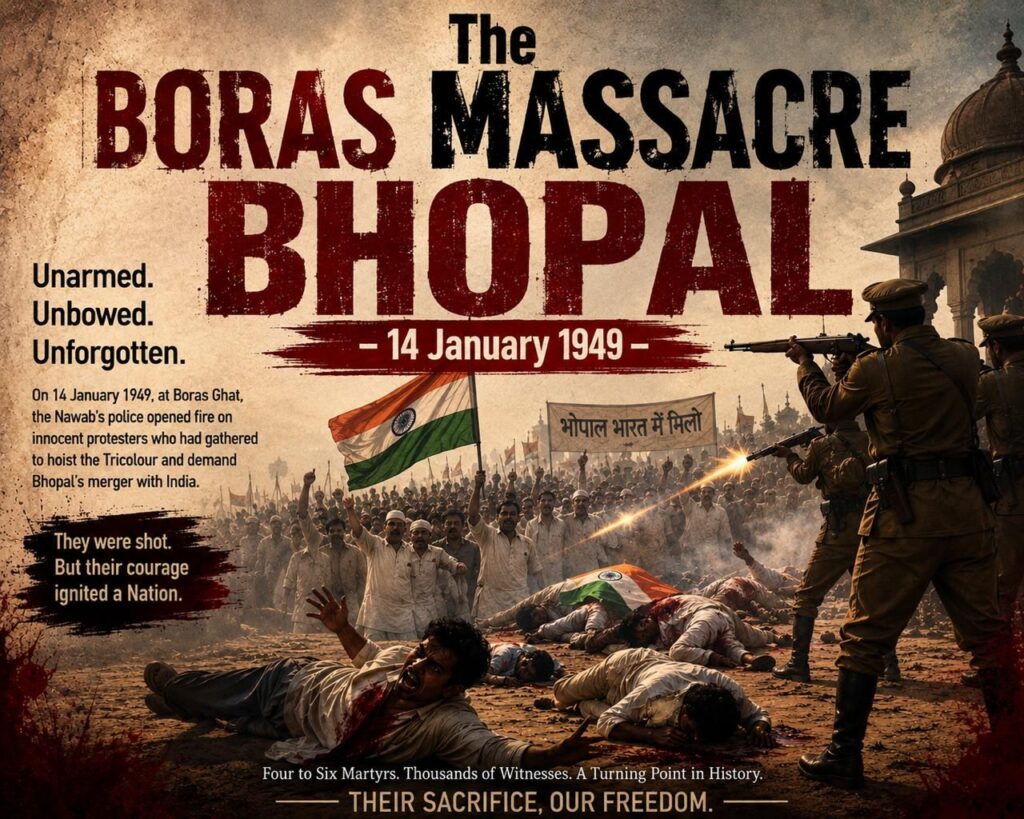
Then came Boras; the moment the movement’s meaning changed forever. Police opened fire on pro-merger demonstrators, and lives were lost. The dead are remembered locally as the Martyrs of Boras, though the precise toll remains obscured by incomplete archives. What is not obscured is the transformation that followed: Bhopal’s struggle was no longer simply about which flag flew over the palace. It had become a struggle against coercion itself; a fight for the basic right to dissent.
The Unfinished Business of Freedom
Here lies Bhopal’s deepest significance. In a nation still defining what independence actually meant, Bhopal exposed an uncomfortable truth: freedom from colonial rule did not automatically deliver liberty to everyone within the new republic’s borders. The people of Bhopal were not rebelling against India; they were fighting to be let in. Their courage proved that in some corners of the subcontinent, the old order first had to be confronted, directly and at cost, before the new one could take root.
Patel’s Patience, and the End of an Era
Sardar Vallabhbhai Patel and V. P. Menon watched Bhopal’s unravelling with the clear-eyed pragmatism that defined India’s integration project. An independent enclave, surrounded entirely by Indian territory, was never sustainable; but unlike Hyderabad’s military reckoning, Bhopal’s surrender came through a quieter convergence of pressure from below and negotiation above. By early 1949, the nawab’s authority had eroded beyond recovery.
On 30 April 1949, Hamidullah Khan signed the Merger Agreement. On 1 June 1949, Bhopal formally entered the Indian Union; closing more than two centuries of princely rule in a single administrative stroke that was, in truth, years of struggle compressed into one signature.
Legacy: A Throne Lost, a Family Reborn
Hamidullah Khan’s remaining years were quiet; his historical legacy contested between those who saw a principled constitutionalist and those who saw a ruler whose resistance prolonged suffering. He died in 1960, having watched the world he fought to preserve dissolve entirely.
But it is the people of Bhopal; not the palace; who own this story’s true legacy. They did not wait to be granted a future. They forced their way into it, through protest, imprisonment, and sacrifice. Bhopal was not merely merged into India. It was claimed, by its own citizens, for a democratic future they had already decided was theirs.
( AI Generated image )
About The Author

Due to the English mischievous policies to keep India and Indians bogged down for centuries to come ,some independent Riyasat heads like the Bhopali one and Junagad one did try to create independent islands within the larger sea of India but to put them on corrective path we had the Great Sardar Patel at hand.
We in kashmir faced unfortunate ness as Sardar didn’t get to handle the affairs.
Maybe we might still be sitting in our third floor Kaanii in our ancestral homes .