
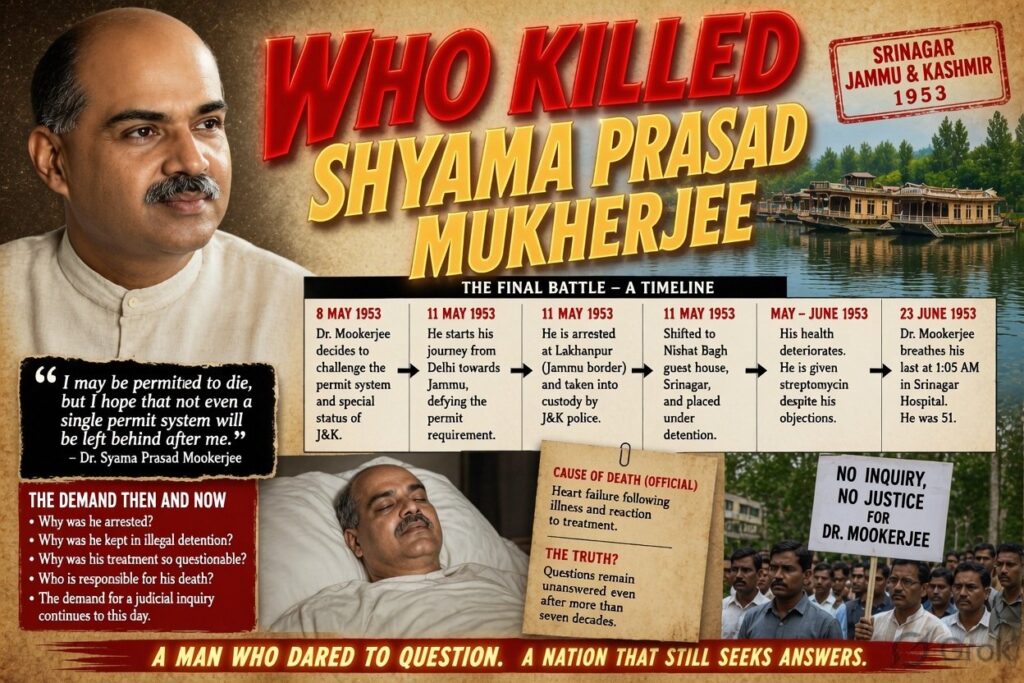
A Death in Detention: How One Man’s Body Rewrote a Nation’s Borders
There is a particular kind of silence that follows an unanswered question for seventy years, not the silence of forgetting, but the silence of something too dangerous to settle. Kashmir, in the summer of 1953, produced exactly that silence. It began with a train ticket and ended with a corpse, and in between lay forty-four days that would quietly decide the constitutional fate of a region for the next sixty-six years.
The man on the train was Dr. Syama Prasad Mukherjee, Vice Chancellor of Calcutta University at thirty-three, a Union Cabinet minister who had resigned on principle, founder-president of the Bharatiya Jana Sangh, and by 1953 the most articulate adversary of an idea he considered a constitutional heresy: that an Indian citizen should need a permit to enter a part of India. Article 370 and the 1952 Delhi Agreement had handed Jammu and Kashmir its own constitution, its own flag, its own prime minister; and a border within a border. Mukherjee called it Balkanisation by another name. His answer was a slogan sharp enough to outlive him by decades: Ek Vidhan, Ek Nishan, Ek Pradhan; One Constitution, One Flag, One Prime Minister.
On 8 May 1953, he boarded that train knowing exactly what waited for him. He was fifty-two, in fragile health, and entirely deliberate. Civil disobedience, he told his companions, meant nothing unless someone senior enough was willing to be arrested testing it. Three days later, at Lakhanpur; the literal gateway from Punjab into the state; he got his arrest.
What followed was not a trial. It was something stranger and more revealing: a government caught in its own trap. Releasing Mukherjee would validate his argument that the permit system was illegitimate. Detaining him would manufacture a martyr out of a sitting Member of Parliament. New Delhi chose detention; and in doing so, chose the slower, more catastrophic outcome.
He was moved from Srinagar’s Central Jail to a hillside cottage near the Mughal-era Nishat Bagh, repurposed overnight into a sub-jail. Isolated, facing Dal Lake, thin on facilities, thinner on medical oversight; it was, by every surviving account, no place to detain a man with a history of pleurisy. For weeks he had no charge, no trial date, no answer to the only question that mattered: how long. He read. He wrote letters when permitted. He grew steadily, visibly worse.
By June, fever and chest pain had set in. He was diagnosed with dry pleurisy; a recurrence of something that had struck him in 1937 and 1944; and the attending physician prescribed streptomycin. Mukherjee reportedly objected: his own physician had warned him the drug didn’t agree with his system. He was reassured and treated anyway.
That single exchange; a warning given, possibly overridden; has haunted the historical record for seventy years, because no independent inquiry was ever convened to resolve it.
The doctor’s name was Ali Mohammad Jan, and his story afterward complicates the easy version of this episode in a way few accounts acknowledge. He was no obscure functionary swallowed by controversy. UK-trained, holding a Diploma in Child Health and membership of the Royal College of Physicians, Edinburgh, Jan had spent over a decade treating patients in rural Jammu and Kashmir before 1953, building a reputation so formidable that Kashmiris would later call him Luqman-e-Kashmir; believed, almost mythically, to diagnose by instinct and heal by touch. In the decades after Mukherjee’s death, Jan did not vanish into disgrace; he became one of the principal architects of Kashmir’s modern medical infrastructure; vice-president of the governing body of the Sher-i-Kashmir Institute of Medical Sciences, founder of the Rotary Club of Kashmir and the Tuberculosis Association of Kashmir, and in 1975 a recipient of the Padma Shri, India’s fourth-highest civilian honour. He died in 1988, his name unblemished in the public record.
That trajectory is itself a kind of evidence; not of guilt, and not of innocence, but of how thoroughly the question was allowed to go unexamined. No inquiry ever tested whether the streptomycin warning was heeded. No disciplinary file exists. No contemporaneous controversy trails Jan’s name through four decades of institution-building. The suspicion around June 1953 survives purely as an open wound, untouched by the four decades of unremarkable, even distinguished, life that followed it. That a man’s death can remain permanently uninvestigated while the physician who treated him goes on to a state honour is not proof of conspiracy; but it is proof of a silence that should never have been allowed to calcify into history.
Mukherjee died at 3:40 a.m. on 23 June 1953, after forty-four days in custody, never charged, never tried. Sheikh Abdullah, then Prime Minister of the state, insisted his government had done everything possible. He later claimed; in his memoir Aatish-e-Chinar; that he wrote to the Centre asking for an inquiry and received no reply. Nehru never ordered one. Mukherjee’s mother, Jogmaya Devi, wrote to Nehru directly, demanding accountability that never came.
What happened next moved with a speed that retrospectively explains everything. Within weeks, the Intelligence Bureau’s surveillance of Abdullah’s contacts with American diplomats and his drift toward an independence agenda reached Nehru’s desk in the form of recorded speeches. On 8 August, Abdullah was dismissed without ever being allowed to test his majority. On 9 August, he was arrested; the beginning of eleven years in custody. Mukherjee’s death had made the political cost of Abdullah’s continued autonomy unbearable; his removal was the price Delhi paid to prove it hadn’t acted with impunity, even if it never said so aloud.
The consequences rippled outward into the subcontinent’s diplomacy. The UN’s mediation had already collapsed that March. With Abdullah gone; the one figure whose authority had made a plebiscite even theoretically plausible; that option died quietly, permanently, by 1956, when Kashmir’s own constitution declared itself irrevocably part of the Indian Union.
The permit system Mukherjee died opposing was abolished within a year; his followers’ first victory. The larger argument took sixty-six years, settled only when Article 370 was abrogated in August 2019. He never lived to see it. But the case he made with his life, and lost with his death, eventually became the law of the land; written, in the end, not in any courtroom, but in the silence of an inquiry that India never held.
(Image is AI generated )
About The Author

India never understood or handled J&K related issues appropriately and timely.
These inadequacies within J&K and the Nation resulted in unjust decisions and displacements, so unfortunate.
indeed sir !