How One Vanishing Girl Shut Down the Kashmir Valley and Why History Erased It
Book Review
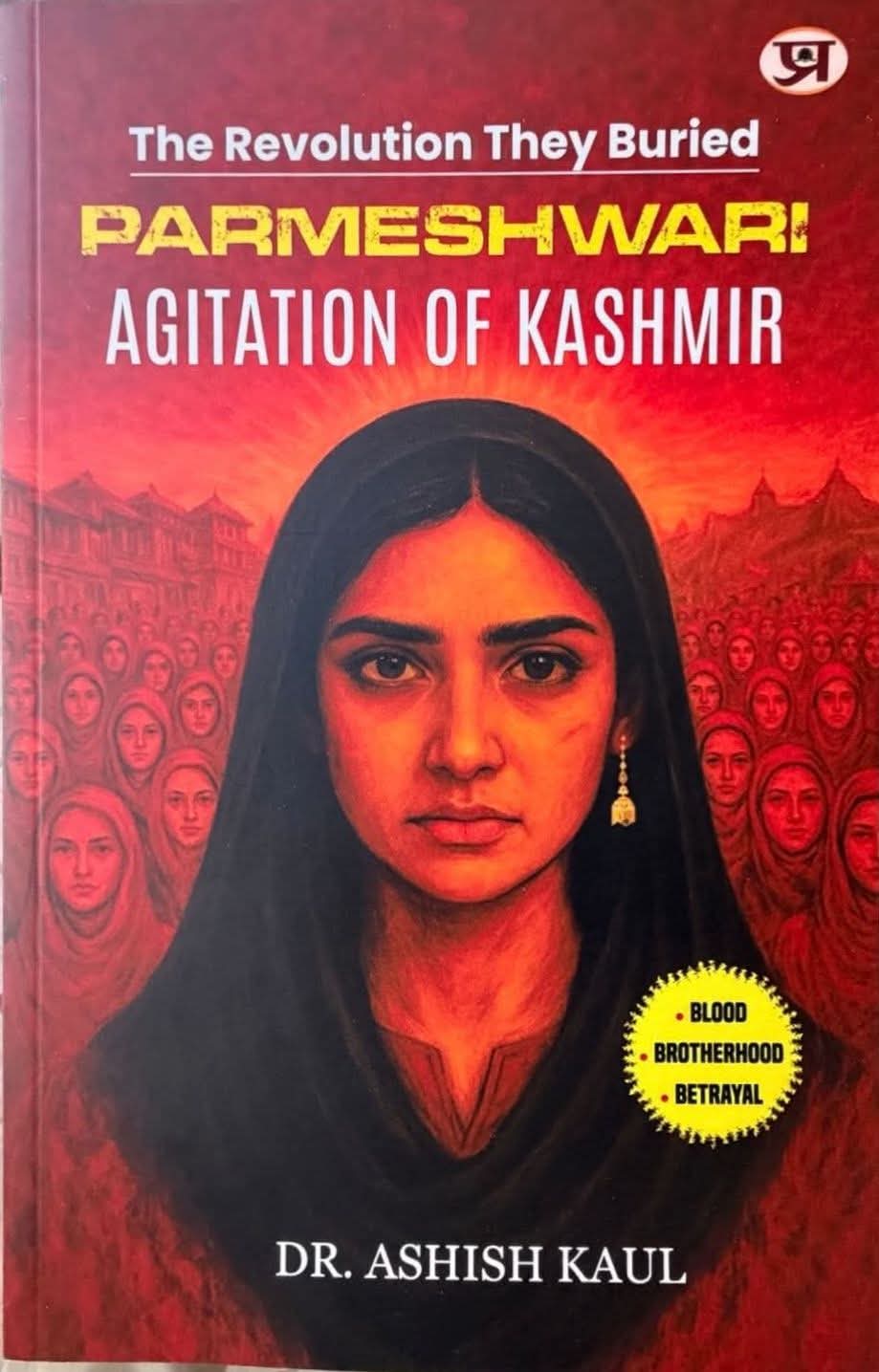
Some books arrive to entertain. Parmeshwari: Agitation of Kashmir – The Revolution They Buried, by Dr. Ashish Kaul, arrives to indict not a person, but a silence. The book reconstructs the events of July–September 1967, when a 17-year-old Kashmiri Pandit girl, Parmeshwari Handu, left home for work in Srinagar’s Lal Chowk and never returned, reappearing only as a newspaper announcement of her conversion and marriage. What followed, as the book and independent reporting confirm, was not a quiet grievance but a thirty-three-day valley-wide shut down in which nearly 5,000 people were arrested in a movement now described as one of independent India’s most significant civilian uprisings. Kaul’s central argument, laid out in his author’s address included with the manuscript, is structural rather than sentimental: the seed of the 1990 Pandit exodus was sown twenty-three years earlier, in a flame that politics chose to extinguish rather than protect.
Excavation, Not Embellishment
What separates this work from sentimental community memoir is its method. Kaul did not simply recount oral memory; he built the narrative from a deliberately incomplete official record falsified medical age certificates, an internal government memorandum dismissing the girl’s conversion as “quite commonplace here… not to be exaggerated,” and the diary of a young protestor who logged every arrest and lathi charge from inside a packed jail cell. The book’s centerpiece event Union Home Minister Yashwant Rao Chavan’s arrival in Srinagar on September 2, 1967, and his departure without enforcing a single one of six demands placed before him is independently corroborated. The book, published by Prabhat Prakashan, was formally launched at the Indira Gandhi National Centre for the Arts and carries a foreword by Sachchidanand Joshi, lending it institutional weight beyond a self-published grievance narrative. It was also presented to Jammu & Kashmir Lieutenant Governor Manoj Sinha, who acknowledged its significance as both historical record and national reckoning.
The Arithmetic of Erasure
The book’s strength lies in its refusal to round off uncomfortable numbers. Two protestors dead. Hundreds injured. A whistleblower, Kishan Raj, beaten to death with no memorial and no prosecution. A coffin filled with straw, used as a decoy to funnel a mob into a Hindu neighbourhood. These are not rhetorical flourishes; they function the way a forensic ledger does , each entry a small, dry fact that, accumulated, becomes an indictment too large to dismiss as anecdote. Kaul is careful to mark the line between documented history and narrative interpolation: the political betrayals, the falsified records, and the Chavan visit are presented as verified fact, while the interior emotional lives of figures like the girl’s mother, Dhanvati, are acknowledged as imaginative reconstruction “in service of documented character.”
Why the Timing Matters
The book lands at a moment when pathways for the return of Kashmiri Pandits to the Valley are being actively rebuilt, which is precisely Kaul’s provocation: a community cannot rebuild on ground whose collapse it has only half-understood. The agitation is also framed in recent coverage as an early, organised civilian demand for legal protections against forced religious conversion, predating contemporary debates by decades a claim that will likely generate as much discussion as the historical narrative itself, given how politically charged that framing remains today.
Parmeshwari is not a tidy book, and it does not try to be. It is uneven in places where archival silence forces the author into reconstruction, and its political framing will not sit comfortably with every reader. But as an act of historical retrieval pulling a 58-year-old uprising out from under three decades of louder, more visible tragedy, it succeeds completely. It does not ask Kashmiri Pandits to grieve again. It asks them, and India, to remember what courage looked like before grief became the only permitted emotion.
About The Author