A landmark T.R.I.S. exhibition curated by Neville Tuli traced India’s journey from colonial gaze to democratic self-discovery -through art, propaganda, and forgotten photographs
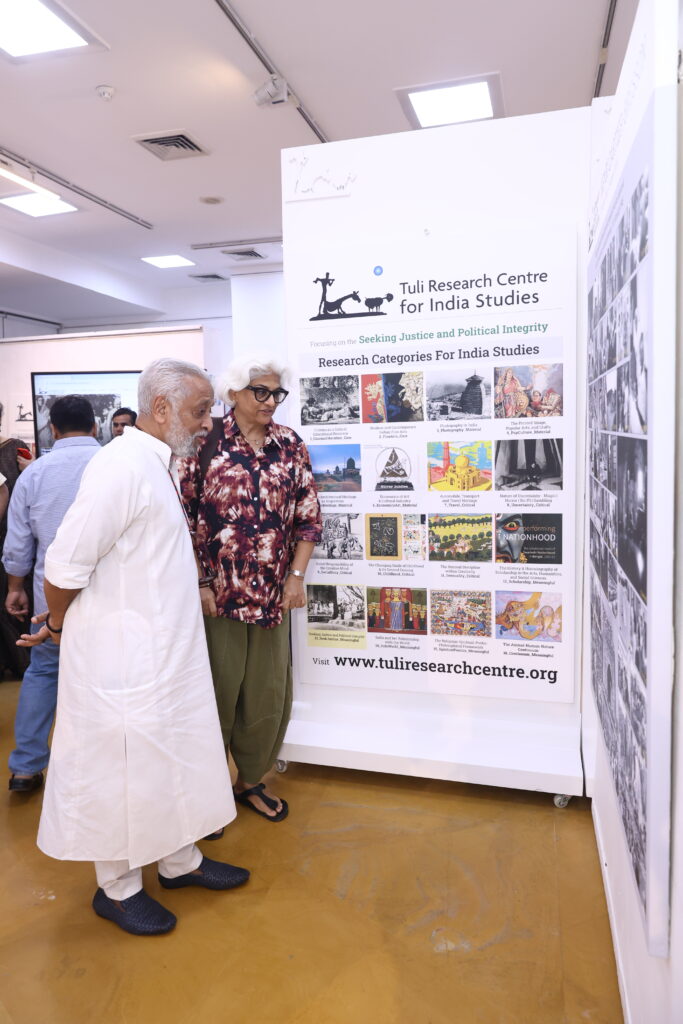
New Delhi: History rarely announces itself in a single frame – it accumulates, layer upon layer, the way silt gathers on a riverbed. That accumulation was precisely what SWARAJ: Revisualising India’s Political History set out to display at the Visual Arts Gallery, India Habitat Centre, from 12 to 16 August.
Presented by the Tuli Research Centre for India Studies (T.R.I.S.) and curated by cultural historian Neville Tuli, the exhibition drew on rare fine and popular art, photography, film publicity material, and archival ephemera to trace India’s political consciousness from early European coastal depictions of the subcontinent, through the 1857 uprising, the rise of nationalist iconography like Bharat Mata, Gandhi’s mass mobilisation, and onward to the Emergency, Partition, and the protest movements of recent decades.
Tuli deliberately left out captions beside the artworks – “I stopped giving captions because people don’t read the image,” he said, wanting viewers to engage directly with line, form, colour, and texture rather than text. Highlights included Felice Beato’s 1858 photographs, a 1932 oil painting of Gandhi at Dandi by Ramendranath Chakravorty, and a Chittaprosad linocut titled Quit India (c.1942).
The show was framed not as nostalgia but as a mirror , an invitation for today’s youth to see their own restlessness reflected in the long, unfinished struggle for self-rule.
The exhibition drew visitors across its five-day run at the India Habitat Centre on Lodhi Road.
About The Author