
Kashmir’s temples are not real estate, they are a civilization’s heartbeat
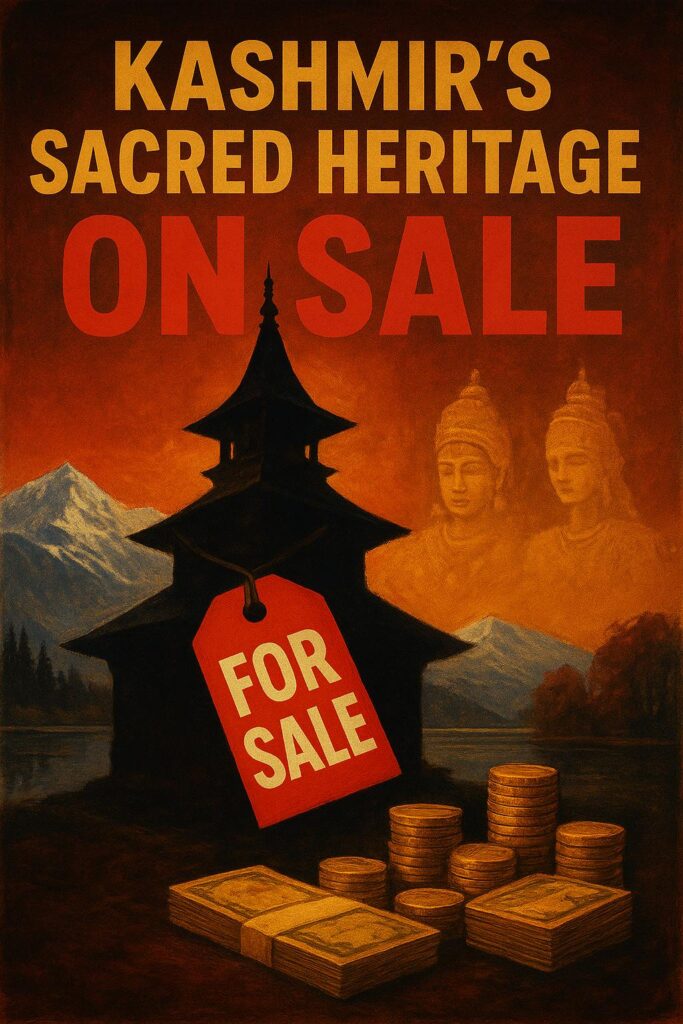
On August 20, 2025, a simple agreement was signed in Srinagar. On one side: Mahant Swami Tapanand, the “seller.” On the other: Tushar Jandial, the “buyer.” The deal? 27 kanals of temple land in Nowgam, worth crores, sold for a fraction of its value. A few lakhs exchanged hands, a few signatures were inked, and with the scratch of a pen, the Gods of Kashmir seemed reduced to commodities.
But let us pause and ask, who owns the temples of Kashmir? From what appears from the circulating papers, can a Mahant sell what does not belong to him? Can sacred land, entrusted by centuries of faith, be transferred like private property? Or is this the ultimate betrayal, not just of law, but of civilization itself?
Article 26 of India’s Constitution guarantees religious communities the right to own and manage property. It was meant to shield temples from personal appropriation. Yet, this very safeguard has been twisted. The deity, who in law is a juristic person, has been robbed of ownership by self-appointed custodians.
The Supreme Court has long clarified, in Govindlalji Maharaj vs. State of Rajasthan (1963), that temple property belongs to the deity, not the priest. Still, the August 20 agreement tells another story: of a mahant treating a divine trust as his personal estate.
Kashmir’s Judicial Hope: The Raghunath Temple Verdict
Not all hope is lost. In August 2024, the J&K and Ladakh High Court struck down fraudulent transfers of 160 kanals of land tied to Srinagar’s Raghunath Temple, restoring property worth over ₹400 crore. The Court laid bare how mahants and local networks colluded to strip temples of their assets.
That judgment proved something vital: the judiciary has both the courage and the tools to reclaim Kashmir’s sacred spaces. But one victory cannot heal decades of systematic plunder.
The Exodus and Exploitation: Sacred Spaces as Spoils
When Kashmiri Pandits were forced into exile in the 1990s, temples stood orphaned. Their custodians scattered, their trusteeship broken. Into this vacuum stepped opportunists, mahants, middlemen, and property dealers, who began to treat temples as abandoned treasure chests. Each fraudulent deed was not just a theft of land; it was a theft of memory, of identity, of a civilization’s roots.
The August 2025 agreement, if true, is just the latest in a shameful series. No trust oversight. No community consent. No acknowledgment that the deity the rightful owner was ever part of the transaction.
When Gods are put on sale, justice must step in
The crisis of Kashmir’s temples is not merely a property dispute; What is at stake in Kashmir is not only stone and soil, but the silent heartbeat of centuries. it is the slow dismembering of memory, faith, and civilization under the guise of stamped paper. Each fraudulent sale is a theft not only of land but of history itself, mocking Article 26 of the Constitution and undermining the very principle of communal guardianship over sacred trusts. The Supreme Court must now step beyond piecemeal remedies and act as the true custodian of both law and heritage,by invalidating illegitimate deeds, constituting statutory temple trusts, and placing all sacred assets under judicially monitored protection. Anything less would not just be negligence, it would be complicity in cultural erasure.
For the displaced Pandit community, these temples are not abandoned relics but living symbols of belonging and return. To safeguard them is to honour a centuries-old covenant between faith and land, between people and their gods. The Constitution demands it, justice requires it, and history pleads for it. If the temples of Kashmir are reduced to commodities, we will have auctioned away more than stone, we will have surrendered conscience itself. Only decisive Supreme Court intervention can ensure that the Gods of Kashmir remain eternal, beyond the reach of greed, protected as both sacred inheritance and national trust
About The Author