A peek inside the widely reported news of the recruitment process and shortlisting of the candidates
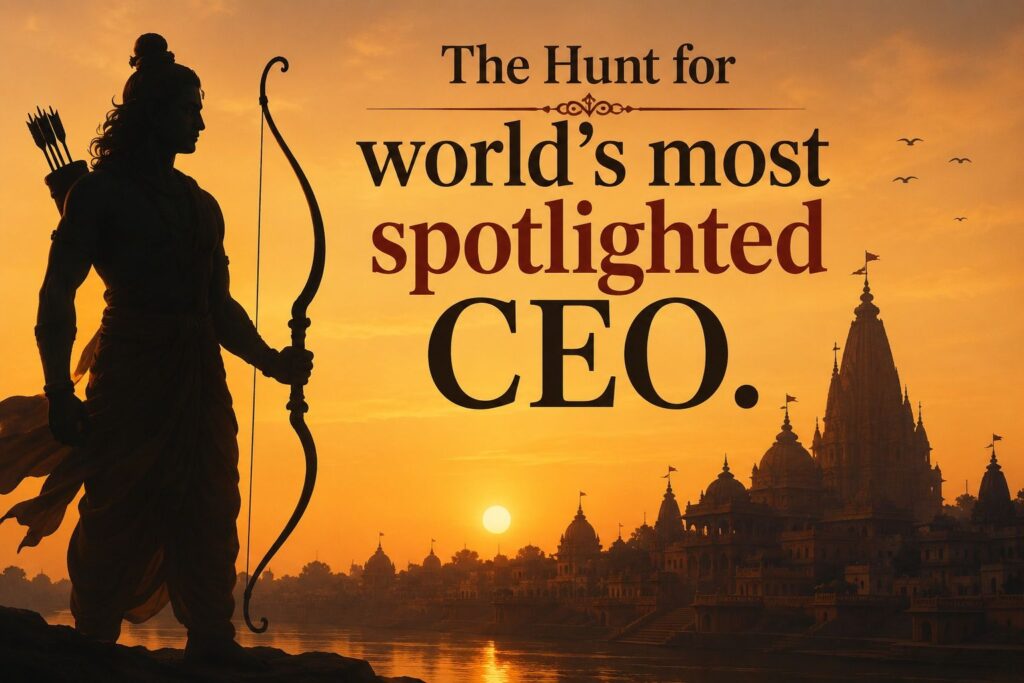
As interviews conclude for the Ram temple trust’s first CEO, the arithmetic of the search is drawing as much scrutiny as the candidates As widely reported, a three-member panel would have possibly spent Tuesday and Wednesday interviewing 18 finalists behind closed doors at the Ram temple’s pilgrim facilitation centre for a post that did not exist a year ago: chief executive officer of the Shri Ram Janmabhoomi Teerth Kshetra Trust, which runs one of India’s most visited, and most donation-rich, religious sites.
The appointment, due September 2, matters less for its novelty than its origin: the Trust agreed in early July to hire a professional CEO only after a June donation-theft scandal forced out its general secretary and a trustee, triggered a police probe, and drew Supreme Court attention. A routine executive search has become a test of governance under scrutiny.
An alleged scandal that forced reform
It began in mid-June, when the Trust itself sought a Special Investigation Team over how cash, gold and other donations were being counted and handled. Its findings, filed within ten days, led Ayodhya police to file an FIR against eight people, mostly donation-counting staff. All eight were arrested in late June; police recovered nearly ₹80 lakh in cash from seven of them. Charges include criminal breach of trust, cheating, theft, criminal conspiracy and offences under India’s anti-corruption law.
The Trust accepted the resignations of general secretary Champat Rai and trustee Anil Mishra, removed the temple administrator, and at its July 6 board meeting resolved to hire a full-time CEO. It also published an account of donations received and spent , unusual disclosure for a normally low-profile body. The Supreme Court has since ordered the state SIT reconstituted under a senior officer, amid opposition calls for a central probe. None of this touches the CEO search directly, but it explains the pressure on the Trust to show the search was rigorous, not just fast.
The numbers behind the search
Applications flooded in by the July 18 deadline from retired bureaucrats, armed-forces officers, academics and corporate executives (see table). A screening committee , retired Supreme Court judge Pramod Kohli, retired Lt Gen Vishnukant Chaturvedi and former nuclear scientist Suresh Haware , narrowed that pool in two stages to the 18 now in Ayodhya, over a reported 12 to nearly 20 days.
Run the clock on that reporting and the arithmetic tightens fast. At the higher end , three evaluators, five hours a day, 20 days , the panel had roughly three-and-a-half minutes per application, collectively, across the full pool; at 12 days, that shrinks to about two minutes each. One reported batch alone , 1,700 applications, three people, three days , works out to over six hours of continuous reading per evaluator per day, before note-taking or discussion.
None of this proves the process was inadequate. Recruiters typically treat this pace as consistent with a first-pass eligibility filter, checking age, qualifications and paperwork against fixed criteria, not a full comparative assessment. The Trust’s published rules require Indian citizenship, practising Hindu faith, a degree, age 50 to 70, and at least two decades in administration, finance or management. A filter against fixed criteria can move fast without moving carelessly.
By the numbers
| Metric | Figure |
| Applications received | 5,200–5,300+ |
| Selection panel | 3 members (retired judge, retired general, retired scientist) |
| Preliminary interview round | ~55 candidates |
| Final shortlist | 18 candidates |
| Reported screening window | 12–20 days |
| Final interviews | August 11–12, Ayodhya |
| Decision expected | September 2 |
Who actually made the uppercut
The eligibility bar was sector-agnostic; a corporate CFO qualified as easily as a retired district magistrate or a two-star general. Reporting on the finalists suggests a narrower reality: one account names three former IAS officers, a former IPS officer and four retired military officers, eight of eighteen from the civil service, police or armed forces, plus candidates who have run large South Indian temples. Corporate India hasn’t vanished entirely; one other report lists former corporate executives among the finalists too, but the more granular reporting points to a shortlist tilted toward government and security veterans.
That balance, if it holds, says as much about the institution the Trust is becoming as about any single hire. A retired official typically brings administrative discipline and familiarity with government oversight, suited from a familiarity perspective. A corporate executive might instead bring modern commercial and administrative processes, critical Human Resource Development, donor-management systems, fraud prevention processes, strategically demonstrated administrative protocols, and result-oriented digital financial controls using the latest technology and AI; all of this the Trust or such institutions are believed to lack. Which instinct it prioritises will shape how the Trust is run, and whether that serves it well, only the CEO’s tenure will answer.
Screening is not due diligence
A rapid pass, however well designed, cannot establish what matters most for a role this sensitive: financial probity, integrity under pressure, latent conflicts of interest, and the judgment to run an institution built on an enormous, cash-based flow of donations, precisely the vulnerability the June scandal exposed. Those qualities surface only through structured interviews, verified references and background checks, presumably the purpose of this week’s final round and the vetting expected before September 2.
Nor is it improper if informal groundwork or prior familiarity with candidates helped narrow a field of more than 5,000 before formal scoring began, provided it fed into an open, consistent process rather than substituted for one.
A measured word of caution
The Trust has taken real steps toward transparency since June: naming a credible panel, publishing eligibility criteria, disclosing donation accounts, and removing officials implicated in the scandal. These are not the actions of an institution trying to hide something.
Having taken those steps, it has also raised the bar for itself. Credibility now rests less on the speed of the search than on what the Trust shows about how it was conducted: a documented rationale for each stage of elimination, disclosed conflict-of-interest checks for panel and finalists alike, and, once the appointment is made, a public account of how 5,000-plus applicants were narrowed to 18, then to one. For an institution in the wake of a criminal probe into how money moved through it, such disclosure looks less like courtesy than a minimum expectation.
Whether the Trust discloses that detail, or lets the September 2 announcement speak for itself, will shape how the appointment is read, regardless of who gets the job. Confidentiality can protect unsuccessful applicants’ privacy. It cannot substitute for the accountability an institution of Ayodhya’s scale, and its current scrutiny, is being asked to demonstrate.
Facts drawn from Indian news coverage of the Trust’s recruitment process and the ongoing donation-embezzlement investigation, current as of August 12, 2026. The Trust has not been accused of, or charged with, any wrongdoing in the CEO selection process itself; the concerns here relate to process transparency, not allegations against the search committee or any candidate. This opinion piece is an individual opinion.
About The Author