The Turkish president reiterated his call for resolving disputes through dialogue and relevant UN resolutions, prompting renewed focus on India’s longstanding position that Kashmir is a bilateral matter.
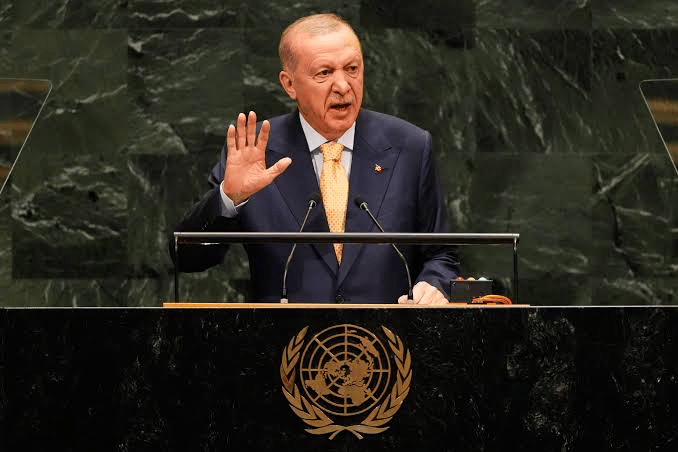
Turkish President Recep Tayyip Erdogan raised the Kashmir issue during his address to the 81st United Nations General Assembly in New York on September 22, calling for disputes to be resolved through dialogue and within the framework of the UN Charter.
“In South Asia, it is important that all disputes, including the Kashmir issue, be addressed through dialogue within the framework of the United Nations Charter and of relevant resolutions,” Erdogan said.
Repeated reference at UN forum
This is not the first time Erdogan has referred to Kashmir during his UNGA address. He raised the issue in September 2025 as well, calling for a resolution through dialogue and in accordance with UN resolutions. He did not mention Jammu and Kashmir in his 2024 address.
India maintains bilateral position
India has consistently rejected third-party involvement in the Kashmir issue, maintaining that it is a bilateral matter between India and Pakistan.
Responding to Erdogan’s earlier remarks, Ministry of External Affairs spokesperson Randhir Jaiswal said India’s position remained unchanged and that there was no need for third-party mediation.
New Delhi has also objected to Erdogan’s comments during his February 2025 visit to Pakistan, when he called for resolving Kashmir through dialogue, taking into account UN resolutions and the aspirations of the people of Kashmir.
India protests earlier remarks
Following Erdogan’s February 2025 comments, India lodged a strong protest with the Turkish ambassador. Jaiswal described the remarks as unacceptable and reiterated that Jammu and Kashmir was an integral part of India, asserting that other countries had no locus standi to comment on the matter.
Erdogan’s latest statement brings the issue back into focus at the annual UN gathering, underscoring the continuing difference between Ankara’s stated position and New Delhi’s stand on external involvement.
About The Author