
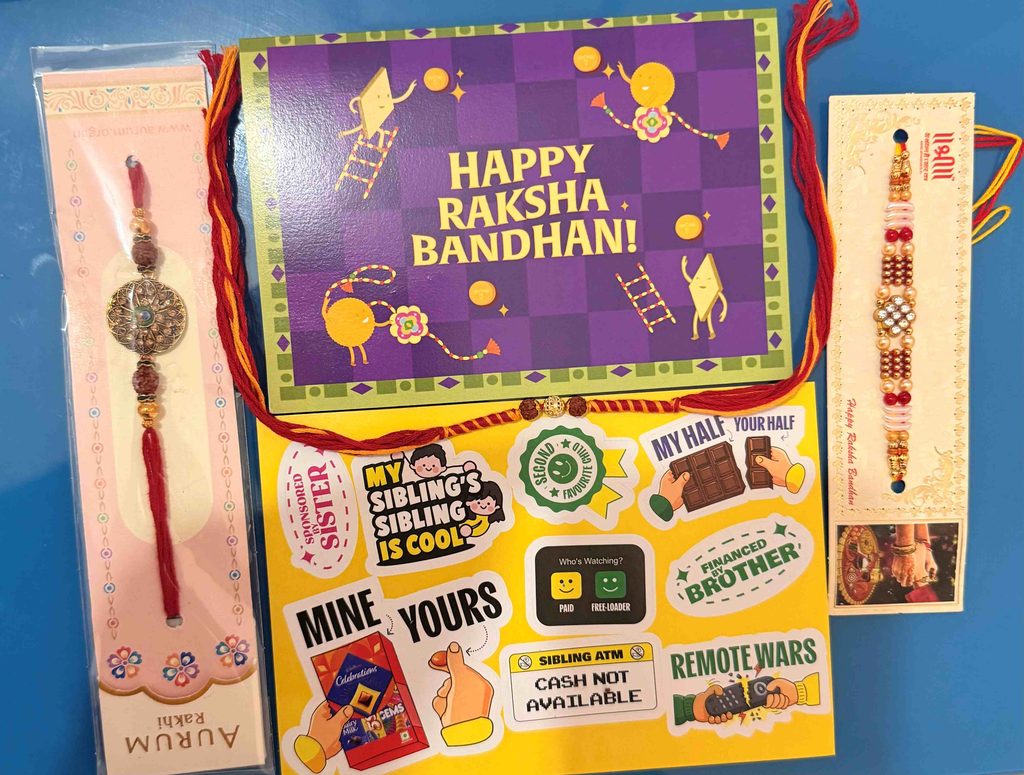
A powerful woman spontaneously cares for her divine friend, receives forevermore his enduring support. That’s how Raksha Bandhan began; that is until society had an idea about how sisters could use their celebration as a chance to “get saved” instead of celebrate. How did gratitude turn to guilt, empowerment transform into entrapment? The answer will astonish you.
Sacred Strings Become Strings That Bind
There were no battles fought before the great build-up to Mahabharat, the war for righteousness, when Krishna’s Sudarshan Chakra concluded its divine justice against the despot Shishupala. And as Krishna finished off the final blow, a crimson droplet of blood dripped from his finger tip. It was as if time had stopped. Queens Rukmini and Satyabhama scurried to create elaborate bandages to treat Krishna’s wound. But it was Draupadi who acted out of pure care and love for her Sakha, cutting a strip from her precious Sari without hesitation, gently wrapping it around his bleeding wound.
Krishna’s eyes overflowed with an immense sense of gratitude. There was nothing obligatory or even necessary here; this was just spontaneous friendship. “Akshyam,” he said softly, making a promise to her of endlessness, assuring her that he would be there for her whenever she needed him. Years later, when Dushasana’s grasping hands attempted to dishonor her in front of a courtroom full of silent observers, Krishna intervened once again with his divine force. He turned Draupadi’s sari into an endless garment. Not because she was powerless — it was because friendship supports friendship, care supports care.
This foundational story raises a profound question which patriarchal society has conveniently ignored — why do sisters need to beg for protection or any other kind of assistance? Does not mutual care go hand-in-hand with real friendships? Why can sisters express vulnerability, but brothers cannot request support, care, or assistance (not because they don’t need it), because society has taught them to silently endure?
August marketplaces explode with sparkly Rakhi’s that may cost more than a person’s daily wage and online shopping sites offer discounts and fast shipping of “protection.” Brothers shop through gift catalogues and sisters choose threads to symbolize their vulnerability, while society applauds what it believes is tradition. Somewhere between the commercial chaos and ritualistic displays, however, Raksha Bandhan has utterly lost its thread, literally and figuratively.
This is the highest level of irony: a society that uses the most vicious curses against disrespecting mothers and sisters has slowly permitted sacred bonds to transform into bonds of subjugation. What began as a festival that wove threads of gratitude has become inextricably knotted into patriarchal ideologies, converting true interdependence into a web of dependence where women are eternally entrapped and men are deprived of the fundamental human right to require aid.
By systematically removing gratitude and inserting reinforcement for dependency instead of gratitude, society has allowed the original bond of mutual respect to twist into a bond of protection where “the brother protects his sister while she prays for his prosperity”; essentially locking women into perpetual vulnerability while raising men to saviours and isolating them emotionally.
The absurdity is stark: tying Rakhi to a ten year old brother to protect a 26 year old sister creates a festival where the logic behind the threads has come undone entirely. This fits patriarchal agendas perfectly: each thread of logic becomes another binding cord reinforcing women’s perceived vulnerabilities while twisting men’s egos into designated protector roles and preventing men from seeking aid when they need it, regardless of whether or not they possess the ability to provide it.
This spiritual entanglement shows how patriarchy does not eliminate empowering narratives, but merely reweaves them into restrictive forms. Hindu Dharma honors goddesses such as Durga, Kali and Saraswati as representations of power, yet encourages a festival where women’s threads bind them into helplessness and men are bound into stoic fortitude. The original friendship between Krishna and Draupadi based upon equality has been re-woven into a template where sacred bonds become binding obligations.
Social theorist Allan G. Johnson illustrates this phenomenon: “To the extent societies are male-dominated, male identified and male centered, they are patriarchal.” Rakhi has been systematically altered to fit within these parameters. According to Johnson in “The Gender Knot”: “Each strand of the patriarchal gender knot that we dismantle, we enter into a long-standing struggle of resistance to oppression.”
Markets today reveal dramatic contradictions: women CEO’s buy “protection bands” for their five year old brothers while society venerates powerful goddesses. Online retailers market their products targeting successful working women with ads offering dependent symbols at discounted prices while building markets where financial independence pays for symbolic submission. These contradictions are so inverted they border on satire ; except society is not laughing; it is buying its own contradictions.
Modern feminist discussion challenges these convenient paradoxes — encouraging brothers to “rise up as feminist allies” rather than exercising patriarchal dominance. Gender inclusive celebrations — sisters tying Rakhis on sisters, recognizing LGBTQ+, etc., represent returns to original notions of mutual support where every individual can both provide and receive aid.
Reintroducing Rakhi’s original feeling of gratitude would totally change the societal consciousness — from perceiving women as helpless dependents to honoring them as co-equal travelers along life’s journey — promoting authentic respect that goes far beyond ritualized gestures and brings about permanent social equality. Ask yourself how different our world would look like: perhaps less honor killings justified as “saving family honor”, less domestic abuse where men believe themselves entitled to dominate their sisters and wives, and ending all forms of moral policing limiting women’s decisions as “for their own good”.
When gratitude replaces paternalism, respect replaces domination.
We’re not discussing this wonderful holiday itself; Raksha Bandhan will always be worth celebrating. We simply need to restore the core feelings of this celebration: Draupadi’s spontaneous care for Krishna, the understanding that love flows most freely when it flows in multiple directions.
We’ll get there by undoing these patriarchal knots: telling stories that illustrate true friendships and reciprocal care; disengaging words of “protection” and reweaving them into “presence” and “gratitude”; selling commerce that celebrates empowerment above entanglement; and re-weaving inclusive celebrations that welcome multi-directional support among all identities.
As we pass through this commercial circus surrounding Raksha Bandhan, we have a decision to make: Are we using threads to symbolise mutual care and friendship or binding ourselves into hierarchical systems that enslave everyone? In a world that invokes the harshest curses for disrespecting mothers and sisters, perhaps now is the moment to disentangle the patriarchal knots tied together to prevent us from achieving this celebration’s heart — restoring the sacred thread of gratitude. The original bonds await restoration — we only need to rediscover the authentic thread that acknowledges both giving and receiving, protecting and being protected, caring and being cared for.
About The Author