Himalayan warming trend raises risk of more such disasters for nearly 2 billion people downstream
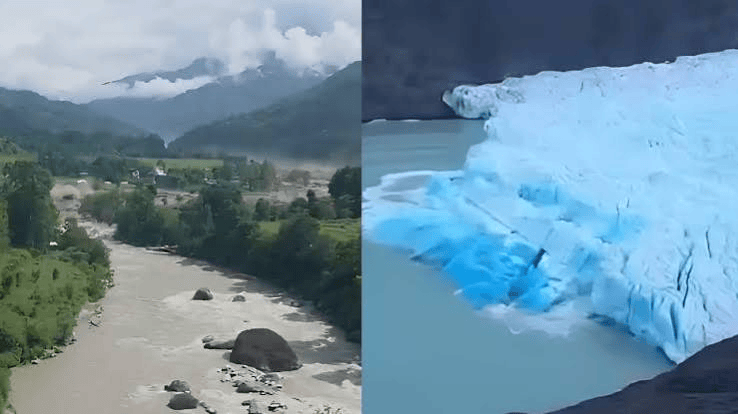
Scientists say a glacier collapse triggered the catastrophic flash flood that killed at least 350 people near Nepal’s border with China, underscoring the mounting climate change risks facing the Himalayan region.
Seismic and satellite data, along with video evidence, suggest a massive section of glacier broke off and collapsed, generating seismic waves equivalent to a 5.2-magnitude earthquake, according to the US Geological Survey. The resulting ice debris likely blocked the Lhende Khola river, causing water to build up rapidly before surging downstream.
Simon Allen, a glacial hazards researcher at the University of Zurich, said investigators have confirmed a large ice avalanche , a mix of ice and rock that liquefied and transformed into the destructive flood.
Nepal’s steep terrain and fast-melting glaciers make it especially prone to such flash floods, a risk intensifying as global warming accelerates ice loss across the Himalayas, which hold the largest reserve of snow and ice outside the polar regions. The UN warns this poses cascading threats from mudslides to water shortages , for nearly 2 billion people who depend on Himalayan-fed rivers.
Himalayan glaciers melted 65% faster between 2010 and 2020 than in the preceding decade, per UN data, while glacial lake flood risks across the wider Hindu Kush Himalaya region could nearly triple by century’s end.
Dan Shugar, a geomorphologist at the University of Calgary, said preliminary analysis points to a glacier snout at roughly 5,200 metres breaking away and descending steeply, gathering melt and sediment en route. Persistent cloud cover has delayed satellite confirmation of the exact sequence of events.
About The Author