
India’s sixth health survey delivers record numbers on access, but on behaviour, norms, and agency, the report card tells a far quieter story: A Healthier India on Paper, a Harder India in Practice.
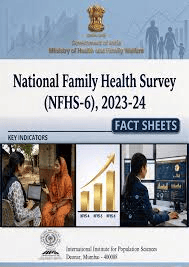
A woman in India today is far more likely to operate a bank account in her own name than to hold title to the roof over her head. That single asymmetry , financial inclusion racing ahead of asset ownership is a fair preview of the tension running through India’s sixth National Family Health Survey (2023–24), a survey of 6.79 lakh households across 715 districts that, on first reading, looks like an unqualified success story. Antenatal care coverage has risen to 95.9%, institutional deliveries to 90.6%, and the Total Fertility Rate has settled at 1.9 children per woman , below replacement level (Ministry of Health and Family Welfare, PIB release, May 2026). Early marriage among women aged 20–24 has fallen from 23.3% to 16.7%. These gains validate two decades of programmatic investment : JSY, PM Matru Vandana Yojana, POSHAN Abhiyaan, Mission Indradhanush.
Yet beneath this report card lie quieter, more stubborn numbers.
Three red flags. First, women’s status remains structurally thin. Only 18.8% of households report a woman owning house or land, alone or jointly , barely up from roughly 14% in NFHS-5. Cash-paid female employment stands at 30.8%, and 22.3% of ever-married women report having experienced spousal violence, a figure that drops sharply where institutional response is strong (Karnataka fell from 44.4% to 14.1%) but persists at nearly three times urban levels in rural India (19.9% vs 6.9%). Child marriage tells a similar half-story: the celebrated fall to 16.7% still means roughly one in six young women married before 18, a number that moves real outcomes : maternal health, schooling, dowry, and a labour-force entry that often starts in the home rather than a classroom.
Second, the survey’s own architecture has acquired blind spots of its own. Anaemia : the indicator on which Anaemia Mukt Bharat was most visibly failing in NFHS-5, at 57% prevalence among women , has been dropped from NFHS-6 on methodological grounds, removing the report card precisely where it mattered most. Child labour is absent for a different reason: NFHS has never measured it at all, leaving India’s only national estimate the 2019–20 Periodic Labour Force Survey’s 2.4% national average , a figure widely considered an undercount, since it excludes unpaid work within the child’s own household, where most child labour in India, especially among girls, actually occurs.
Third, nutrition behaviours are regressing even as services expand. Exclusive breastfeeding under six months fell from 63.7% to 55.8%; only 15.3% of children aged 6–23 months receive a nutritionally adequate diet despite years of ICDS and POSHAN outreach. Adult metabolic risk has worsened sharply — female obesity climbed from 24% to 30.7%, male from 22.9% to 27.3% — even as women’s education, banking access, and connectivity all improved. Caesarean rates touched 27.2% nationally, with private facilities at 54.1% against 16.9% in public ones — a gap that reflects information asymmetry and provider incentive more than clinical need.
Is the sector cognizant? Partially. Official communication foregrounds the celebratory indicators; independent commentary has been quicker to interrogate the anaemia exclusion, the rural-urban violence gap, and the obesity-empowerment paradox. But cognizance has not yet translated into reallocation. The pattern across all three red flags is identical: service delivery has scaled : ANC contact points, ICDS reach, institutional beds ,while indicators tied to belief, norm, and habit have stagnated or worsened. Land laws exist; women’s claims on them don’t. Breastfeeding counselling exists in protocol; declining practice suggests it isn’t landing as behaviour. C-section information exists; informed refusal does not.
This is precisely the terrain Social and Behaviour Change Communication occupies and precisely where investment remains thinnest, despite SBC’s demonstrated returns in polio eradication, HIV prevention, and Swachh Bharat’s sanitation-behaviour shift. NFHS-6 is not an argument against service delivery; it is evidence that delivery alone has reached its ceiling on several fronts. The real test arrives with NFHS-7.
With ANC and institutional-delivery coverage already brushing against saturation, that round will not be remembered for how many more facilities India built, but for whether breastfeeding rates recovered, land titles began following women’s names, and obesity curves bent , outcomes no budget line for infrastructure can buy on its own. Building toward that requires the social sector to stop treating behaviour change as a soft add-on to hard delivery, and start designing the two together from the first rupee , so that the next factsheet reads less like a report card on access, and more like one on agency.
About The Author

बेहद सटीक और गहरी केस स्टडी! Shefali ने सिर्फ आंकड़ों को नहीं दिखाया, बल्कि उनके पीछे छिपे सामाजिक व्यवहार और प्रशासनिक प्राथमिकताओं पर जो सवाल उठाए हैं, वो वाकई सराहनीय हैं। हेल्थ पॉलिसी और ग्राउंड रियलिटी के इस अंतर्विरोध को इतनी संजीदगी से सामने लाने के लिए लेखक को बधाई| ये सभी को पढ़ना चाहिए ताकि आपने स्तर पर हम ऐसी समस्याओं को सुधारने में योगदान दे सकें और न कि सिर्फ इन आंकड़ों का हिस्सा बने रहें।